
What if the most significant risk to your mobile business isn't a kitchen fire, but a compliance gap that halts your operations during a peak festival weekend? Operating a mobile kitchen in Harris County requires more than culinary skill; it demands a precise understanding of evolving regulatory frameworks. Obtaining the right liability insurance for food trucks in Houston is no longer just a recommendation, it's a foundational requirement for securing the new statewide Texas permits effective July 1, 2026.
We understand that navigating the intersection of municipal health codes and commercial risk can feel overwhelming, especially when you're focused on daily service and maintaining equipment. This 2026 guide clarifies exactly what you need to protect your investment and maintain operational continuity. You'll learn how to meet the 1 million dollar liability standards often required by local venues, strategies for securing your specialized kitchen assets, and ways to streamline your overhead through professional risk management. We'll examine the specific requirements of the City of Houston Health Department to ensure your business remains fully compliant and ready for inspection.
Operating a mobile food unit in Harris County involves managing a complex matrix of operational risks and legal obligations. While the Texas Department of State Health Services streamlined processes with the July 1, 2026, statewide permit, local compliance still hinges on professional risk mitigation. Obtaining liability insurance for food trucks in Houston serves as the primary shield against third-party claims, covering incidents ranging from foodborne illness to property damage at a vending site. This coverage isn't merely a financial safety net; it's a prerequisite for entering the city's most lucrative markets.
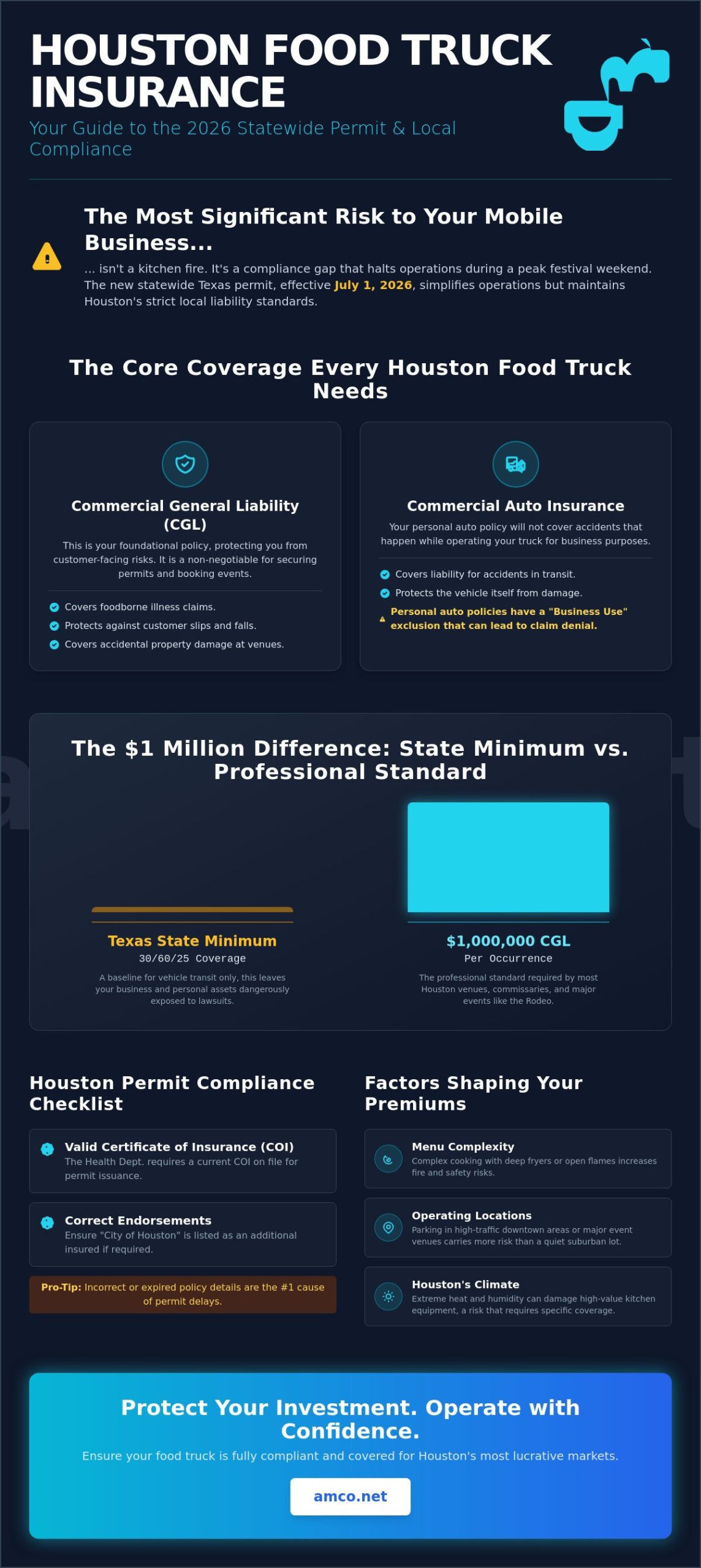
Texas law establishes specific minimums for vehicle operation, often cited as 30/60/25 for bodily injury and property damage. However, these figures represent a baseline for basic transit, not a comprehensive business strategy. A professional Commercial General Liability (CGL) policy is essential because most Houston commissary kitchens and high-traffic event venues require a minimum of $1 million in coverage before granting access to their facilities. Relying on state minimums leaves your personal and business assets exposed to litigation that can easily exceed those low thresholds, especially considering the CDC estimates 48 million Americans suffer from foodborne illnesses annually.
To better understand the specific regulatory environment in our state, watch this detailed tutorial on food truck requirements:
A standard General Liability policy addresses the physical risks inherent in food service. This includes a customer slipping near your service window or accidental fire damage to a neighboring structure. Professional Liability, often referred to as Errors & Omissions, is typically reserved for those providing specialized consulting or menu development services. For the vast majority of Houston vendors, a robust General Liability policy provides the necessary protection for daily operations at local breweries or public parks. It's the standard expected by landlords and municipal authorities alike.
Securing a mobile food permit from the City of Houston Health Department requires precise documentation. Your Certificate of Insurance (COI) acts as a verification tool during the permitting process, proving that you possess the necessary liability insurance for food trucks in Houston to operate safely. Common filing errors, such as incorrect additional insured endorsements or expired policy dates, frequently cause significant delays in permit issuance. Meeting the rigorous standards of premium locations like Post Houston or the Bayou City Art Festival requires proactive policy management to ensure your coverage aligns with their specific contractual demands.
A food truck represents a sophisticated hybrid of a commercial vehicle and a high-volume kitchen. This dual nature means that standard business policies often fall short if they aren't tailored to the mobile food niche. To maintain full operational continuity, you must address risks that occur both on the road and at the service window. Professional liability insurance for food trucks in Houston typically starts with a foundational General Liability Insurance policy, but comprehensive protection requires several additional layers of specialized coverage to account for the unique mobility of your assets.
Beyond the vehicle and equipment, you must consider the human element of your business. If you employ seasonal help or full-time staff, Workers Compensation Insurance is frequently required by event organizers, even though it isn't a state mandate for all Texas businesses. Additionally, if your menu includes craft beer or cocktails at local festivals, Liquor Liability is essential to cover incidents related to alcohol service. Balancing these different policies ensures that your liability insurance for food trucks in Houston remains robust enough to handle the unpredictable nature of the mobile food industry. Taking the time to evaluate your specific risk profile with a professional can help you secure the right Business Liability Insurance for your long term growth.
Houston's operational environment presents challenges that go beyond standard food safety protocols. Securing the right liability insurance for food trucks in Houston means accounting for environmental variables that stationary restaurants never face. The intersection of municipal health department requirements and the private standards of property managers creates a complex compliance landscape. For mobile vendors, insurance isn't just a regulatory hurdle; it's the mechanism that grants access to the city's most profitable vending zones.
Sudden downpours and flash flooding are characteristic of the region, making comprehensive protection a necessity rather than an option. While basic General Liability Insurance addresses third-party injuries, it doesn't typically cover the vehicle's physical assets during a flood event. Property managers in the Greater Houston area frequently require "Additional Insured" status on your policy, ensuring they are protected from claims arising from your presence on their land. This requirement is a standard part of the permitting process for high-traffic locations across Harris County.
The persistent humidity of Southeast Texas poses a significant threat to delicate electronic POS systems and kitchen ventilation units. Moisture buildup can lead to equipment failure or electrical hazards that standard warranties might not cover. Windstorm and hail considerations are equally vital for trucks parked in open lots, where exposure to sudden storm cells is high. During the Atlantic hurricane season, business interruption coverage within a Commercial Property Insurance policy becomes a critical tool. It provides a financial buffer when severe weather forces operational shutdowns, helping you manage ongoing overhead costs when you can't be on the street.
Securing a spot at prestigious events involves meeting specific insurance tiers that often exceed basic municipal requirements. Organizers for the Houston Livestock Show and Rodeo or the Bayou City Art Festival demand rigorous proof of coverage, often requiring limits of $1 million to $2 million. Similarly, business parks in the Energy Corridor or major corporate campuses in Westchase have their own liability standards. Managing certificates for multiple locations requires a methodical approach to ensure every venue's specific language is included. Successfully balancing these demands allows your business to move seamlessly between private catering gigs and public festivals without risking a breach of contract. If you're managing multiple units, coordinating your Business Liability Insurance ensures consistent protection across your entire fleet.
Determining the precise investment required for liability insurance for food trucks in Houston involves a detailed analysis of your specific risk profile. Premiums aren't static; they reflect the technical complexity of your operation and your history as a business owner. While a basic $1 million liability limit is the standard for most municipal permits, many high-tier Houston venues now require $2 million in coverage to account for increased litigation risks. Your annual costs are primarily influenced by the age of your vehicle, the driving records of all listed operators, and the physical security of your primary parking location within Harris County.
Security measures play a significant role in risk assessment. A truck parked in a gated, monitored facility with advanced anti-theft systems presents a lower risk for theft and vandalism compared to those in open lots. Additionally, investing in professional safety training for your staff and installing certified fire suppression systems can lead to a more favorable underwriting process. These proactive steps demonstrate to carriers that you operate with professional discipline, which often results in more competitive premium structures over the long term.
The culinary nature of your business directly impacts your risk tier. A mobile unit equipped with deep fryers and high-pressure propane systems carries a higher fire risk than a sandwich cart or a cold-brew coffee truck. This variance is reflected in your General Liability and Commercial Property Insurance costs. The relationship between your total equipment value and your Inland Marine premiums is also direct; high-end, specialized kitchen technology requires higher coverage limits. For high-volume units operating seven days a week, the increased usage of kitchen assets translates to a higher probability of equipment failure or operational accidents, which underwriters evaluate during the quoting process.
Navigating the complex market for insurance houston requires a partner who understands the local regulatory and environmental landscape. As an independent agency, AMCO analyzes multiple carriers to identify the most efficient coverage structures for your specific niche. Bundling your commercial auto insurance with your general liability often provides a more cohesive protection plan while streamlining your monthly overhead. This professional approach ensures you don't pay for redundant coverage while maintaining the high limits required for Houston's premier vending sites. To secure a tailored protection plan that matches your business goals, contact our expert team for a professional insurance review.
Since 1987, AMCO has functioned as a stable partner for the Houston business community. We recognize that liability insurance for food trucks in Houston is not a generic product but a custom-engineered solution. Our agents bring deep specialized knowledge of the local regulatory environment, from the City of Houston Health Department requirements to the specific fire safety standards of the Harris County Fire Marshal. This local presence allows us to provide a level of technical support that national, digital-only carriers cannot replicate. We understand the operational rhythms of the city, ensuring your coverage remains as mobile as your kitchen.
Efficiency is a core metric for any mobile food operator. We prioritize the rapid delivery of digital certificates of insurance, as we understand that a missing document can prevent you from entering a high-revenue festival or business park. Our extensive background in commercial trucking insurance Houston provides us with a unique perspective on the operational hazards of heavy vehicles equipped with industrial kitchens. We treat your food truck as a professional fleet asset, ensuring that every risk, from transit to service, is meticulously documented and covered under a professional framework.
With over 35 years of experience, our agency has navigated thousands of commercial claims and policy renewals. This historical data allows us to identify the most cost-effective coverage paths for new entrepreneurs entering the Houston market. We balance the need for high-tier protection with the reality of monthly overhead costs. To support the modern operator, our mobile app provides instant access to policy details and document management. This technology ensures that whether you're at a commissary kitchen or a late-night event, your proof of coverage is always available on your device.
Securing a comprehensive policy begins with a systematic review of your operational data. To facilitate a precise quote, you should prepare your vehicle identification number (VIN), a detailed inventory of your kitchen equipment, and the driving records of your staff. During your initial consultation, an AMCO expert will analyze your menu type and primary vending locations to determine the appropriate risk classification. This methodical approach ensures that your liability insurance for food trucks in Houston is both compliant and economically optimized for long term growth. Get your Houston food truck insurance quote now to protect your mobile investment with a partner who understands the local landscape.
Building a resilient mobile food business requires a systematic approach to risk management. The transition to the 2026 statewide permit doesn't eliminate the need for localized compliance; it merely shifts the regulatory framework. You must still align your operations with the specific liability tiers required by Houston's premier event organizers and property managers. By integrating robust liability insurance for food trucks in Houston, you protect your capital investment from the unpredictable nature of both the road and the kitchen environment.
AMCO has supported the local business community since 1987, providing the stability and expert guidance necessary to thrive in a competitive landscape. We offer access to over 20 top insurance carriers and maintain an A+ rated customer service standard to ensure your professional needs are met with precision. Don't let a compliance gap or an unforeseen weather event stall your operational momentum. Request a Fast Food Truck Insurance Quote from AMCO today to secure a tailored protection plan. We're ready to partner with you in protecting your professional legacy and ensuring your long term success.
Yes, legal requirements exist for both the vehicle and the business operation. Under the 2026 Texas statewide permitting rules, you must maintain commercial auto insurance to operate on public roads. Additionally, the City of Houston Health Department requires proof of liability insurance for food trucks in Houston before issuing a mobile food unit permit. Most commissary kitchens won't allow you to prepare food without active coverage in place.
Yes, product liability coverage is typically bundled within a standard General Liability policy to address foodborne illness claims. This protection is vital because the CDC estimates that 48 million Americans suffer from foodborne illnesses annually. If a customer claims they became ill after consuming your food, this coverage manages the legal defense costs and potential settlements. It's a critical component for any vendor serving the public at Houston festivals.
Texas law requires minimum liability limits of 30/60/25 for commercial vehicles, but these figures are often insufficient for a business. While the state mandates $30,000 for bodily injury per person, $60,000 per accident, and $25,000 for property damage, most professional venues require at least a $1 million combined limit. Carrying higher limits ensures that a single traffic accident won't deplete your business capital or lead to personal asset exposure.
Obtaining a certificate of insurance (COI) can often be completed quickly through agencies with digital policy management systems. While processing times vary by carrier, modern platforms allow for rapid generation of these documents to meet venue deadlines. You should check with your agent to ensure they can provide the specific "Additional Insured" language required by Houston property managers or event organizers before your scheduled vending date.
Texas law doesn't legally mandate Workers Compensation for most private employers, but it remains a common requirement for event participation. Even with one part-time employee, many Houston festivals and corporate campuses require this coverage to shift risk away from the venue. It protects your business from the high costs of workplace injuries, ensuring that medical expenses and lost wages are handled through the insurance system rather than your operating budget.
Theft of specialized kitchen equipment is generally covered under an Inland Marine or Commercial Property Insurance policy. Because standard auto policies only cover the vehicle itself, you need this specific "mobile property" protection for fryers, grills, and POS systems. If equipment is stolen while the truck is parked or in transit, this coverage provides the funds to replace those assets and resume your operations with minimal downtime.
Your driving record is a primary factor used by underwriters to determine your commercial auto premium. A history of accidents or moving violations indicates higher risk, which typically results in increased monthly costs. Maintaining a clean record for all listed drivers is one of the most effective ways to lower the overall cost of liability insurance for food trucks in Houston. Some carriers also offer safety credits for businesses that implement formal driver training programs.
Trailers and motorized food trucks are handled differently from a risk and policy structure perspective. A food trailer requires a policy that covers the trailer itself as well as a commercial auto policy for the vehicle doing the towing. In contrast, a motorized food truck is insured as a single unit that includes both the vehicle and the permanently attached kitchen. Both configurations require specialized endorsements to ensure the high value cooking equipment is fully protected during transit.