


A surety bond isn't just a regulatory hurdle; it's the financial passport your business needs to secure high-value projects across the Lone Star State. Many professionals view the process of obtaining surety bonds for contractors in Texas as a confusing administrative burden that frequently delays project starts. You've likely felt the frustration of distinguishing bonds from standard liability insurance or facing unexpected municipal requirements that stall your momentum. It's understandable to feel that these mandates are designed to eat into your margins rather than support your growth.
This guide clarifies the complexities of Texas Department of Insurance (TDI) compliance and local permit mandates. You'll master the differences between performance, payment, and bid bonds while learning how to secure competitive rates even with credit challenges. We'll examine the "Little Miller Act" thresholds for 2026 and provide a roadmap for fast approvals that keep your crews on-site. By the end of this article, you'll have the expertise to manage your bonding portfolio as a strategic asset rather than a recurring headache.
A surety bond acts as a specialized financial instrument. It guarantees a contractor's performance and adherence to legal standards. Unlike a simple contract between two people, this is a tripartite agreement designed to shift risk away from the project owner. To answer the foundational question, What is a Surety Bond? it's essentially a line of credit that ensures professional accountability. For those managing surety bonds for contractors in Texas, understanding this structure is the first step toward qualifying for larger commercial projects.
The three parties involved are the Principal, the Obligee, and the Surety. You are the Principal. The Obligee is the entity requiring the bond, such as a Texas municipality or a private developer. The Surety is the financial institution, often represented by an agency like AMCO.NET LLC, that provides the financial backing. While liability insurance protects your business from losses like property damage, bonds protect the project owner from your potential failure to perform. Texas mandates these bonds to safeguard public funds and maintain high safety standards across the construction industry.
To better understand this concept, watch this helpful video:
The Texas Department of Insurance (TDI) oversees the regulatory environment for bonding within the state. It ensures that sureties operate with sufficient capital and ethical standards. While federal projects follow the federal Miller Act, state-level work is governed by the Texas Government Code Chapter 2253. The Texas Little Miller Act mandates that contractors provide a payment bond for any public works project exceeding $25,000 to ensure subcontractors and suppliers receive their due compensation. This framework creates a transparent marketplace where financial risk is managed through established legal channels.
Holding the correct surety bonds for contractors in Texas offers more than just legal compliance. It functions as a badge of financial health and operational reliability. Vetted professionals who have undergone rigorous financial scrutiny gain immediate trust from homeowners and commercial developers. You simply cannot bid on most municipal or state projects without the appropriate bonding capacity in place. Furthermore, bonding allows you to scale your operations. It demonstrates to lenders and partners that your business can handle high-stakes obligations without defaulting. Partnering with an agency like AMCO.NET LLC, which has served Texas since 1987, ensures you have the local expertise to navigate these requirements efficiently.
Identifying the specific surety bonds for contractors in Texas depends heavily on your trade and the project's jurisdiction. License and permit bonds are the most common entry-level requirements. These are mandated by cities or the state to ensure you follow building codes and local ordinances. Without them, you can't legally pull permits or maintain your trade license. The Role of Surety Bonds in Construction extends beyond simple compliance; it establishes a baseline of trust between the contractor and the governing body. Securing the right surety bonds for contractors in Texas protects your business from being excluded from the bidding process.
Construction bonds are more project-specific and are usually required for larger contracts. A bid bond ensures that if you win a contract, you'll actually sign it and provide the required performance and payment bonds. Performance bonds guarantee the work meets the contract's specs, while payment bonds ensure everyone from the material supplier to the HVAC subcontractor gets paid. This prevents liens on public property, which is vital since you can't file a lien against government buildings in Texas. For many firms, having these bonds ready is the difference between staying a small local shop and becoming a major regional player.
Requirements vary significantly between Houston, Dallas, and San Antonio. For instance, the City of Houston often requires specific bonds for sidewalk and driveway construction, whereas Dallas might have different thresholds for plumbing and electrical contractors. HVAC professionals must be particularly careful, as city-specific bond amounts can change based on the total project value or annual permit volume. You don't want to find out a bond is missing the morning you plan to start work. If you're unsure which specific bond your municipality requires, consulting with a local agency like AMCO can help clarify your obligations before you bid.
Public projects, like those managed by TxDOT, have rigid bonding mandates under the Texas Little Miller Act. Private residential or commercial builds might not always require bonds, but many sophisticated developers insist on them to mitigate risk. Maintenance bonds are another critical tool, protecting the owner from defects for a set period after completion. For developers, subdivision bonds are often required to guarantee that infrastructure like roads and sewers will be completed as promised. These layers of protection ensure that the financial burden of a contractor's failure doesn't fall on the taxpayers or the private developer.
Understanding the financial structure of surety bonds for contractors in Texas requires a clear distinction between the total bond amount and the premium you pay. The bond amount represents the maximum penalty the surety will pay the obligee in the event of a default. However, your actual cost, or the premium, is only a small percentage of that total value. For most standard risks, these premiums typically range between 1% and 3% annually. This means a $50,000 bond doesn't require a $50,000 payment; it costs a fraction of that, allowing you to maintain liquidity for your daily operations.
Your credit history serves as the primary metric for risk assessment in the bonding industry. Sureties view a high credit score as an indicator of financial responsibility and a lower likelihood of bond claims. If your business is navigating credit challenges, the SBA Surety Bond Guarantee Program provides an essential safety net by guaranteeing bonds for small businesses that might otherwise struggle to meet traditional underwriting criteria. Beyond credit, providing audited financial statements and demonstrating years of industry experience can lower your premium by proving your company's long-term stability.
Contractors in the standard market, typically those with credit scores above 700, enjoy the most competitive rates. These businesses often qualify for streamlined "credit-only" applications for smaller bond amounts. Conversely, the non-standard market serves contractors with credit scores below 650 or those with limited operating history. While rates are higher in this tier, successful project completion and improved financial reporting help you migrate toward standard rates over time. A personal indemnity agreement is a standard requirement where the business owner pledges personal assets to reimburse the surety for any losses paid out on the bond, which directly influences the risk assessment and final pricing.
The relationship between your project's scope and your annual revenue is a critical underwriting factor. If a single project represents a disproportionately large percentage of your yearly turnover, the surety may perceive a higher risk of insolvency and adjust the premium upward. Unusual contract clauses, such as extended warranty periods or aggressive liquidated damages, also drive up costs because they lengthen the surety's window of exposure. Finally, a lack of prior bonding history in the state can lead to more conservative pricing initially. As you build a track record of completed projects and zero claims, your standing with sureties improves, leading to better terms for future surety bonds for contractors in Texas.
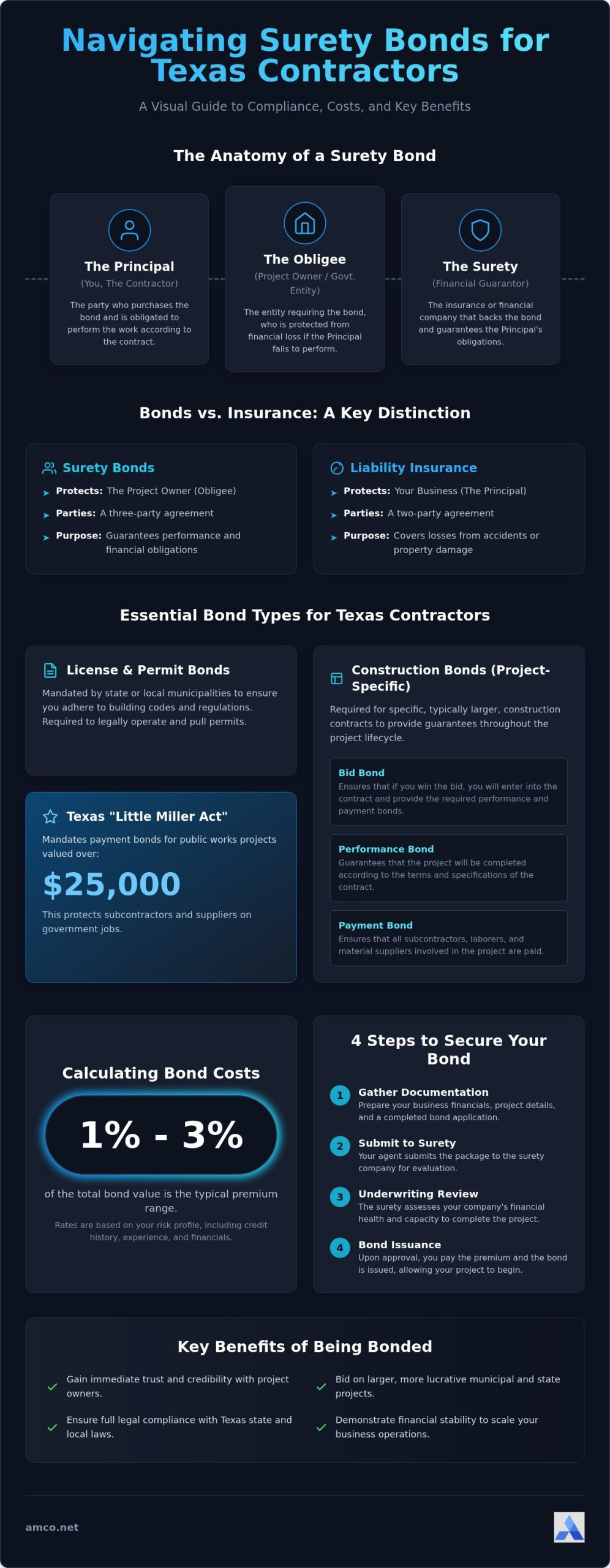
Securing surety bonds for contractors in Texas doesn't have to be a bottleneck for your operations. It's a methodical process that begins with identifying the specific obligee and the exact bond amount they require. Whether you're dealing with a municipal permit in San Antonio or a high-stakes state contract, having absolute clarity on the bond type is essential. Once you've confirmed these details, gather your documentation. This usually includes both personal and business financial statements alongside specific project descriptions and trade history.
A robust application package minimizes time-consuming back-and-forth with underwriters. For bonds with higher limits, sureties typically require CPA-prepared financial statements to verify your company's liquidity and net worth. Providing Work-in-Progress (WIP) reports helps the surety understand your current capacity and project history. Technical expertise and a clean insurance history are significant factors in modern risk assessment. You should prepare to provide the following items:
After your package is ready, submit it to a specialized agency. AMCO, serving the state since 1987, uses an independent model to shop multiple carriers for the best rates. You'll receive a quote based on your credit profile and overall financial health. Review the terms carefully and sign the indemnity agreement. This document represents a legal commitment to reimburse the surety if a claim occurs. Once you've signed and paid the premium, you'll receive the bond. The final step is filing the original document with the appropriate Texas authority to satisfy your legal obligations.
Efficiency is key to starting projects on time. In 2026, digital signatures and online filing are the standard for surety bonds for contractors in Texas. These digital tools eliminate the logistical delays associated with physical mail and manual processing. You must ensure all data entry is precise. Minor errors in the business name or bond amount can lead to immediate TDI filing rejections. A local agent acts as your advocate, explaining nuances in your financial history to underwriters to secure more favorable terms. This professional representation is often the difference between a quick approval and a project delay. If you're ready to secure your coverage, you can contact our team for a bond consultation today.
Selecting a bonding partner requires more than just finding the lowest premium; it requires a collaborator who understands the specific operational challenges of the Texas construction market. AMCO has served the Texas business community since 1987, providing a stable foundation for contractors navigating the shifting regulatory landscape. Our deep roots in Houston and statewide reach allow us to anticipate municipal requirements before they delay your project. Whether you're bidding on a massive infrastructure project in Dallas or a specialized trade job in San Antonio, our team provides the technical expertise needed to secure surety bonds for contractors in Texas with precision and speed.
As an independent agency, we don't serve a single insurance carrier; we serve your business. This model is particularly beneficial when seeking surety bonds for contractors in Texas because it allows us to shop multiple A-rated surety markets simultaneously. This competition ensures you receive the most competitive rates available, even if your company is navigating credit challenges or rapid growth. Our agents provide personalized service, acting as a bridge between your financial data and the surety underwriters. We offer ongoing support for bond renewals and help you adjust your bonding capacity as your project portfolio expands. This consultative approach transforms bonding from a transactional hurdle into a strategic asset for your firm's growth.
Efficiency in risk management often comes down to consolidation. Many contractors find that managing separate policies across different agencies leads to administrative gaps and missed compliance deadlines. By bundling your bonding needs with your commercial trucking insurance and general liability coverage, you create a unified defense for your business assets. This holistic view allows us to identify potential risks across your entire operation, from the job site to the road. Even your personal coverage, such as car insurance, can be managed within the same expert framework to ensure your professional and personal liability are both addressed.
We've designed our process to be as lean as possible for small to mid-sized contractors. Our fast-track bonding options require minimal paperwork for standard license and permit bonds, allowing you to secure coverage and pull permits in record time. This responsiveness is backed by a legacy of trust that spans nearly four decades. We understand that in the construction industry, time is literally money. Our goal is to provide the stability and professional distance that fosters trust with your obligees while giving you the agility to win bigger contracts. When you're ready to take the next step in your professional journey, Get your Texas contractor surety bond quote from AMCO today!
Mastering the nuances of surety bonds for contractors in Texas is a fundamental step for any firm aiming to transition from residential repairs to high-value public works. You now understand that these bonds aren't just administrative hurdles; they're essential tools that validate your financial stability and technical competence. By accurately identifying municipal permit needs and maintaining a strong credit profile, you position your business to secure more lucrative contracts with better margins.
Since 1987, AMCO has operated as a Texas-owned agency dedicated to the success of local builders. We provide expert support for professionals in Houston, Dallas, San Antonio, and beyond, leveraging our relationships with A-rated surety carriers to find the most competitive rates. Our team handles the technical complexities of bonding so you can focus on project delivery and operational growth. It's time to secure the professional backing your business deserves. Get a Fast Surety Bond Quote for Your Texas Business and take the next step toward your company's long-term stability. We look forward to supporting your upcoming projects.
A surety bond isn't insurance. While liability insurance covers your business against property damage or injury claims, surety bonds for contractors in Texas protect the project owner from financial loss if you fail to fulfill your contractual obligations. It's a financial guarantee of performance rather than a policy that pays for your company's own mishaps. You remain legally responsible for reimbursing the surety for any payouts made on your behalf.
Most standard license and permit bonds are approved within 24 to 48 hours. If you're applying for a credit-only bond with a strong financial profile, digital processing in 2026 often allows for same-day issuance. Complex performance bonds for large public works projects require a more detailed underwriting process. This involves a thorough review of your financial statements and work history, which can take several business days to finalize.
You can still secure a bond even with credit challenges. The non-standard market and the SBA Surety Bond Guarantee Program provide pathways for contractors with lower credit scores to obtain necessary coverage. While these options typically involve higher premiums and more rigorous documentation, they allow you to continue bidding on projects. Over time, consistent performance and improved financial reporting help you qualify for more competitive standard market rates.
If a claim is filed, the surety company conducts a neutral investigation to determine its validity. If the claim is verified and you don't resolve the issue, the surety pays the obligee up to the bond's limit. Unlike insurance, you must then repay the surety every dollar they spent on the claim, including legal fees. This indemnity requirement makes avoiding claims vital for your company's long-term financial health.
The cost is determined by your credit score and financial history rather than a fixed fee. For a $10,000 bond, contractors with excellent credit often see annual premiums between 1% and 3% of the bond amount. If your credit is in the non-standard range, the premium could increase toward 10%. These rates are set by the surety carrier's risk assessment and are not established as a flat price by the agency.
Texas doesn't have a statewide general contractor license, so you often need separate permit bonds for different municipalities. While some trades like electricians have state-level requirements, general construction work is governed by local city or county ordinances. You should always verify the specific bonding mandates in Houston, Dallas, or San Antonio before starting work. Partnering with a local agent helps you track these varying requirements across multiple jurisdictions.
Renewing your bond for 2026 involves paying the annual premium before your current bond expires. For standard license bonds, the process is usually a simple invoice payment that keeps the bond active with the obligee. For larger performance or payment bonds, the surety may request updated financial statements or work-in-progress reports to re-evaluate your bonding capacity. Missing a renewal deadline can lead to immediate permit suspensions or contract defaults.
A bid bond guarantees that you'll sign the contract and provide the required final bonds if your proposal is selected. It prevents contractors from withdrawing bids without penalty. A performance bond takes over once the contract is signed, ensuring the project is completed according to the agreed-upon terms and specifications. While the bid bond covers the selection phase, the performance bond protects the owner throughout the entire construction lifecycle.