


The lowest quote on your desk is often the most expensive mistake a Texas carrier can make. In a year where operational costs are under intense scrutiny, finding truly affordable trucking insurance requires a delicate balance between lean premiums and the robust coverage limits that shippers and brokers demand. You've likely felt the pressure of rising rates in major hubs like Houston and San Antonio, where congestion and litigation risks continue to drive the market upward.
We recognize that thin margins leave little room for error, especially when slow response times from national call centers keep your trucks off the road. This guide provides a clear roadmap to securing comprehensive protection that safeguards your business without overextending your budget. You'll discover the current 2026 liability requirements for Texas intrastate and interstate operations, learn how to optimize your safety profile for better rates, and see why a localized approach to risk management is the key to long-term profitability.
Affordability in the 2026 market isn't about finding the lowest number on a quote sheet. It's about optimizing the total cost of risk. True affordable trucking insurance balances the monthly premium with the amount of risk your business can safely retain. In a year marked by rising equipment costs and complex legal environments in Texas, a policy that seems cheap at first glance can quickly become a financial liability if it fails during a claim. Precision in policy structuring is what separates a sustainable business from one vulnerable to a single incident.
Economic pressures in 2026, such as high repair costs and increased litigation in metropolitan areas like Dallas and Houston, have shifted how underwriters view risk. Carriers are looking for stability and data-driven safety records. For an owner-operator or fleet manager, this means that maintaining a policy with an A-rated carrier is no longer optional; it's a prerequisite for securing high-paying loads from reputable brokers who prioritize financial reliability.
To better understand how to optimize your costs, watch this helpful video:
A low-cost policy often achieves its price point by stripping away critical endorsements. For instance, a carrier hauling perishables through the I-10 corridor might save on premiums by omitting Reefer Breakdown coverage, only to face a total loss of cargo value when a cooling unit fails. Your deductible also plays a vital role in this calculation. While a higher deductible lowers your monthly premium, it must remain at a level your cash flow can support in an emergency. Brokers also scrutinize A.M. Best ratings. If your insurance carrier isn't financially stable, you might find yourself locked out of the most profitable contracts in the Texas market.
Primary Liability remains the non-negotiable foundation of any policy, meeting the 2026 federal and state minimums required to stay legal. However, protecting your assets requires looking beyond these minimums. Physical Damage coverage is essential in a high-inflation market to ensure you can replace equipment at current market values without draining your reserves. For leased operators, Non-Trucking Liability (NTL) and Bobtail insurance provide the necessary protection when the truck isn't under dispatch. Balancing these mandatory requirements with strategic optional coverages ensures your business remains resilient against localized risks in hubs like San Antonio and Laredo.
Underwriters in 2026 utilize granular data to calculate risk. They no longer rely solely on basic fleet information. Instead, they analyze the specific corridors you frequent and the historical performance of your driver pool. Your radius of operation is a fundamental component of this calculation. Carriers operating within a 100 or 200-mile radius generally see lower premiums than long-haul operators because reduced mileage equates to lower accident exposure. If your trucks stay within Texas, you avoid many of the complexities and risks associated with interstate travel.
Your Safety Measurement System (SMS) scores are equally influential. These scores provide a real-time window into your compliance and safety culture. High violation rates for vehicle maintenance or hours-of-service (HOS) signal to underwriters that a claim is likely. Driver experience remains the single most significant price driver. Most preferred carriers require at least two years of verifiable CDL experience to offer competitive rates. A single driver with a poor record can negate the savings of an otherwise safe fleet.
The type of freight you haul dictates your risk profile. Hauling hazardous materials requires specialized endorsements and higher liability limits, which naturally increases the cost compared to hauling dry van goods. Equipment age also creates a trade-off. While an older tractor has a lower insurable value, which reduces physical damage premiums, it may be subject to stricter inspections by underwriters who fear mechanical failure. Your Motor Truck Cargo limits must strictly align with the maximum possible value of your highest-value load to ensure full indemnity during a loss.
New carriers face a steep learning curve in the insurance market. For the first two years of operation, "New Authority" premiums reflect the lack of a proven safety track record. During this period, building a clean history is essential for future rate reductions. Underwriters also examine credit scores as a predictor of loss frequency. A strong credit profile suggests financial stability and a lower likelihood of filing small, frequent claims. Using telematics to prove safe driving habits is one effective strategy for carriers with less-than-perfect records to secure affordable trucking insurance.
Consulting with an independent agency to compare commercial trucking insurance can reveal which underwriters are currently favoring your specific cargo niche. This expertise is vital for maintaining affordable trucking insurance while your business grows and your risk profile evolves. Proactive management of these variables ensures you aren't overpaying for essential protection.
Securing affordable trucking insurance requires a disciplined review process that moves beyond the initial premium quote. When you're comparing proposals, use a standardized checklist to ensure every carrier provides identical coverage limits and deductible structures. A lower price often masks significant gaps in protection, such as lower sub-limits for specific cargo types or higher deductibles that could strain your cash flow in the event of a loss. You must verify that the policy includes essential federal and state filings, such as the MCS-90 endorsement and Form E, which are required by the FMCSA and the Texas Department of Motor Vehicles respectively.
Independent agencies offer a distinct advantage over captive agents who represent only one brand. Because an independent partner has access to multiple niche markets, they can shop your profile across several carriers to find the best fit for your specific operation. This competitive environment is the most effective way to source affordable trucking insurance without sacrificing the depth of coverage. Be wary of low-cost policies that bundle hidden administrative fees or high interest rates on installment plans, as these can significantly increase your annual expenditure.
A policy's definitions can dictate its true utility. For example, a scheduled auto policy only covers vehicles specifically listed on the declaration page, whereas any auto coverage provides broader liability protection for vehicles you might hire or borrow. You must also check for radius restrictions. If your operations occasionally expand beyond a 500-mile radius, a restrictive local-only policy could void your coverage during a route change. Finally, ensure the policy meets the specific requirements of major brokers like Amazon or CH Robinson, who often mandate A-rated carriers and specific cargo endorsements.
The speed of administrative support is a hidden factor in your total operational cost. A 24/7 certificate of insurance (COI) portal allows you to secure new loads instantly, even on weekends or after business hours. Without this access, your truck sits idle while you wait for an agent to manually process a request. Efficient claims handling is equally critical. Every day your equipment is out of service represents lost revenue, making fast processing a key component of business continuity. For a deeper look at regional requirements, see our guide on Commercial Trucking Insurance in Houston to understand how local expertise accelerates these processes.
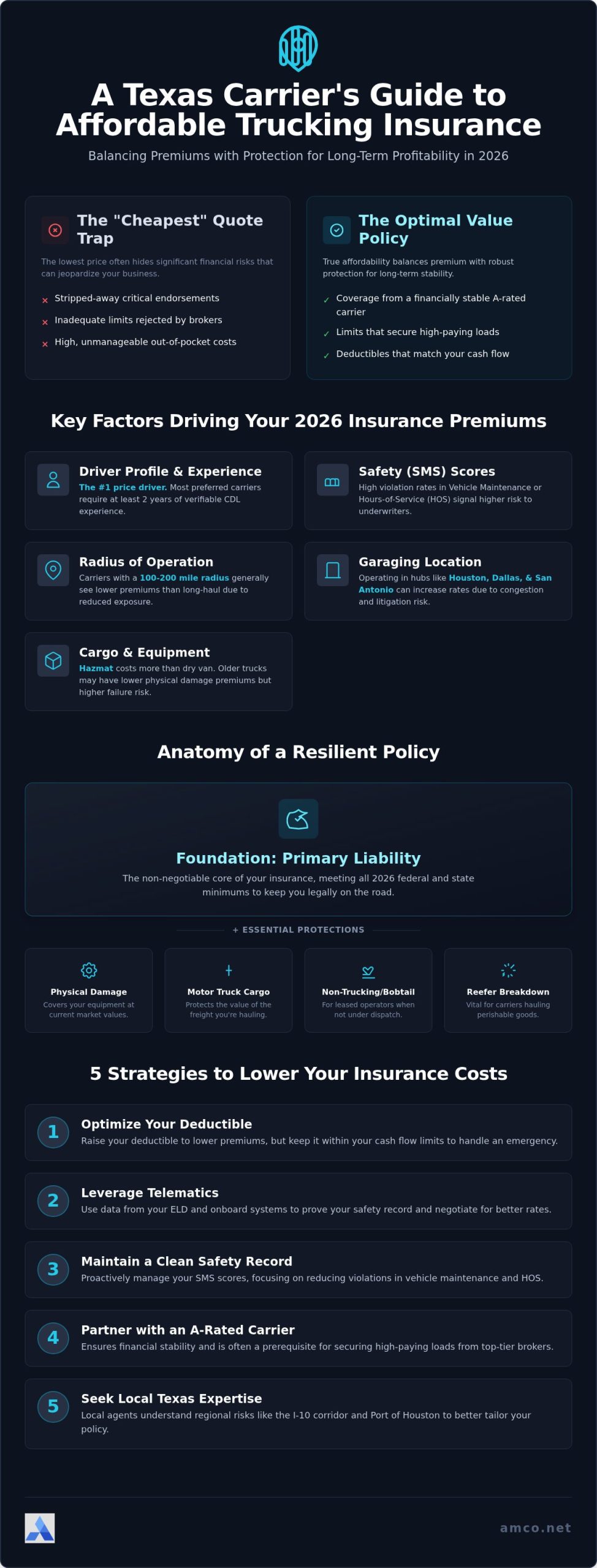
Strategic risk management is the most effective way to secure affordable trucking insurance in a volatile market. Rather than simply accepting annual rate increases, proactive carriers utilize specific operational adjustments to demonstrate a lower risk profile to underwriters. This process begins with data transparency. Sharing your Electronic Logging Device (ELD) data and telematics with insurance providers allows them to price your policy based on actual safety performance rather than broad industry averages. When an underwriter sees consistent adherence to speed limits and hours-of-service regulations, they're far more likely to apply "Safe Driver" credits to your account.
Financial structuring also plays a significant role in cost reduction. You can achieve immediate premium savings by increasing your deductible to a level that balances risk with your available cash flow. While this requires a higher out-of-pocket payment during a claim, the cumulative monthly savings often outweigh the potential cost. Additionally, you should implement the following practices:
In 2026, technology is the primary tool for exoneration and premium control. Dashcams provide objective proof of non-fault in accidents, which is critical for protecting your loss history from "nuclear verdicts" or fraudulent claims. We're seeing a significant rise in Usage-Based Insurance (UBI) among regional Texas carriers, where premiums are calculated based on actual mileage and driving behavior. Furthermore, equipping your fleet with forward-collision warning systems can trigger 5-10% discounts from many preferred carriers, as these systems drastically reduce the frequency of rear-end collisions.
Managing the scope of your operations can yield substantial savings without compromising your service quality. If your business model allows you to stay within a 100 to 200-mile radius of major hubs like Houston or Dallas, designating a "local" radius on your policy will result in lower rates than an unlimited long-haul designation. You should also consider downsizing your scheduled auto list during slow seasons to avoid paying for coverage on idle equipment. To find the best local rates, it helps to work with a specialized Insurance Company Near Me that understands the specific hazards of Texas corridors. For a personalized analysis of your fleet's potential savings, you can request a commercial trucking insurance quote from our expert team.
AMCO.NET LLC has provided specialized risk management solutions to the Texas transport sector since 1987. As a Houston-based independent agency, we offer a level of regional insight that national call centers simply cannot replicate. Our team understands the specific operational pressures of the I-10 corridor and the logistical complexities of the Port of Houston. This localized knowledge allows us to identify affordable trucking insurance structures that account for the unique traffic and litigation risks inherent to the Lone Star State. We don't just sell policies; we build complex system solutions tailored to the B2B environment.
Unlike captive agents who are restricted to a single provider's appetite, we leverage our relationships with multiple carriers to find the most competitive fit for your fleet. Our status as an independent broker means we work for the carrier, not the insurance company. To streamline your operations, our mobile app provides instant access to policy management, allowing you to handle payments and generate Certificates of Insurance (COIs) from the cab of your truck. This technology ensures your business remains mobile and compliant without administrative delays that could cost you a load.
Our reach extends across the state's most critical logistics points. For Laredo-based carriers, we provide expertise in cross-border logistics and the specific endorsements required for international freight exchange. In the Permian Basin, we support the unique needs of the oil and gas trucking sector in Midland and Odessa by securing coverage that meets the elevated liability standards of energy industry contracts. We also offer fast-track quoting for owner-operators in Dallas, San Antonio, and Austin, ensuring that regional carriers can secure affordable trucking insurance that matches their specific route profiles and garaging locations.
We view our relationship with carriers as a long-term professional partnership. Since 1987, we've helped numerous new authorities scale their operations from a single unit to an enterprise-level fleet. We understand that your insurance needs evolve as you add equipment and drivers, and we're committed to providing the technical background and follow-up necessary for sustainable growth. Our focus remains on delivering fast and reliable solutions that protect your margins while maintaining the high standards required by your brokers and the FMCSA. We invite you to experience the stability and professional professionalism that comes with nearly four decades of Texas market experience.
Get your affordable trucking insurance quote from AMCO today and secure a partner who understands the road ahead.
Navigating the 2026 insurance market requires more than just chasing the lowest premium. It demands a sophisticated understanding of how technology, safety records, and local risk factors intersect to determine your total cost of operation. By leveraging telematics data and optimizing your policy structure with strategic deductibles, you can maintain comprehensive protection while keeping your margins intact. These adjustments turn insurance from a static expense into a dynamic tool for business stability.
Partnering with an agency that has served Texas truckers since 1987 ensures you have access to multiple A-rated carriers and expert advice tailored to regional hubs like Laredo and Houston. Our mobile app provides 24/7 policy management, ensuring you never miss a load due to administrative delays. Securing affordable trucking insurance is a continuous process of refinement and professional oversight that rewards safe, efficient operations.
Take the next step in protecting your business and improving your bottom line. Get a Fast & Affordable Trucking Quote from our team of independent specialists today. We're ready to help you navigate the Texas roads with confidence and stability.
Average premiums vary significantly based on your experience level and authority age. For an owner-operator with a clean record, annual costs typically range between $9,500 and $18,500 in the current market. New authorities often face higher entry costs, with first-year premiums ranging from $13,000 to $22,000. These figures depend on your specific cargo type, garaging location, and Safety Measurement System scores.
New authorities can secure affordable trucking insurance by focusing on higher deductibles and providing verifiable CDL experience. Underwriters often provide more competitive rates to new businesses when the owner has at least two years of clean driving history. Sharing telematics data early also helps prove safe driving habits to carriers. Working with an independent agency allows you to access niche markets designed specifically for new ventures.
Personal auto insurance policies strictly exclude vehicles used for commercial purposes or those exceeding specific weight limits. If you're operating a box truck for business, you must carry a commercial policy to be legally compliant and protected during a claim. Attempting to use a personal policy for commercial freight usually leads to denied claims and potential policy cancellation. A dedicated commercial policy ensures your assets are properly covered.
Non-Trucking Liability (NTL) covers you when using your truck for personal reasons while you aren't under dispatch. Bobtail insurance provides broader coverage whenever the tractor is operating without a trailer, regardless of your dispatch status. Many owner-operators find NTL more affordable, but your lease agreement often dictates which specific coverage is required. Understanding these distinctions is vital for maintaining continuous protection during your off-duty hours.
While federal minimums for household goods movers are low, most general freight shippers in Texas require at least $100,000 in cargo coverage. You should evaluate your highest-value load to ensure your limits provide full indemnity. If you haul electronics or specialized machinery, you may need to increase these limits to $250,000 or more. Matching your coverage to your actual cargo value prevents devastating out-of-pocket losses.
Many A-rated carriers offer premium credits or discounts for fleets that utilize forward-facing dashcams and advanced safety technology. These devices provide objective evidence during accident investigations, which significantly reduces the insurer's litigation risk. Some providers also offer subsidized hardware or reduced rates for usage-based insurance programs. Implementing these systems is a proven strategy for maintaining affordable trucking insurance over the long term.
Using a non-rated or poorly rated carrier can prevent you from securing loads with top-tier brokers and shippers. Many freight contracts specifically mandate that your insurance provider maintains an A-minus rating or better for financial stability. If your carrier’s rating drops, you might find your certificates of insurance rejected at the loading dock. We prioritize A-rated carriers to ensure your business reputation remains strong and your contracts stay valid.
We provide instant access to Certificates of Insurance through our 24/7 mobile app and online portal. This technology allows you to generate and send certificates directly to brokers from your smartphone, even outside of traditional business hours. For complex requests requiring manual review, our specialized team prioritizes speed to keep your trucks moving. Reducing downtime is a key part of our commitment to your operational efficiency and profitability.