

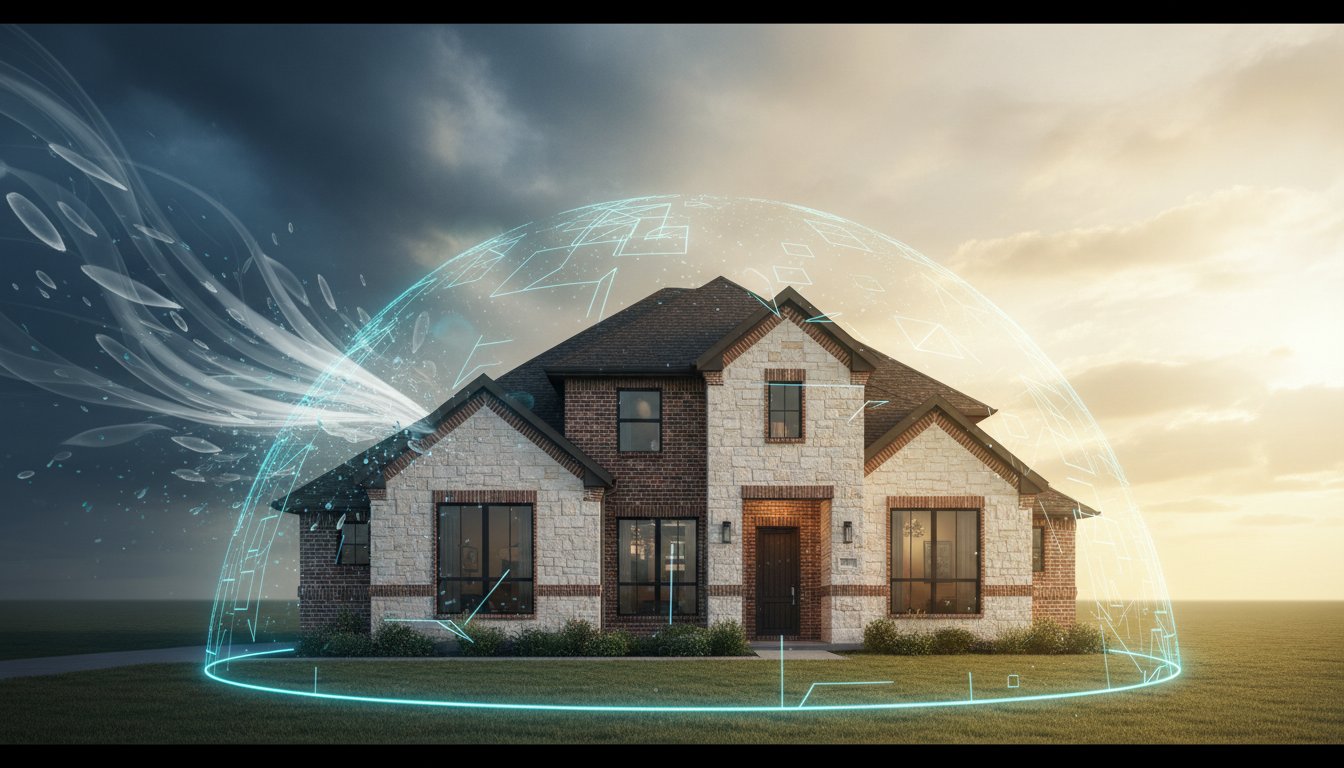
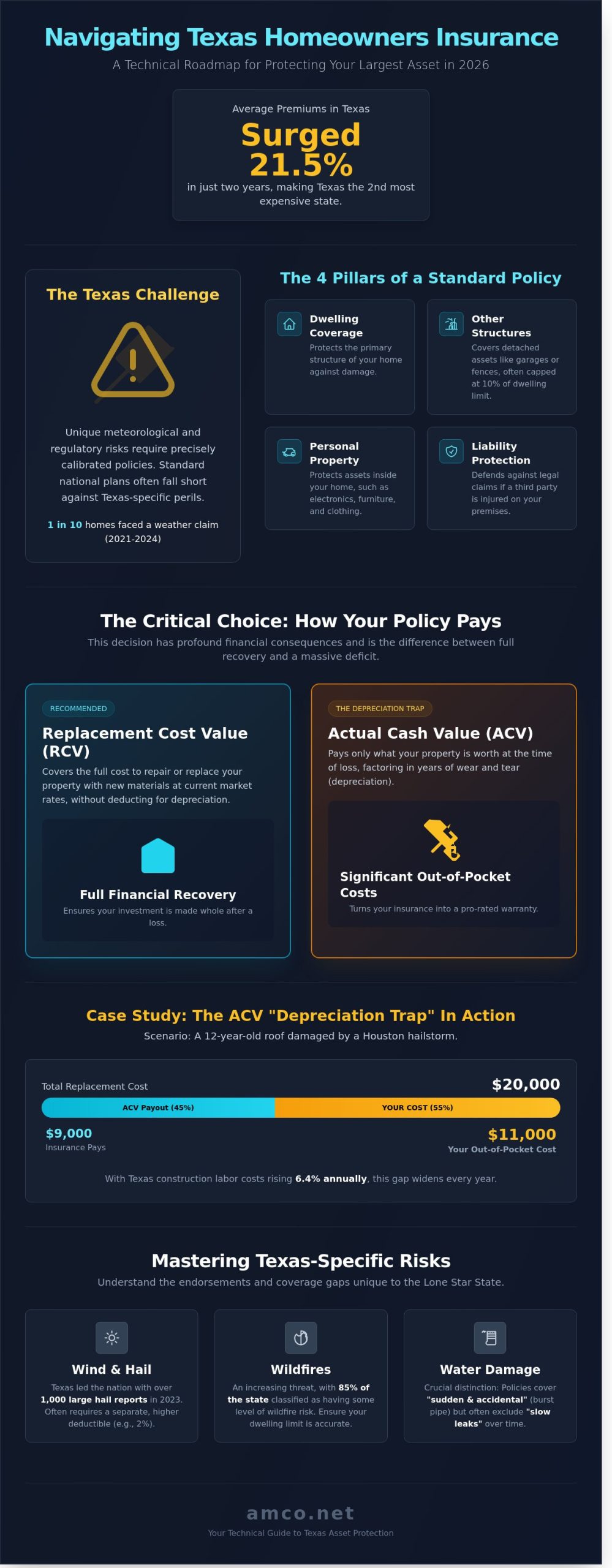
According to the Texas Department of Insurance 2024 data, average premiums across the Lone Star State surged by 21.5% in just two years, making Texas the second most expensive state for property protection. You likely recognize that your current Homeowners Insurance policy feels more like a mounting liability than a stable safety net. It's a common frustration for property owners in Houston and the Gulf Coast who face a complex grid of windstorm, hail, and flood requirements. Choosing the wrong deductible or overlooking a specific endorsement can lead to a capital loss that takes years to recover.
We've designed this 2026 guide to serve as a technical roadmap for your asset protection strategy. You'll gain a precise understanding of policy components and learn how to identify gaps before the next major weather event occurs. We'll examine localized savings strategies and professional endorsements that can reduce your annual costs by approximately 12% without compromising your coverage limits. From evaluating replacement cost versus actual cash value to mastering Texas-specific mandates, this analysis ensures your largest investment remains secure and economically viable.
Homeowners insurance acts as a technical safeguard for your most significant capital investment. It is a contractual agreement where the insurer assumes specific financial risks in exchange for a premium. According to the foundational principles of Homeowners Insurance, this coverage typically encompasses the structure, contents, and personal liability of the policyholder. In the Texas market, specifically looking ahead to 2026, these policies aren't just generic templates. They require precise calibration to account for the state's unique meteorological risks and regulatory environment.
To better understand how these coverage layers function together, watch this detailed breakdown:
While the State of Texas doesn't legally mandate coverage for debt-free homes, 98% of mortgage lenders in cities like Houston and Austin require a comprehensive policy to secure the asset. For a property owner, this isn't just a hurdle for closing; it's a strategic risk management tool. In a state where 1 in 10 homes faced a weather-related claim between 2021 and 2024, maintaining a robust Homeowners Insurance policy ensures operational continuity for your household. It provides the emotional peace of mind necessary when living in a climate known for its volatility. For a broader perspective on managing all your coverage needs in the region, the comprehensive guide to insurance in Houston offers valuable context on how personal and commercial policies intersect in the 2026 market.
Wind and hail often require separate deductibles in North Texas and the Gulf Coast. In 2023, Texas led the nation with over 1,000 large hail reports, forcing many Houston residents to adopt 2% windstorm deductibles to manage premium costs. Central Texas and the Hill Country face increasing wildfire risks; 85% of the state is currently classified as having some level of wildfire threat according to recent forest service data.
Water damage coverage remains a point of technical distinction. Most policies cover "sudden and accidental" events, like a pipe bursting at 3:00 AM, but exclude "slow leaks" that occur over months. Distinguishing between these two is vital for long-term property maintenance. Understanding these nuances ensures your Homeowners Insurance functions as a reliable safety net rather than a source of administrative frustration when a claim arises.
Choosing how your Homeowners Insurance calculates property value is a technical decision with profound financial consequences. It's the difference between a fully funded recovery and a multi-thousand dollar deficit after a claim. Replacement Cost Value (RCV) covers the price of new materials at current market rates without deductions for age. Actual Cash Value (ACV) pays only what the item is worth at the time of loss, factoring in years of wear and tear.
For a Houston home with a 12-year-old roof, an ACV policy might only pay 45% of the total replacement cost after a hailstorm. This "Depreciation Trap" forces homeowners to cover the remaining $11,000 on a $20,000 project out of pocket. Navigating Wind, Hail, and Flood Gaps requires understanding these valuation nuances, especially since 2025 data shows Texas construction labor costs rising by 6.4% annually. An ACV policy essentially turns your insurance into a pro-rated warranty rather than a safety net.
An "Inflation Guard" endorsement is a critical secondary layer for Texas residents. It automatically adjusts your coverage limits to match the rising costs of lumber, steel, and skilled labor. Without this adjustment, a policy written in 2024 could leave a property 18% underinsured by 2026. Maintaining a policy that reflects current market reality ensures long-term financial stability and prevents the erosion of your home's equity during a total loss scenario.
If a 2026 hurricane renders your residence uninhabitable, "Loss of Use" coverage handles additional living expenses. This includes hotel bills and restaurant costs that exceed your normal monthly budget, providing a vital buffer during reconstruction. Personal liability acts as a shield against catastrophic legal judgments, typically starting at $100,000, though current litigation trends suggest $300,000 is a safer baseline. Medical payments to others cover smaller injuries, such as a guest slipping on a rain-slicked walkway, which prevents minor accidents from escalating into expensive lawsuits. For those managing complex assets, seeking a comprehensive risk assessment can identify specific gaps in these liability layers.
Texas risk management requires a technical approach to policy structures. A standard Homeowners Insurance policy in the Lone Star State functions differently than in the Midwest or Northeast. Most notably, insurers here frequently utilize percentage-based deductibles for wind and hail damage. Instead of a $1,000 flat fee, you might face a 1% or 2% deductible based on the home's total insured value. On a $450,000 property, a 2% deductible means a $9,000 out-of-pocket cost before coverage activates. This structure shifts significant financial responsibility to the owner, making precise policy selection a critical financial decision.
Soil composition presents another regional technicality that many owners overlook. The expansive clay soils found in Dallas and San Antonio undergo dramatic volume changes during drought and soak cycles. Standard policies usually exclude damage caused by shifting foundations or hydrostatic pressure. Adding a specific foundation water damage endorsement is a necessary technical upgrade for properties in these metro areas. This add-on provides a layer of security against slab movement, which can otherwise lead to repair costs exceeding $25,000 for a single-family residence.
Coastal risk mitigation involves the Texas Windstorm Insurance Association (TWIA). In 14 designated coastal counties and parts of Harris County, standard carriers often exclude wind and hail entirely. Property owners must secure a Certificate of Compliance, specifically a WPI-8 or WPI-8-E, to prove the structure meets rigorous building codes. Without this documentation, obtaining windstorm coverage becomes nearly impossible. Risk managers should also prepare for premium adjustments during the June to November hurricane season; historical data shows rates can fluctuate by 12% based on early season atmospheric forecasts and Atlantic sea-surface temperatures.
The most expensive misconception in Texas real estate is that Homeowners Insurance covers rising water. It doesn't. Data from the 2023 Texas flood season confirmed that 25% of all flood claims occurred in areas designated as low-to-moderate risk. Houston residents should evaluate the National Flood Insurance Program (NFIP) managed by FEMA against emerging private market alternatives. Private policies often provide higher limits for personal property and "loss of use" coverage that the federal program lacks. Even if you aren't in a mandatory flood zone, the investment is a logical hedge against the state's increasingly volatile drainage patterns. Learn why renters in Houston, Dallas, and San Antonio also need dedicated renters insurance protection to ensure their personal assets remain secure during extreme weather events.
Optimizing your Homeowners Insurance costs in 2026 requires a technical approach to risk management rather than simple price shopping. Data from the first quarter of 2025 indicated that Texas premiums rose by an average of 22% due to increased climate volatility. The most efficient method to counteract these rising costs is bundling your home and auto policies with a single carrier. This strategy typically yields a premium reduction between 15% and 22%, while also simplifying your administrative oversight by consolidating billing cycles. For Houston residents looking to maximize their savings, exploring comprehensive car insurance Houston options alongside your homeowners policy can unlock significant multi-policy discounts.
Your home's physical infrastructure serves as a primary variable in premium calculation. Installing UL 2218 Class 4 impact-resistant shingles can reduce the wind and hail portion of your premium by up to 35%. In regions like North Texas or the Panhandle, where hail frequency is 40% higher than the national average, these shingles often pay for themselves through premium savings within 4.5 years. Additionally, strategic deductible management offers immediate relief. Shifting from a standard $1,000 deductible to a 2% percentage-based deductible can lower monthly costs by approximately 18%, provided you maintain a dedicated reserve fund to cover the higher out-of-pocket expense during a claim event. For a comprehensive breakdown of additional cost-reduction techniques specific to the Houston market, the guide on cheap homeowners insurance in Houston and Texas outlines carrier-specific strategies and regional discounts that can meaningfully reduce your annual premium burden.
Modern insurance carriers now prioritize preventative technology over reactive claims. In Houston, monitored alarm systems that include both intrusion and fire detection can trigger a 10% discount on the base rate. Water leak detection systems represent a newer frontier in premium credits; 65% of top-tier Texas insurers now offer a 3% to 5% discount for IoT-enabled shut-off valves. Furthermore, new home discounts remain substantial. Residential builds in Conroe or Midland completed after 2024 benefit from 20% lower rates because they adhere to the latest International Residential Code (IRC) standards, which emphasize structural integrity and electrical safety.
The Texas insurance market remains highly volatile in 2026, making the role of an independent agent critical for cost control. Unlike captive agents who represent a single brand, independent experts analyze the portfolios of 15 or more carriers simultaneously to find technical alignment with your specific property profile. When searching for an insurance company near me that understands Texas-specific risks, working with a local independent agency provides access to specialized regional coverage options that national carriers often overlook. An annual policy review is essential, especially since construction material costs in the Gulf Coast region fluctuated by 12% in the last fiscal year. You can explore more specific regional strategies in this guide on 5 Ways to Lower Your Home Insurance Cost in Houston to ensure your coverage remains both lean and robust.
Looking for professional guidance to secure your assets? Contact our Texas insurance specialists to optimize your coverage and reduce your annual premiums today.
Since 1987, AMCO has operated with a focus on professional stability within the volatile Texas insurance market. While many national firms struggle with the technical complexities of Gulf Coast weather patterns, our team applies decades of analytical experience to every policy. We've managed client portfolios through every major event from the 1990s floods to the historic 2021 winter freeze. This history isn't just a timeline. It's a repository of data that helps us predict and mitigate risks for your family.
We operate as an independent broker rather than a captive agent. This structure provides a distinct advantage in cost optimization. Instead of forcing your needs into a single carrier's rigid framework, we scan multiple providers to find the most efficient Homeowners Insurance coverage. This technical approach ensures that your policy aligns with the specific construction and location of your property. If one carrier raises rates by 12% after a storm season, we have the flexibility to move your coverage to a more stable provider. It's about maintaining long-term financial security for your household. Residents navigating the full spectrum of personal and business coverage needs can benefit from reviewing the 2026 insurance Houston industry insights to understand how market shifts affect every type of policy in the region.
Generic call centers often lack the regional knowledge required to handle Texas claims. Our Houston staff understands the difference between a 77002 zip code and a 77024 property. This local expertise translates to faster claim processing and more accurate policy advice. We don't just sell policies; we engineer protection based on the reality of living in Southeast Texas. Our solutions are fast, affordable, and built on the foundation of 38 years of local presence. For businesses operating commercial fleets in the region, we also provide specialized guidance on commercial trucking insurance Houston carriers need to navigate the complex regulatory environment and protect their assets. Additionally, for those who prefer two-wheeled transportation, we offer expert advice on motorcycle insurance in Houston Texas to ensure comprehensive protection for all your vehicles.
AMCO has maintained a physical presence in Houston for over 35 years, extending our expert advisory services to San Antonio and Dallas. We prioritize technological continuity by offering a dedicated mobile app and online portal. These tools allow homeowners to manage documentation and claims with precision. Our 1987 foundation provides a level of market stability that newer, digital-only platforms cannot replicate during a crisis. We remain a partner in your home's safety, ensuring your coverage evolves as the Texas market changes.
Securing a personalized quote is a methodical process designed for accuracy. To provide a professional assessment, we'll need specific data points including the age of your roof, the square footage of your residence, and any recent structural upgrades. This information allows us to calculate your Homeowners Insurance rates with technical precision. You can initiate this process online or speak directly with a Houston based specialist to review your options.
Take the next step in protecting your investment: Protect your Texas home with a free quote from AMCO
Securing the right policy requires more than a standard agreement; it demands a technical understanding of how replacement cost and actual cash value impact your long-term recovery. In the 2026 Texas market, navigating the specific risks of wind, hail, and flood gaps isn't just a recommendation, it's a financial necessity for property preservation. By focusing on cost-optimization strategies and technical coverage details, you can maintain comprehensive protection without unnecessary premium inflation. AMCO has operated as a stabilizing force in the Texas insurance landscape since 1987. Our status as an independent agency allows us to analyze options from 20+ different carriers to find the exact configuration for your unique needs. We've maintained an A+ rating by providing objective, expert-led guidance that prioritizes your home's continuity. You don't have to navigate these complex regional requirements alone. Our team applies decades of local expertise to ensure your Homeowners Insurance performs exactly when you need it most. Take the next step toward a data-driven insurance strategy today.
Get a Fast, Affordable Homeowners Insurance Quote Today
We're ready to help you build a more secure and predictable future for your Houston home.
Texas state law doesn't require you to carry a policy on your property. However, 98% of mortgage lenders mandate coverage as a condition of your loan to protect their financial interest in the asset. If you let your policy lapse, your lender can purchase force-placed insurance, which typically costs 3 times more than a standard private policy while providing less protection.
A standard policy covers wind and hail damage from hurricanes, but it excludes damage caused by rising water or storm surges. In coastal regions like Harris County, you'll often face a specific windstorm deductible of 1% to 5% of your home's insured value. You must secure a separate flood insurance policy through the NFIP or a private carrier to protect against water ingress during a tropical event.
The projected average annual premium for homeowners insurance in Texas for 2026 is $4,200. This figure reflects a 12% increase from 2024 data, driven by rising labor costs and the increased frequency of severe weather events. Rates in Houston and Galveston often trend 20% higher than the state average due to the elevated risk of hurricane landfalls and coastal flooding.
You should carry at least $300,000 in personal liability coverage, though $500,000 is the recommended standard for Texas residents with significant assets. Since the average cost of a serious slip-and-fall lawsuit can exceed $250,000 in legal fees and settlements, lower limits leave your savings vulnerable. If your net worth exceeds $1 million, consider adding an umbrella policy for an extra layer of fiscal security.
If your carrier decides to exit the Texas market, they're legally required to provide a written notice of non-renewal at least 60 days before your policy expires. This window allows you to shop for a new provider without a gap in coverage. If you can't find a private carrier after two documented rejections, you become eligible for the Texas FAIR Plan, which acts as the state's insurer of last resort.
Installing a UL 2218 Class 4 impact-resistant roof can reduce your annual premiums by 10% to 25% depending on your carrier. Insurance companies offer these incentives because hail claims in Texas topped $1.6 billion in 2023 alone. You'll need to submit a "Proof of Installation" form and a certificate of completion from your contractor to lock in these professional rate reductions.
Most homeowners insurance policies provide liability protection for dog bite incidents, provided the breed isn't explicitly excluded in your policy documents. With the average dog bite claim settlement reaching $58,000 in 2023, this coverage is essential for pet owners. Always verify your "Animal Liability" limits, as some carriers now cap these specific payouts at $25,000 regardless of your overall liability limit.
You can identify your specific risk level by entering your address into the FEMA Flood Map Service Center. Don't assume you're safe if you're in a "low-risk" Zone X; 25% of all flood claims in Texas occur outside of high-risk floodplains. Local resources, such as the Harris County Flood Control District maps, provide additional data on street-level flooding history that federal maps might miss. Tenants living in flood-prone areas should also review a comprehensive renters insurance guide for Houston, Dallas, and San Antonio to understand how to protect their personal belongings when their landlord's policy won't cover them.