
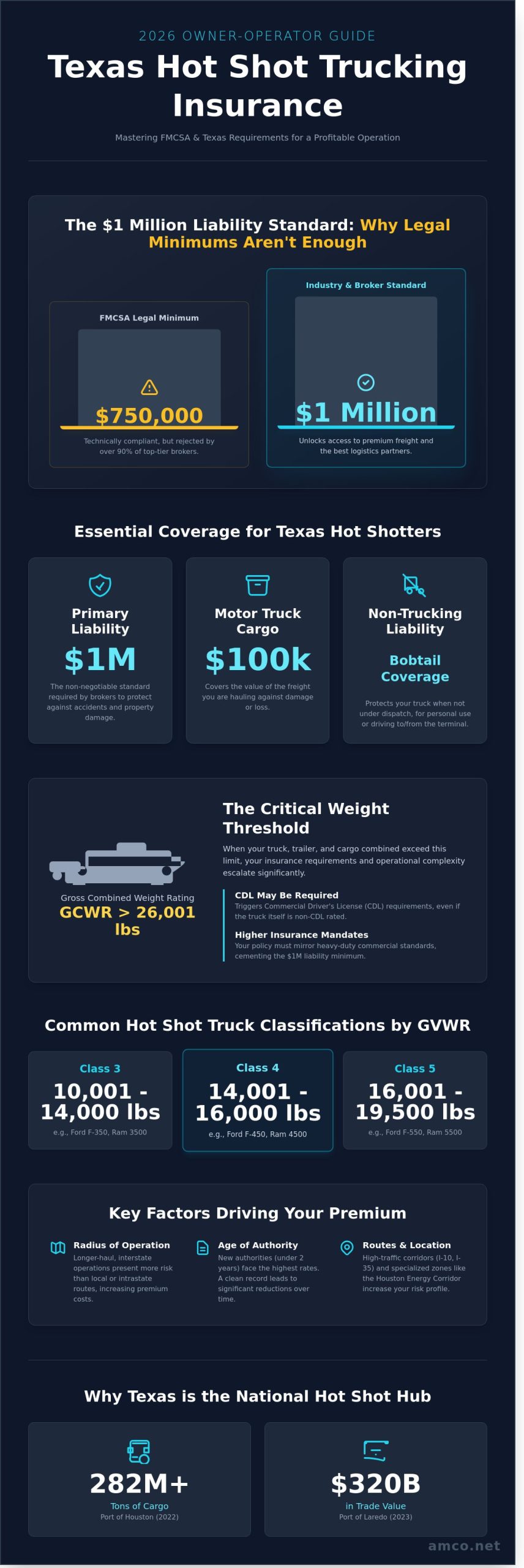
While the FMCSA technically requires only $750,000 in primary liability, over 90% of top-tier logistics brokers in Houston and throughout Texas now mandate a $1 million minimum before they'll even release a rate confirmation. This gap between legal minimums and industry reality often leaves new owner-operators sidelined before their first haul. If you've looked at initial quotes for hot shot trucking insurance lately, you know that securing a policy for a new authority can feel like an uphill battle against rising premiums and complex TXDMV filings.
We understand that you're not just looking for a policy; you're looking for a sustainable business foundation that keeps your trucks moving without overextending your cash flow. This 2026 guide provides the technical clarity required to master Texas insurance requirements while meeting the $1 million liability and $100,000 cargo standards that today's brokers demand. We'll examine the specific steps to align your FMCSA compliance with local Texas regulations and highlight strategies to reduce your monthly costs through proven risk management protocols.
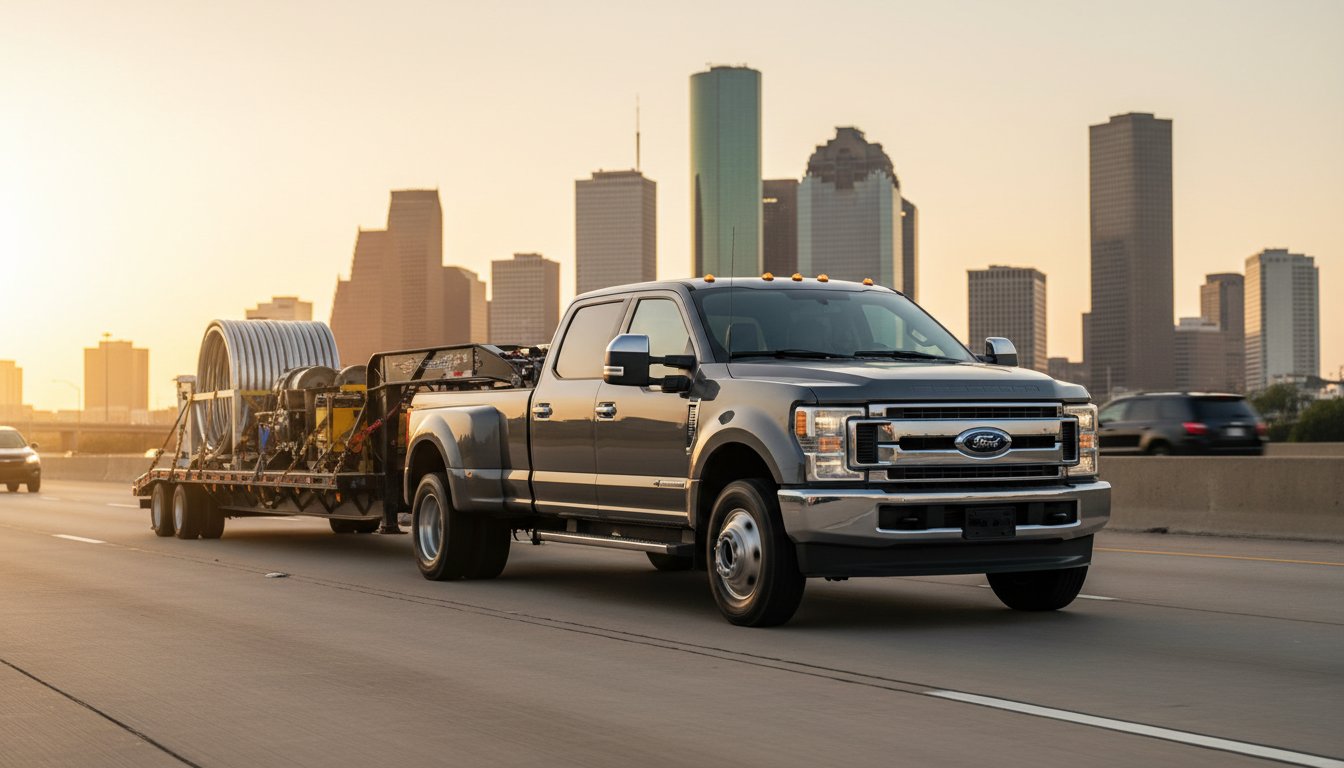
Hot shot trucking insurance provides a specialized commercial auto framework for operators utilizing medium-duty trucks for time-sensitive deliveries. Unlike standard long-haul trucking involving Class 8 semis, these policies cater specifically to Class 3, 4, and 5 vehicles transporting smaller, high-priority loads. To understand the operational scope of this niche, one must first define What is Hot Shot Trucking? as it relates to non-CDL requirements and rapid-response logistics. This insurance ensures that the unique risks of hauling heavy equipment with a pickup truck are fully mitigated.
Texas serves as the primary hub for this industry due to its massive infrastructure. The Port of Houston recorded over 282 million tons of cargo movement in 2022, creating a constant demand for regional distribution that larger fleets cannot always fulfill. Similarly, the Port of Laredo processed $320 billion in trade in 2023. These hubs necessitate a robust insurance structure that addresses both local TXDMV requirements for intrastate hauls and FMCSA regulations for interstate commerce. By 2026, the regulatory landscape expects a clearer distinction between "expedited freight" and traditional hot shotting, particularly regarding electronic logging device (ELD) mandates and cargo valuation.
To better understand how to structure your coverage, watch this helpful video:
Class 3 trucks, such as the Ford F-350 or Ram 3500, operate within the 10,001 to 14,000 lbs Gross Vehicle Weight Rating (GVWR). Insurance providers evaluate these differently than Class 4 vehicles (up to 16,000 lbs) or Class 5 units (up to 19,500 lbs). In Texas, your specific truck classification dictates your minimum liability limits. If your Gross Combined Weight Rating (GCWR) exceeds 26,000 lbs once a trailer is attached, your hot shot trucking insurance requirements will shift to mirror heavy-duty commercial standards, often requiring $750,000 to $1,000,000 in primary liability coverage.
Operating within Houston's Energy Corridor introduces unique risks that differ from standard freight. Hauling specialized oilfield equipment to the Permian Basin involves high-value cargo and demanding off-road environments. Carriers must account for the density of the I-10 and I-35 corridors. These routes see some of the highest commercial traffic volumes in the United States, which increases the statistical likelihood of collisions. Local Texas geography and the specific nature of energy-sector equipment directly influence your risk profile and subsequent premiums for hot shot trucking insurance.
Operating a hot shot rig in Texas requires a clear understanding of both legal mandates and commercial realities. While the FMCSA sets a minimum of $750,000 for primary liability for vehicles over 10,000 lbs GVWR, this figure often falls short in practice. For drivers navigating the busy corridors between Houston and Dallas, carrying a $1 million policy is the practical entry point. Securing the right hot shot trucking insurance is not just about staying legal; it's about qualifying for the freight that keeps your business profitable. Professional carriers should also consider Non-Trucking Liability, often called Bobtail coverage, to protect the truck when it's not under dispatch.
The gap between the $750,000 legal minimum and the $1 million broker standard is a critical hurdle for new authorities. By 2026, over 90% of top-tier freight brokers and shippers require $1 million in primary liability to even consider a carrier for a load. This higher limit opens doors to higher-paying contracts in the Houston energy and manufacturing sectors. While the premium for a $1 million policy is higher, the cost-benefit analysis shows that the increased access to premium load boards often offsets the expense within the first 60 days of operation. You can review specific safety compliance details in the Texas Hot Shot Trucking Regulations provided by the Department of Public Safety.
Cargo insurance is where technical precision matters most. In the insurance industry, this is technically classified as "Inland Marine" coverage because it protects goods in transit over land. For hot shot truckers, a $100,000 limit is the "golden ticket" required by most load boards. However, you must scrutinize your policy for specific exclusions. Common exclusions include:
Protecting specialized equipment often hauled in the Houston industrial sector requires a policy that accounts for the unique risks of flatbed and gooseneck transport. Understanding the full scope of what your cargo coverage entails is critical; Houston carriers operating along high-theft corridors like the I-10 should review a comprehensive breakdown of motor truck cargo insurance to understand policy inclusions, exclusions, and the specific protections required to meet broker contract obligations. Operators who also run enclosed cargo vehicles as part of their regional distribution network should review the requirements for box truck insurance in Houston and Texas, as cargo limits and filing requirements differ significantly from open-deck hot shot operations.
Operations near the Port of Houston frequently involve swapping trailers or hauling equipment you don't own. This is where Trailer Interchange coverage becomes vital. It's different from Non-Owned Trailer Physical Damage, which typically covers a specific trailer under a long-term lease. Trailer Interchange provides broader protection for any non-owned trailer in your possession under a written interchange agreement. Ensuring your dually and gooseneck are correctly scheduled on your hot shot trucking insurance policy prevents coverage gaps during Texas weather events or road debris incidents. For those looking to optimize their operational safety, exploring complete industrial solutions can help streamline your logistics and protection strategy.
The distinction between CDL and Non-CDL operations defines the risk profile for every provider of hot shot trucking insurance in Houston. The 26,001 lb Gross Vehicle Weight Rating (GVWR) serves as the regulatory boundary. If your truck and trailer combination stays below this limit, you aren't legally required to hold a Commercial Driver's License. However, this technicality significantly impacts your insurance eligibility and the number of carriers willing to offer a quote. In 2026, insurance companies have tightened their underwriting guidelines, often viewing Non-CDL operators as higher risks due to the lack of standardized formal training documentation.
Staying under the 26,001 lb threshold requires precise equipment management. A standard RAM 3500 dual-rear-wheel truck often has a GVWR of 14,000 lbs. Pairing it with a popular 40-foot gooseneck trailer rated at 14,000 lbs puts the total Gross Combined Weight Rating (GCWR) at 28,000 lbs. This setup immediately triggers CDL requirements. To remain Non-CDL, operators must "derate" their trailers to 12,000 lbs or less through the manufacturer.
A common pitfall occurs when drivers ignore these ratings and haul loads based on the physical capacity of the trailer rather than the paper rating. If an accident occurs while you're over the 26,001 lb limit without a CDL, your insurance carrier can void the claim entirely. Finding carriers that specialize in the Texas Non-CDL market is increasingly difficult for new authorities. Many providers now require a minimum of 24 months of verified CDL experience before they'll consider a new policy, even for smaller rigs.
Holding a CDL offers a measurable financial advantage that outweighs the initial cost of the license. Statistical data from 2024 shows that CDL holders maintain lower loss ratios because they're subject to more rigorous medical exams and drug testing protocols. In the Texas market, a CDL can reduce your hot shot trucking insurance premiums by 15% to 20% compared to a Non-CDL driver with the same equipment.
Beyond the direct premium savings, a CDL opens doors to higher-paying freight. High-value cargo brokers often mandate that drivers hold a CDL regardless of the truck's size. These brokers prioritize operators who demonstrate a commitment to Federal Safety Requirements and professional standards. For a Houston-based operator, the CDL isn't just a license; it's a tool for cost optimization and long-term business stability.
Insurance costs for Houston operators remain a primary overhead concern as we head into 2026. For an established Texas authority with at least three years of clean operations, annual premiums for hot shot trucking insurance typically range between $12,000 and $18,000 per power unit. New authorities face a steeper climb. Startup operations should budget between $22,000 and $32,000 for their first year. These figures reflect the high-density traffic risks inherent to the I-10 and US-59 corridors.
Your "Radius of Operation" dictates a significant portion of your quote. Carriers categorized as regional often stay within a 500-mile radius of Houston. If your routes extend into long-haul territory, expect a 15% to 22% increase in your liability premiums. This jump accounts for the increased likelihood of driver fatigue and the higher costs associated with out-of-state vehicle recovery.
Underwriting departments now scrutinize Motor Vehicle Records (MVRs) with surgical precision. A single "serious" violation, such as following too closely or speeding 15 mph over the limit, can trigger a 25% rate hike. By 2026, Electronic Logging Device (ELD) data has become a central pricing tool. Carriers use telematics to monitor hard braking events and cornering speeds. Operators who share this data voluntarily often secure "safety performance" discounts of 8% to 12% because they provide transparency that reduces the insurer's risk profile. Understanding how underwriters interpret this data is essential; hot shot operators who want to ensure their initial estimates remain accurate through final policy issuance should review the process for obtaining accurate commercial truck insurance quotes in Texas, which details how TXDMV and FMCSA filing discrepancies can cause unexpected premium shifts.
Adjusting your deductible is the fastest way to influence monthly cash flow. Moving from a $1,000 to a $2,500 deductible can reduce physical damage premiums by 12% to 15%. This requires a cash reserve to cover potential out-of-pocket costs, but the long-term savings often outweigh the risk for disciplined owners. Maintaining a clean Texas CDL is equally vital; drivers with zero points over a 36-month period qualify for preferred tier pricing. Additionally, bundling your general liability with commercial auto through a single provider typically yields a 5% multi-policy discount. For a deeper look at how Texas fleet owners are structuring their coverage to control rising fixed costs, the affordable trucking insurance cost-optimization guide for 2026 provides a comprehensive framework for reducing premiums without sacrificing critical protections.
The first 12 months of a new authority are statistically the most volatile. Most insurers require a down payment of 20% to 25% to bind a policy for a new venture. This initial investment secures your MCS-90 endorsement and filings with the FMCSA. Many traditional carriers refuse to quote drivers with less than two years of CDL experience, but AMCO.NET specializes in connecting new Houston ventures with specialized markets that value equipment quality over years in business. This expertise ensures your startup isn't grounded before its first load.
Ready to secure a competitive rate for your Houston operation? Request an expert hot shot trucking insurance quote and optimize your fleet's fixed costs today.
Houston serves as the primary hub for the I-10 corridor, a critical freight lane where local knowledge translates directly into operational efficiency. Choosing a local agency means working with professionals who understand the specific risks associated with the Port of Houston and the surrounding industrial zones. AMCO.NET LLC provides this regional insight, offering a technical expertise that national call centers cannot replicate. We don't just sell policies; we build insurance frameworks that support your business's long-term stability. Securing the right hot shot trucking insurance is the final step in moving from a driver to a business owner.
Securing your Texas authority requires precise documentation and adherence to federal standards. We facilitate fast-track filings for MCS-90 and BMC-91 forms, ensuring your compliance data reaches the FMCSA and state agencies immediately. Because we broker multiple A-rated carriers, we can match your specific equipment to the provider best suited for your risk profile. These A-rated carriers provide the financial solvency necessary to pay claims promptly, protecting your business from sudden capital outlays. This technical matching process helps in optimizing your premiums while maintaining the high coverage limits required by top-tier freight brokers.
AMCO.NET LLC has spent 35 years refining its approach to the Texas insurance market. Our B2B focus means we understand that insurance is a fixed cost that must be managed to ensure profitability. We take a consultative approach, reviewing your specific broker contracts to confirm your hot shot trucking insurance meets every requirement for the loads you intend to haul. Our team handles all policy servicing, from issuing certificates of insurance to managing renewals, so your focus remains on the road and your equipment. For larger fleet operations requiring more comprehensive coverage, our expertise extends to commercial trucking insurance Houston solutions that address the complex regulatory environment facing multi-unit carriers.
Obtaining a quote is a straightforward, data-driven process. To begin, you'll need to provide your vehicle's VIN, driver history, and your planned operating radius. This information allows our agents to conduct a comprehensive market search across our carrier network. For owner-operators planning to scale their fleet or transition to larger rigs, we also provide Semi Truck Insurance in Houston to facilitate a smooth transition. Contact AMCO.NET LLC today for a professional review of your insurance needs and secure a policy that protects your professional future.
Success in the 2026 Texas freight market requires more than just a reliable dually and a gooseneck trailer. It demands a professional approach to risk management that satisfies Federal Motor Carrier Safety Administration (FMCSA) standards and the specific requirements of Houston shippers. Whether you're operating a non-CDL setup or a full commercial fleet, your policy must cover the precise cargo and liability limits necessary to keep your authority active and your trucks moving.
AMCO has supported Texas owner-operators since 1987, providing the technical depth needed to navigate complex state and federal filings. We connect you with A-rated commercial carriers to ensure your hot shot trucking insurance offers long-term stability rather than just a temporary fix. Our Houston-based team specializes in helping new authorities establish a professional foundation from day one. Don't leave your operational continuity to chance when expert guidance is available to protect your business assets.
Get a Fast Hot Shot Trucking Insurance Quote from AMCO.NET and start your journey with the backing of an industry leader who understands the Texas road.
Hot shot trucking insurance carries higher premiums than standard commercial auto because of the increased liability risks and higher cargo values associated with for-hire transportation. Standard policies don't include the specific endorsements required for long-distance logistics operations. Most carriers evaluate the Gross Vehicle Weight Rating and the higher frequency of highway miles when they calculate these rates. The complexity of these professional operations necessitates specialized coverage that protects against specific freight-related losses.
Texas law requires a Commercial Driver's License (CDL) if your truck and trailer combination has a Gross Combined Weight Rating exceeding 26,001 pounds. If your equipment stays below this 26,001-pound threshold, you can operate with a standard Class C license. However, insurance providers often offer lower premiums to CDL holders because they've passed rigorous safety and skill testing. Maintaining a CDL acts as a professional credential that demonstrates technical proficiency to underwriters and freight brokers.
The Federal Motor Carrier Safety Administration (FMCSA) doesn't mandate a specific cargo insurance minimum for most haulers, but industry standards dictate a $100,000 limit. Most Houston-based freight brokers won't issue contracts to drivers carrying less than this $100,000 threshold. You'll need to verify specific requirements with each shipper, as high-value industrial equipment often requires limits exceeding $250,000. This coverage ensures the financial continuity of your operations if freight is damaged during transit.
You can obtain hot shot trucking insurance with a new authority, though your choice of carriers is more limited than established fleets. Statistics from the FMCSA show that new entrants face higher scrutiny during the first 12 to 18 months of operation. Many specialized insurers in the Houston area provide "New Venture" programs specifically designed for startups. These policies focus on the driver's personal motor vehicle record and previous industry experience to determine eligibility.
Physical damage coverage includes your trailer and permanently attached equipment like ramps, provided they're listed on your policy schedule. You must specify the stated value of the trailer and any specialized loading equipment to ensure full replacement in a total loss scenario. Standard liability doesn't cover damage to your own equipment; you need a specific physical damage endorsement for that. Accurate documentation of these assets prevents gaps in your operational protection.
Hauling hazardous materials requires a specific hazmat endorsement on your CDL and a significant increase in your liability coverage limits. Under 49 CFR 387.9, carriers transporting certain hazardous substances must maintain a minimum of $5,000,000 in public liability insurance. This is a 666% increase over the standard $750,000 requirement for non-hazardous freight. Failure to secure this specific hot shot trucking insurance endorsement can result in immediate federal fines and the suspension of your operating authority.
Texas regulations classify dually trucks based on their Gross Vehicle Weight Rating, which often places them in the commercial category if they exceed 10,000 pounds. When used for commercial purposes, these vehicles must comply with Texas Department of Transportation marking and registration rules. Insurance carriers specifically look for dually configurations because the extra tires provide better stability for heavy loads. This mechanical advantage often makes the vehicle more favorable during the underwriting process for specialized hauling.
Your radius of operation directly impacts your premium because longer distances increase the statistical probability of highway accidents. Most insurers categorize the radius into three brackets: local (within 100 miles), intermediate (100 to 300 miles), and long-haul (over 300 miles). Drivers operating within a 100-mile radius of Houston often see lower rates due to reduced fatigue factors and familiar routes. Expanding your territory beyond state lines adds interstate regulatory requirements that further influence the total policy cost.