

If the FMCSA moves forward with raising the minimum liability requirement to $2 million later this year, will your current policy keep your fleet on the road or force an operational halt? You're likely already feeling the pressure of rising premiums cutting into margins that are thinner than they were just twelve months ago. With road freight accounting for over 65% of the Texas logistics market, the competition for profitable loads is fierce, and insurance costs are often the deciding factor in your annual profitability.
Securing commercial trucking insurance Houston has become increasingly complex as regulatory bodies tighten oversight on driver eligibility and international trade protocols. We understand the frustration of navigating the gap between TxDMV requirements and the $1 million liability limits usually demanded by shippers and brokers. This guide provides the technical clarity needed to master Texas trucking regulations while securing the most competitive rates available in 2026. We will analyze the critical distinctions between MCS-90 and Form E filings, the specific insurance demands of the Houston-to-Laredo trade corridor, and the most efficient ways to obtain a fast certificate of insurance to keep your cargo moving without delay.
Commercial trucking insurance Houston isn't a single policy but a complex architecture of coverages designed to protect your fleet, cargo, and business assets. It functions as a multi-layered shield. Primary auto liability addresses road accidents, while cargo insurance covers the goods in transit. For companies operating in Houston, this protection is critical. As a primary logistics hub with significant port activity and cross-border trade, the risks are higher than in rural areas, making comprehensive coverage a baseline requirement for any professional operation.
The Federal Motor Carrier Safety Administration (FMCSA) and the Texas Department of Motor Vehicles (TxDMV) dictate the specific mandates you must follow in 2026. While Primary Liability covers damage caused by the truck during operation, General Liability protects your business from non-driving risks, such as injuries on your premises or loading dock incidents. Distinguishing between these two is vital for ensuring no gaps exist in your liability profile.
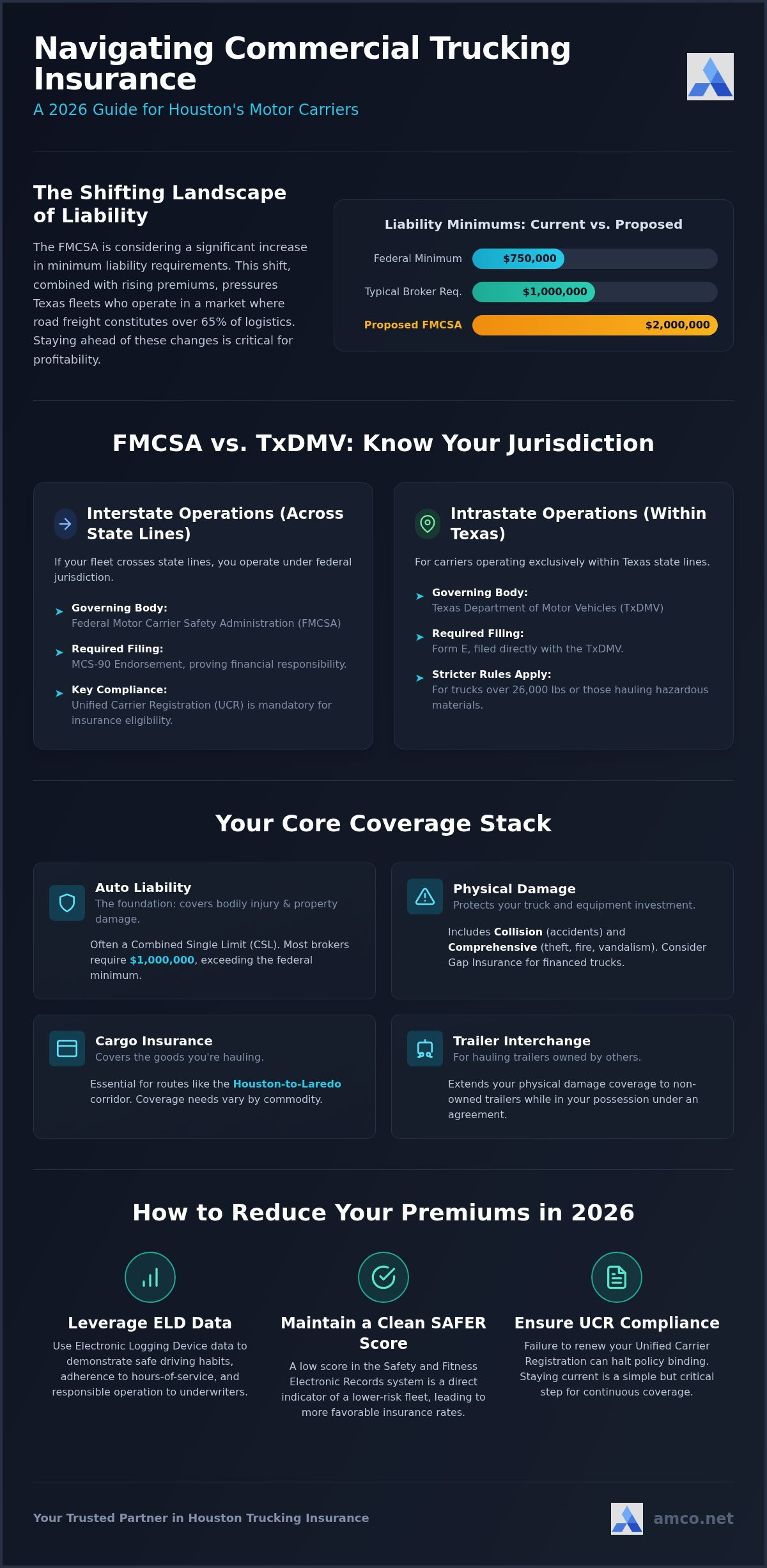
Determining your filing requirements depends on where your trucks travel. If your fleet crosses state lines, you fall under federal jurisdiction and must maintain an MCS-90 endorsement. The MCS-90 endorsement is a federal mandate ensuring that motor carriers maintain sufficient financial responsibility to cover public liability for bodily injury, property damage, and environmental restoration. For 2026, the federal minimum for general freight remains $750,000, though most Houston brokers require $1,000,000 to secure contracts.
Intrastate carriers operating exclusively within Texas must file a Form E through the TxDMV. While the state minimum for light vehicles is lower, trucks over 26,000 pounds or those hauling hazardous materials face much stricter requirements. Staying compliant prevents roadside out-of-service orders and preserves your authority in a tightening regulatory environment.
UCR compliance is a prerequisite for most commercial trucking insurance Houston providers. This annual registration fee applies to all interstate motor carriers. In 2026, enforcement has tightened, and failing to renew your UCR by the deadline can lead to immediate insurance eligibility issues. Carriers often find that underwriters won't bind a policy if the UCR status isn't active. This registration ensures your fleet is recognized across all participating states, streamlining your operations from the Port of Houston to any destination across the country.
Auto Liability serves as the non-negotiable foundation of any commercial trucking insurance Houston policy. Unlike standard commercial auto plans, trucking liability is often structured as a Combined Single Limit (CSL). This provides a singular, larger pool of coverage for both bodily injury and property damage per occurrence. This flexibility is vital when dealing with the high-value assets and significant risks associated with heavy-duty hauling. To maintain legal authority, your limits must align with federal insurance requirements, which currently mandate $750,000 for general freight. However, most Houston-based brokers and shippers won't even consider a contract unless you carry at least $1,000,000 in liability protection.
Physical damage coverage protects your capital investment from external threats. Collision coverage addresses road accidents, while comprehensive coverage handles non-collision events such as theft, fire, or vandalism. If your operations involve hauling trailers owned by other entities, a trailer interchange agreement is a technical necessity. This specific endorsement extends your physical damage protection to the non-owned trailer while it's in your possession. In 2026, equipment replacement costs remain elevated. Adding gap insurance to your policy ensures that if a newer, financed truck is totaled, the settlement covers the full loan balance rather than just the depreciated market value.
Cargo insurance is the primary protection for the goods you transport along the critical Houston-to-Laredo trade corridor. Each commodity type requires different considerations. You must ensure your policy meets all Texas cargo insurance requirements to maintain your reputation with freight brokers. Standard cargo policies often have a $100,000 limit, but high-value electronics or specialized machinery may require significantly more.
Pay close attention to exclusions that can leave you vulnerable. Reefer breakdown coverage is essential for those hauling perishables, as standard cargo forms often exclude losses due to temperature changes. Similarly, unattended vehicle clauses can void claims if a theft occurs while the truck is left at an unmonitored facility. Reviewing these technical details with an expert trucking insurance broker ensures your policy actually pays out when a loss occurs.
Finally, Non-Trucking Liability (NTL) offers protection for owner-operators when the truck is driven for personal use outside of active dispatch. It's a distinct coverage from bobtail insurance, which applies when the truck is under dispatch but not pulling a trailer. Having both ensures you aren't left with a massive liability gap during the "off-duty" hours of your operation.
The Houston market presents unique operational demands that standard policies often fail to address. For owner-operators and hot shot carriers, a one-size-fits-all approach creates dangerous liability gaps. Specialized equipment like reefers, dump trucks, and flatbeds requires endorsements that account for specific cargo risks and operational environments. Managing these variables requires a deep understanding of how different truck classes interact with local industry demands, particularly within the energy and maritime sectors.
Hot shot trucking has seen a significant surge in Texas, particularly within the energy and oilfield sectors. These operators typically utilize Class 3-5 trucks with gooseneck trailers to deliver time-sensitive freight. Because these loads often include expensive machinery or specialized parts for refineries, cargo limits frequently exceed the standard $100,000 threshold. It's essential to ensure your policy meets the Federal Motor Carrier Safety Administration (FMCSA) insurance requirements while also satisfying the high-limit demands of energy sector brokers.
For leased-on owner-operators, clarity regarding liability is paramount. Bobtail insurance covers the truck while under dispatch without a trailer, whereas Non-Trucking Liability (NTL) provides protection during personal, non-business use of the vehicle. Many independent contractors also opt for Occupational Accident insurance. This serves as a cost-effective alternative to Workers' Compensation, providing essential medical and disability benefits for the driver in the event of a work-related injury. Ensuring these coverages are in place is a critical step in securing commercial trucking insurance Houston that protects both the driver and the business assets.
Operating out of the Port of Houston introduces another layer of technical complexity. To access the terminals, carriers must comply with the Uniform Intermodal Interchange and Facilities Access Agreement (UIIA) standards. This requires specific limits and language within your policy to ensure seamless entry and exit from the port. Beyond the docks, the last-mile delivery into Houston's urban sprawl increases the risk of minor collisions and property damage claims. A broker who understands the intricacies of intermodal transport can structure a policy that covers these high-traffic risks without inflating premiums unnecessarily. Sticking with a partner who has served the Texas market since 1987 ensures your filings are handled with the precision required for port authority compliance.
Reducing the operational overhead of commercial trucking insurance Houston requires a shift from reactive purchasing to proactive risk management. In 2026, the most competitive rates are no longer found through simple price shopping. Instead, they're earned by carriers who treat safety data as a tangible financial asset. Underwriters have moved toward data-driven pricing models that reward transparency and technological integration. By focusing on your fleet's digital footprint, you can exert significant downward pressure on your annual premiums.
Modern underwriters prioritize telematics data when calculating renewals. Sharing your ELD insights provides objective proof of safe driving habits, which often leads to premium credits that aren't available to carriers with opaque operations. This data serves as your best defense against the rising trend of "Nuclear Verdicts" in Texas. These massive jury awards have made insurers extremely cautious. Implementing AI-driven dashcams and real-time driver coaching demonstrates a commitment to safety that can lower your risk profile. Even small fleets should implement a formal safety program to reduce the frequency of roadside violations, as a clean SAFER score directly correlates to more favorable quotes.
Direct carriers typically provide a single, fixed price that may not reflect the nuances of your specific operation. Working with an independent agency like AMCO.NET LLC allows you to access a broad spectrum of A-rated carriers simultaneously. This market access is crucial for finding the right balance between coverage limits and monthly costs. Before you apply for commercial truck insurance quotes, we perform a "Risk Profile" audit. This process identifies and corrects errors on your FMCSA record that might otherwise inflate your premiums before a single underwriter sees your application.
Strategic deductible management is another effective tool for cost control. By increasing your out-of-pocket risk for physical damage claims, you can achieve substantial monthly savings. However, this must be balanced against your cash flow requirements to ensure a single incident doesn't jeopardize your operations. A professional broker helps you find that "sweet spot" where your risk exposure aligns with your financial stability. To begin optimizing your fleet's coverage and reducing your fixed costs, request a professional risk assessment from our Houston team.
Consistency in your safety protocols is the final piece of the puzzle. Carriers who maintain stable driver pools and consistent maintenance schedules are viewed as lower-risk entities. In a tightening market, your reputation for reliability is just as important as your years in business. By combining technological tools with expert brokerage, you can secure the protection your business needs without overextending your budget.
Since 1987, AMCO.NET LLC has served as a stable anchor for the Texas transportation industry. We don't operate as a faceless national portal. Instead, we function as a dedicated B2B partner that understands the specific operational challenges of the Houston to Laredo corridor. Our approach is defined by a deep technical understanding of the logistics sector, ensuring that your commercial trucking insurance Houston isn't just a certificate, but a robust risk management framework.
Speed is a critical factor in the trucking industry. A delayed Certificate of Insurance (COI) can result in lost loads and damaged broker relationships. We've optimized our internal processes to ensure fast, responsive COI issuance. Through our mobile app and online portal, you can manage your policy 24/7, providing the technological continuity required for modern fleet management. This blend of heritage and technology ensures your trucks stay on the road without administrative bottlenecks.
Our expertise extends across the primary Texas logistics hubs, including Houston, San Antonio, Dallas, and Laredo. This geographic reach is supported by our bilingual team, which provides essential support to Texas's diverse trucking community. Understanding the regional nuances of each market allows us to tailor solutions that account for local traffic patterns and specific port requirements. You can learn more about our history as AMCO: A Houston Insurance Agency You Can Trust Since 1987.
Securing a precise quote requires a detailed analysis of your current operations. To expedite this process, you should have your DOT number, driver lists, and equipment schedules ready for review. Our team performs a thorough audit of your safety data to identify potential premium reductions before submitting your application to our network of A-rated carriers. This methodical approach ensures you receive competitive trucking insurance that doesn't compromise on essential coverage limits.
We remain committed to the long-term stability of your business. By moving beyond simple price-based sales, we provide the advisory support needed to handle the evolving regulatory environment of 2026. Whether you're a new authority or an established fleet, our goal is to provide a predictable, high-performance insurance solution. Request your commercial trucking insurance quote today to begin a professional risk assessment with our Houston-based experts.
The landscape of commercial trucking insurance Houston is defined by tightening regulations and the increasing importance of safety data. Success in this environment requires more than just meeting the $750,000 federal minimum. It demands a proactive approach to risk management and a thorough understanding of the Houston to Laredo trade corridor. By leveraging telematics and maintaining a clean SAFER score, you position your business for long-term financial stability and lower operating costs.
Partnering with an experienced independent agency provides the market access needed to navigate these complexities. Since 1987, AMCO.NET has specialized in Texas trucking, providing access to an A-rated carrier network and fast, responsive service. We don't just sell policies; we provide the systems and support to keep your fleet moving efficiently. Secure Your Commercial Trucking Quote from AMCO.NET today and ensure your operation stays compliant and competitive. Your road to better coverage starts with a partner who understands the Texas logistics industry from the ground up.
In 2026, the minimum liability requirement for interstate general freight remains $750,000 as mandated by the FMCSA. Carriers operating exclusively within Texas must meet TxDMV standards, which vary based on vehicle weight and cargo type. Most Houston freight brokers and shippers require a $1,000,000 policy limit to grant access to their loads. Aligning your coverage with these higher industry standards is essential for maintaining a consistent operational flow.
Costs for commercial trucking insurance Houston are influenced by several variables, including your SAFER score, radius of operation, and equipment value. Your specific premium is determined by your loss history and safety protocols rather than a fixed market price. New authorities typically face higher initial costs compared to established fleets. We recommend a professional risk audit to identify specific areas where your operation can earn credits and reduce annual overhead.
Yes, obtaining coverage for a new authority is possible, though the underwriting process is more rigorous. Insurers often look for experienced drivers and a solid business plan to mitigate the risks associated with a lack of company history. We specialize in helping new ventures navigate these initial hurdles by connecting them with carriers that have an appetite for emerging businesses. Maintaining a clean driving record from the start is vital for long-term rate stability.
Bobtail insurance provides liability protection when the truck is under dispatch but not pulling a trailer. In contrast, Non-Trucking Liability (NTL) applies when the vehicle is used for personal, non-business purposes outside of active dispatch. Distinguishing between these is critical for leased-on owner-operators to ensure no gaps exist in their protection. Selecting the correct endorsement depends on your specific contract with the motor carrier and your off-duty vehicle usage patterns.
While not always a state mandate for light vehicles, cargo insurance is a practical necessity for hot shot truckers in Texas. Most shippers in the energy and industrial sectors require a minimum of $100,000 in cargo coverage to secure a contract. Without this protection, your business is directly liable for damaged or stolen goods. Given the high-value machinery often transported through the Houston-to-Laredo pipeline, comprehensive cargo limits are a cornerstone of professional risk management.
AMCO.NET prioritizes operational speed by offering fast, responsive Certificate of Insurance (COI) issuance. Through our dedicated mobile app and online portal, clients can often access and send their certificates 24/7. This technological integration ensures that you never miss a load opportunity due to administrative delays. Our goal is to provide the documentation you need with the precision required by your brokers and shippers, keeping your fleet moving without interruption.
The primary factors affecting your 2026 premium include your CSA score, driver experience levels, and the implementation of safety technology. Underwriters also analyze your "Texas Triangle" routes and the types of commodities you haul. Modern pricing models heavily weight telematics data, meaning fleets that demonstrate safe driving habits through ELD logs often secure more favorable rates. Proactive maintenance and a stable driver pool remain the most effective long-term strategies for premium control.
Many carriers in our A-rated network offer premium credits or discounts for fleets that utilize ELDs and AI-powered dashcams. These tools provide objective evidence of safety compliance and help defend against fraudulent claims. We assist in securing commercial trucking insurance Houston for fleets that leverage these technologies to improve their safety profile. Integrating these tools demonstrates a commitment to risk mitigation that underwriters reward with more competitive annual premiums.