

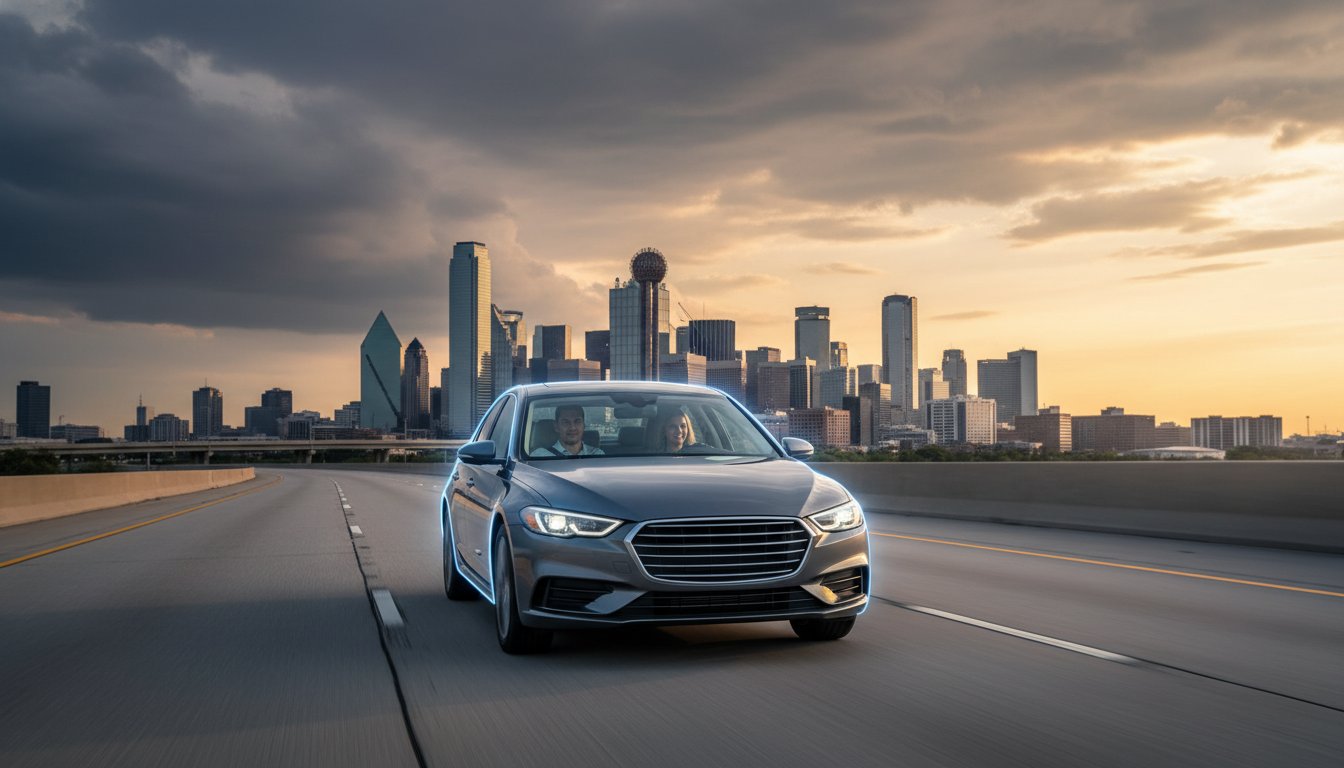
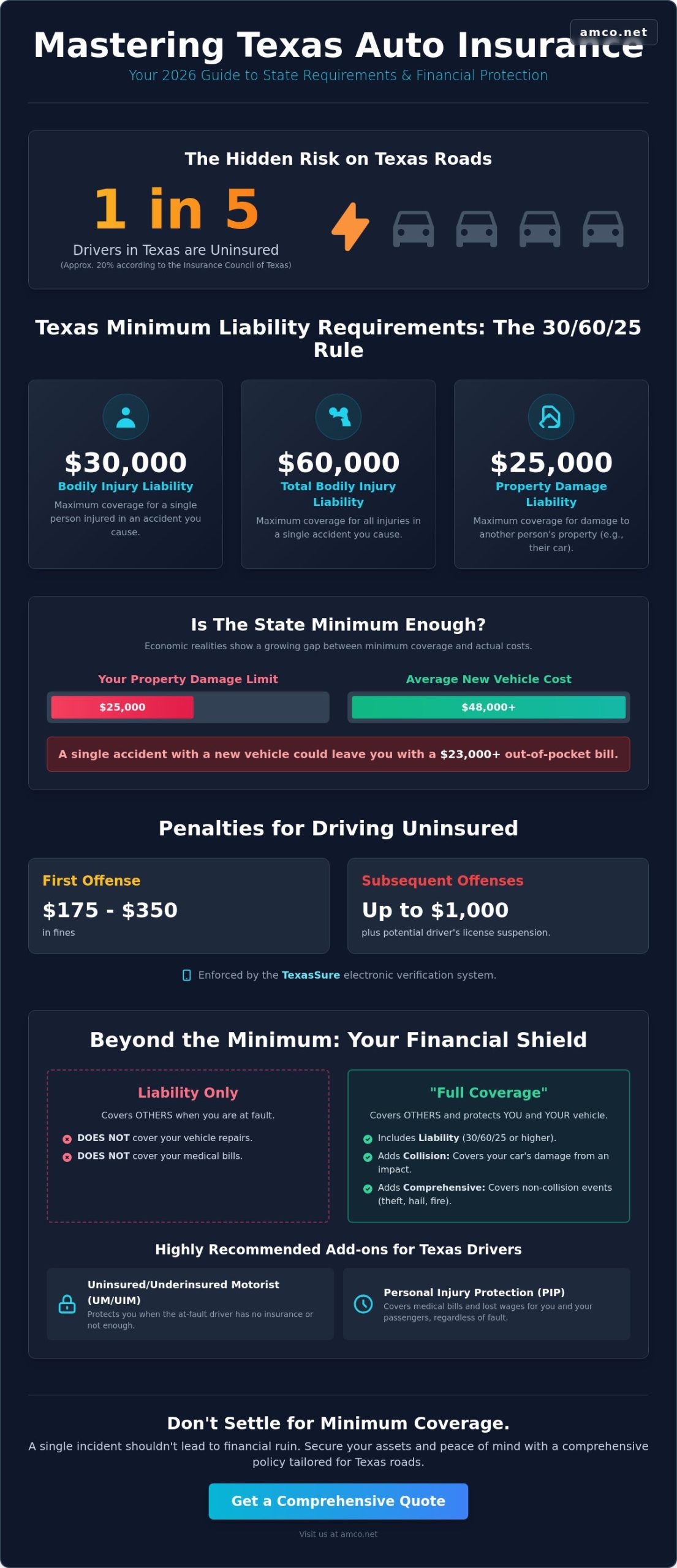
According to the Insurance Council of Texas, approximately 20% of motorists on the road today are operating without a policy. This statistic is particularly concerning for vehicle owners in high-density areas like Houston and Dallas, where traffic congestion and environmental factors create a complex risk environment. Securing reliable texas auto insurance is no longer just about meeting the state's 30/60/25 minimum liability requirements; it's about safeguarding your financial stability against uninsured motorists and the increasing frequency of severe weather events.
We understand that the rising cost of premiums and the ambiguity surrounding "full coverage" can make policy selection difficult for even the most diligent drivers. This guide serves as a technical resource to help you master the essentials of 2026 insurance requirements. We'll provide a detailed analysis of localized risk factors, clarify the distinctions between mandatory and optional protections, and offer a structured approach to finding a local agent who prioritizes long-term cost optimization and comprehensive security for your vehicle.
Texas law operates under the Financial Responsibility Act. This mandate requires every driver to demonstrate the ability to pay for damages or injuries they cause in a motor vehicle accident. Most drivers meet this requirement by maintaining a valid texas auto insurance policy that adheres to the state's specific minimum coverage limits. Failure to provide proof of this financial responsibility can lead to immediate legal complications.
The current legal standard in Texas is the 30/60/25 rule. This structure allocates $30,000 for bodily injury per person, $60,000 for total bodily injury per accident, and $25,000 for property damage. While these figures were once considered standard, they often fall short of 2026 economic realities. The average cost of a new vehicle in the U.S. now frequently exceeds $48,000, making a $25,000 property damage limit insufficient for accidents involving late-model trucks or electric vehicles common on Texas roads. Understanding Essential Coverage Options is the first step toward securing your professional and personal financial stability.
To better understand this concept, watch this helpful video:
Operating a vehicle without meeting these texas auto insurance standards leads to severe penalties. First-time offenders face fines between $175 and $350. Subsequent violations can trigger fines up to $1,000 and the suspension of your driver's license. Texas also utilizes the TexasSure electronic verification system, allowing law enforcement to instantly confirm your policy status during routine stops or after a collision.
Texas follows a "proportionate responsibility" model, which is a form of comparative negligence. This means fault is assigned as a percentage to each driver involved. If you're involved in a collision on I-35 in Austin or I-10 in Houston, insurance adjusters evaluate police reports, dashcam footage, and witness statements to determine liability. Under Texas Civil Practice and Remedies Code Section 33.001, you can't recover damages if your percentage of responsibility exceeds 50%. Adjusters play a critical role here, as their findings dictate which policy pays for the repairs and medical bills.
Texas law mandates a minimum level of financial responsibility for every motorist. Drivers must carry liability limits of at least $30,000 for injuries per person, $60,000 per accident, and $25,000 for property damage. These figures represent the baseline Texas Auto Insurance Requirements. However, relying solely on these minimums creates substantial financial exposure. Professional drivers and vehicle owners should evaluate optional coverages to ensure long term stability and asset protection. Selecting the right texas auto insurance policy involves looking beyond the legal minimums to address the specific risks of Texas highways.
Texas Department of Motor Vehicles data indicates that approximately 8.3% of drivers on state roads operate without any coverage. This creates a significant gap in protection. Uninsured/Underinsured Motorist (UM/UIM) coverage acts as a vital safety net. It pays for your damages when the at-fault party lacks sufficient policy limits or flees the scene of a hit-and-run. In 2026, medical costs and vehicle repair technologies continue to outpace the state minimum 30/60/25 limits. UM/UIM ensures that a collision with an underinsured driver doesn't result in out-of-pocket expenses for your family.
Personal Injury Protection (PIP) is a standard offering in the state that provides a broader scope of recovery than Medical Payments (MedPay). While MedPay strictly covers healthcare costs, PIP covers medical bills plus 80% of lost wages, regardless of fault. For those navigating the vast distances of the I-10 or I-35, Towing and Labor coverage provides essential roadside support. Similarly, Rental Reimbursement ensures your daily operations aren't halted during a lengthy repair process following a Houston fender-bender. Maintaining this level of protection is as critical as securing industrial assets through professional solutions.
An SR-22 is not an insurance policy; it's a certificate of financial responsibility filed with the state. The Texas Department of Public Safety requires this filing for drivers with specific violations, such as driving while intoxicated, multiple at-fault accidents, or operating a vehicle without valid texas auto insurance. It serves as proof that you maintain the required coverage levels for a period of usually two to three years. If you need specialized guidance on high-risk filings, you can consult our SR-22 insurance Texas guide for detailed filing procedures and compliance steps.
Geographic location serves as a primary pillar in actuarial risk assessment. Your specific ZIP code in Houston or Austin acts as a baseline for premium calculations, reflecting local variables such as population density, litigation trends, and historical claim frequency. For instance, a driver in Houston's 77002 ZIP code often encounters higher base rates than a resident in a suburban Austin neighborhood like 78731. These discrepancies stem from the statistical probability of filing a claim within those specific boundaries. Houston drivers seeking a data-driven approach to managing these costs can benefit from reviewing car insurance quotes houston residents use to benchmark competitive rates against local risk profiles.
Regional economic activities also dictate risk profiles. Drivers in Midland and Odessa face unique challenges due to heavy industrial traffic and the high volume of commercial vehicles associated with the Permian Basin's energy sector. This contrasts sharply with Laredo, where risks are more closely tied to international trade corridors and cross-border vehicle theft statistics. Urban Texas counties consistently report theft rates up to 35% higher than rural regions, a factor that directly inflates the comprehensive portion of texas auto insurance premiums. Analyzing these regional nuances helps clarify How to Find Affordable Auto Insurance in Texas by identifying which localized risks are within a driver's control.
Texas leads the nation in billion-dollar weather disasters, forcing insurance providers to adjust their 2026 actuarial models. North Texas and the Panhandle remain situated in "Hail Alley," where a single storm can cause thousands of dollars in vehicle damage. In Houston, the risk of catastrophic flooding makes comprehensive coverage a non-negotiable component of a secure policy. 2026 climate projections indicate an increase in the intensity of sudden flash floods, meaning carriers now prioritize flood-resilient garaging as a factor in regional pricing structures.
The "Texas Triangle"—the region encompassing Dallas-Fort Worth, Houston, and San Antonio—contains the state's highest concentration of traffic-related incidents. Dense congestion on the I-35 and I-45 corridors contributes to a higher frequency of rear-end collisions and multi-vehicle accidents. Local road construction projects, such as the multi-year North Houston Highway Improvement Project, create shifting traffic patterns that temporarily spike local claim rates. For a more granular analysis of how metropolitan infrastructure impacts your policy, consult the car insurance houston guide for city-specific data. These urban environments demand higher liability limits to protect against the increased probability of litigation following an accident in high-traffic zones.
Rising premiums in 2026 require a data-driven approach to cost management. Combining home and auto policies remains the most effective strategy for immediate reduction. Most Texas carriers offer a 15% to 25% discount for bundled accounts. This creates a more stable risk profile for the insurer and simplifies your administrative oversight. Telematics programs have evolved significantly by 2026. These "Pay-How-You-Drive" models use real-time sensors to track braking, speed, and cornering. Drivers who demonstrate safe habits can secure discounts up to 40%, though it requires sharing driving data with the provider.
Market conditions shift rapidly; comparing quotes every 12 months is a technical necessity. Many national carriers apply a "loyalty tax" where long-term customers pay higher rates than new applicants. This practice, known as price optimization, penalizes those who don't actively shop. For those living in high-traffic areas, check this cheap car insurance houston guide for localized pricing strategies. Efficiency in texas auto insurance costs comes from active policy management rather than passive renewals.
Optimize your coverage and reduce overhead with a professional insurance consultation today.
Selecting the right coverage involves more than comparing monthly premiums. The structural difference between captive agents and independent brokers significantly impacts your long term financial security. Captive agents represent a single insurance carrier, which restricts your options to one set of underwriting guidelines. Independent brokers maintain access to dozens of different carriers. This professional flexibility allows a broker to scan the entire market to find a policy that aligns with your specific risk profile and budget.
Since 1987, AMCO has provided this objective analysis to drivers in Houston and San Antonio. A local broker acts as your advocate, especially during the friction of a complex multi party claim. While national 1-800 numbers often route you through automated queues and various adjusters, a local agency provides a consistent point of contact. They understand the technical details of Texas liability laws and ensure that your documentation is handled with precision. This level of personalized support is essential when navigating the administrative hurdles of a significant accident.
Insurance requirements aren't uniform across the state. Underwriting nuances in Bryan, Conroe, and Midland vary based on local traffic density, weather patterns, and regional crime statistics. A local agent understands these variables and helps you navigate texas auto insurance requirements with a focus on local reality. For high risk drivers or those with unique coverage needs, this specialized knowledge is the difference between a rejected application and an affordable policy. Professional risk management involves analyzing your neighborhood's specific data to ensure you aren't overpaying for generic coverage packages.
Modern insurance management requires a balance of digital efficiency and human expertise. AMCO provides a mobile app for immediate access to ID cards and policy documents, yet maintains physical offices for face to face consultations. This hybrid approach serves new residents who need a fast quote turnaround to meet registration deadlines. Professional agents handle the technical transition of your out of state policy, ensuring no gaps in coverage occur during your move.
Choosing a local partner means your insurance strategy evolves as your life changes. Whether you're adding a teen driver or updating your liability limits, a professional broker provides the continuity and technical oversight required for total peace of mind. Get your personalized Texas auto insurance quote today and experience the benefit of a local advocate who understands the Texas roads as well as you do.
Adhering to the 30/60/25 liability mandates is the starting point for any driver, but true security comes from understanding how local variables affect your long-term costs. Drivers in metropolitan hubs like Houston, San Antonio, and Dallas face unique risk profiles that require a strategic approach to coverage. Since 1987, AMCO has operated as a stabilizing partner for motorists, leveraging nearly four decades of expertise to navigate the shifting landscape of texas auto insurance. We provide direct access to multiple A-rated insurance carriers, ensuring your policy is backed by financial strength and industry-leading claims processing.
Professional guidance simplifies the process of balancing required legal minimums with the comprehensive protection your assets deserve. Our local agents don't just sell policies; they offer technical consultations that prioritize cost optimization and risk mitigation. By choosing a partner with deep roots in the Texas market, you gain a level of predictability and service that digital-only providers can't match. It's time to move beyond guesswork and secure a policy built on a foundation of reliability and professional precision.
Get a Fast & Affordable Texas Auto Insurance Quote
Safe driving starts with the right preparation, and we're ready to help you navigate every mile with confidence.
Texas law mandates a minimum liability coverage known as 30/60/25. This requirement means your policy must provide $30,000 for each injured person, $60,000 for total injuries per accident, and $25,000 for property damage. The Texas Department of Insurance oversees these standards to ensure all drivers maintain basic financial responsibility on public roads.
Failing to carry this minimum protection results in legal penalties. Fines for a first offense typically start at $175 and can reach $350. Subsequent violations lead to higher fines and the potential suspension of your driver's license or vehicle registration.
Houston remains one of the costliest cities for texas auto insurance due to high population density and frequent accident reports. Drivers in the Houston metro area often pay 15% to 25% more than the state average. This price gap is driven by higher rates of litigation and vehicle theft compared to rural regions.
In contrast, cities like Amarillo or San Angelo typically see lower premiums. These areas benefit from fewer recorded collisions and lower repair costs per capita, which allows carriers to offer more competitive rates for residents in those zip codes.
An SR-22 is a certificate of financial responsibility that proves you carry the state's required liability limits. It's usually required by the Department of Public Safety after a DUI conviction or a period of driving without insurance. Filing this form can increase your annual premiums by 60% or more depending on your provider.
Most carriers view drivers requiring an SR-22 as high-risk clients. This designation leads to stricter underwriting and fewer discount opportunities for a mandatory three-year period. It's a technical filing that ensures your coverage stays active, as the insurer must notify the state if the policy lapses.
Insurance companies in Texas utilize credit-based insurance scores to determine risk and set premium levels. State regulations allow this practice because actuarial data shows a strong correlation between credit history and claim frequency. Drivers with excellent credit scores often secure rates that are 40% lower than those with poor credit.
You can request a special review of your score if an extraordinary life event, such as a medical emergency or job loss, impacted your financial standing. Under Texas law, insurers must consider these circumstances if they directly caused a temporary drop in your credit-based insurance score.
You must rely on your own Uninsured Motorist (UM) coverage to pay for repairs and medical bills if the at-fault driver lacks insurance. Statistics from the Insurance Research Council indicate that approximately 8% of Texas drivers operate without any coverage. Without UM protection, you're responsible for paying your own deductible and expenses upfront.
If you don't have this optional coverage, your only recourse is to sue the at-fault driver individually. However, collecting funds from uninsured individuals is often difficult and time-consuming. This makes UM coverage a vital component of a stable financial plan for Texas motorists.
Texas law requires insurance providers to include Personal Injury Protection (PIP) in every liability policy unless you reject it in writing. PIP provides a minimum of $2,500 to cover medical expenses and 80% of lost wages for you and your passengers. It's a no-fault benefit, meaning it pays out regardless of who caused the collision.
This coverage offers a layer of immediate financial stability after an accident. Since it doesn't require a fault determination to trigger a payout, it's often the fastest way to cover emergency room visits or initial rehabilitation costs without waiting for a legal settlement.
You can reduce your texas auto insurance costs in 2026 by enrolling in telematics programs that track real-time driving habits. Many Texas carriers offer discounts of up to 30% for drivers who demonstrate safe behaviors like avoiding hard braking and late-night travel. These programs use mobile apps or plug-in devices to verify your risk profile.
Maintaining a claims-free record for 36 months and bundling your auto policy with homeowners insurance can also lower your total expenditure. Most providers offer a 15% discount for multi-policy households, which improves long-term cost-efficiency for your family's insurance budget.
Hail damage is covered only if your policy includes comprehensive insurance. North Texas is part of a high-risk weather zone where storms caused over $1.6 billion in insured vehicle losses across the state in 2023. Standard liability-only policies don't pay for weather-related repairs or glass replacement.
If you live in Dallas or Fort Worth, adding comprehensive coverage is a technical necessity to protect your vehicle's value. This coverage pays for repairs minus your deductible, ensuring that a single spring storm doesn't result in a total financial loss for your asset.