


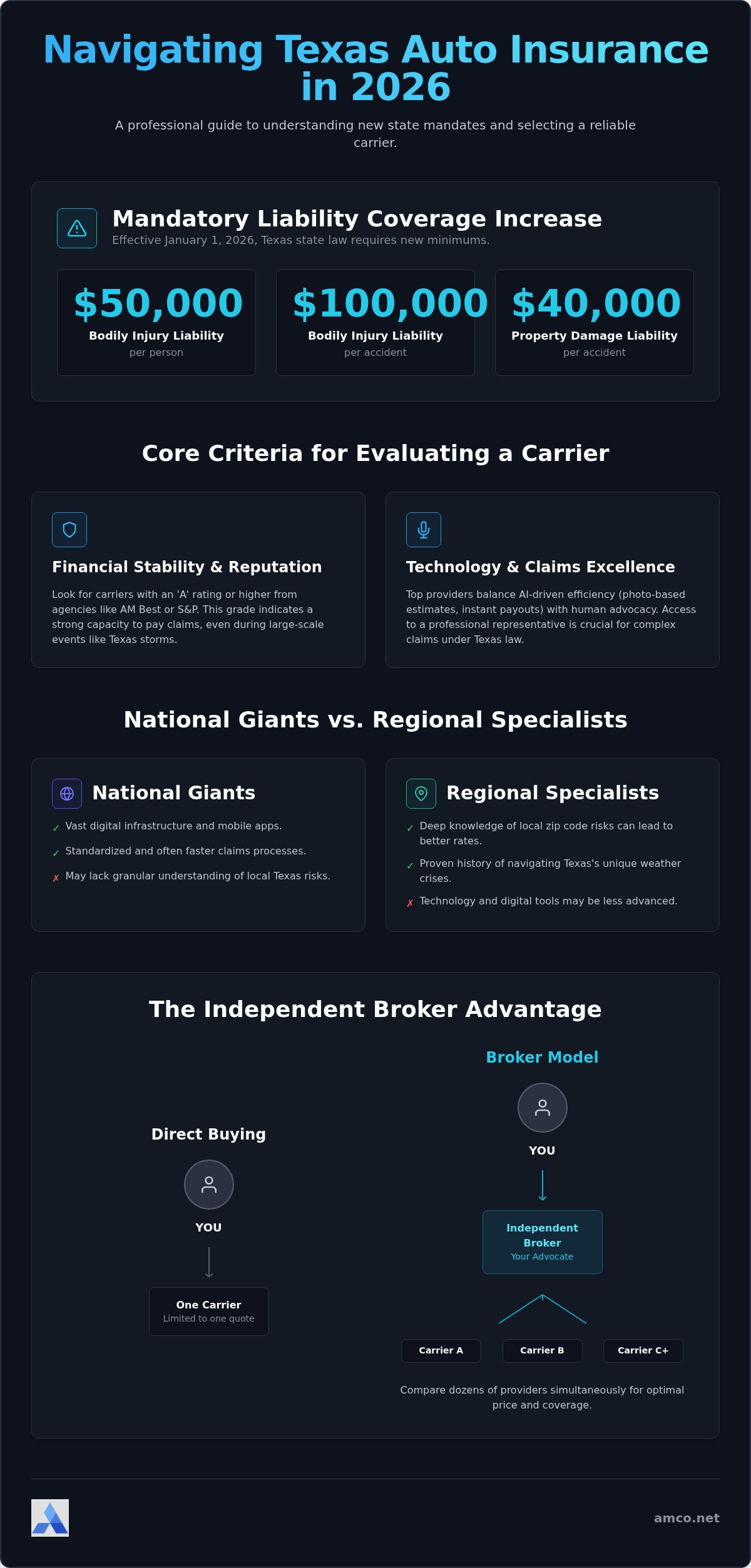
Did you realize that as of January 1, 2026, the Texas state-mandated minimum liability coverage has increased to 50/100/40? This regulatory shift means thousands of drivers are now legally underinsured. Selecting the right car insurance providers in this new environment requires a balance of technical compliance and financial foresight. You've likely seen your premiums rise recently due to climate risks and inflation. It's understandable to feel skeptical about whether a major carrier will prioritize your claim or simply protect their own bottom line.
We're here to clarify the complexities of the current Texas market and help you find a policy tailored to your specific risk profile. This guide offers a professional analysis of the top-performing carriers based on financial stability and local claims handling. You'll gain access to a vetted shortlist of providers and learn how the independent broker model can secure better rates. We'll also explore strategies to reduce your premiums without compromising the coverage limits that protect your assets.
Understanding the distinction between a carrier and an agency is the first step toward securing a professional policy. Car insurance providers are the financial institutions that actually underwrite the risk, hold the capital, and pay out claims when a loss occurs. Agencies like AMCO.NET LLC serve as the strategic bridge, utilizing 35 years of local experience to match drivers with these providers based on specific risk profiles. In 2026, the Texas market is characterized by heightened volatility. Economic factors like sustained inflation and the rising cost of high-tech vehicle repairs have pushed average annual premiums in the state to approximately $2,462, which is notably higher than the national average.
Texas drivers must also distinguish between standard and non-standard car insurance providers. Standard carriers typically seek low-risk profiles with clean driving records. Non-standard providers specialize in higher-risk scenarios, such as drivers requiring an SR-22 or those with a history of multiple at-fault accidents. The ideal match depends entirely on your specific data. For instance, a Houston commuter dealing with high-density traffic risks requires different coverage structures than a San Antonio business owner managing a local commercial fleet. Each carrier calculates these risks using proprietary algorithms that prioritize different data points.
Choosing between national giants like Progressive or Travelers and regional Texas specialists involves weighing specific trade-offs. National carriers offer vast digital infrastructures and standardized claims processes that many tech-savvy drivers prefer. However, regional providers often possess a more granular understanding of local zip code risks, which can lead to more competitive rates for specific Texas neighborhoods. A carrier's risk appetite isn't static. It fluctuates based on their previous year's loss ratios in specific regions. This is why a provider that was affordable last year might become the most expensive option upon renewal in 2026.
The Texas Department of Insurance (TDI) maintains strict oversight to ensure all car insurance providers remain solvent and capable of fulfilling their financial obligations. This oversight is crucial within the broader framework of Vehicle Insurance in the U.S., where state-level regulation dictates consumer protections. As of 2026, the new 50/100/40 minimum liability requirements are a central focus for regulatory compliance. An admitted carrier is a provider that has been formally approved by the TDI and is a member of the Texas Property and Casualty Insurance Guaranty Association, which offers an additional layer of financial protection for the policyholder if the carrier becomes insolvent.
Selecting between various car insurance providers requires a rigorous evaluation of their underlying operational health. As premiums in Texas continue to reflect rising vehicle values and climate risks, the technical integrity of your chosen carrier determines your long-term financial security. You shouldn't base a decision solely on the initial quote. Instead, look at the carrier's ability to maintain stable rates and honor claims during large-scale events, such as the severe storms that frequently impact the Gulf Coast and North Texas regions.
An insurance company's financial 'grade' is a primary indicator of its reliability. Ratings from independent agencies like AM Best or Standard & Poor’s (S&P) offer an objective look at a provider's capital reserves. A carrier with an 'A' rating or higher has demonstrated the capacity to meet its ongoing insurance obligations. It's also vital to consider a provider's loss ratio specifically within the Texas market. If a carrier's losses in the state are disproportionately high, you may face steeper renewal increases. Providers with historical longevity in Texas have already proven they can survive the state's unique weather crises without collapsing or exiting the market entirely.
The 2026 insurance landscape is defined by the integration of AI-driven appraisals. Many top-tier car insurance providers now utilize photo-based estimating tools that allow for instant mobile payouts. This technology reduces the 'hassle factor' by eliminating the need for a physical adjuster visit for minor accidents. However, the most effective carriers balance this automated efficiency with human advocacy. In the event of a complex dispute or a multi-vehicle collision, having access to a professional claims representative who understands Texas liability laws is indispensable. Efficiency shouldn't come at the cost of accuracy or fair compensation.
Customer service accessibility often dictates your overall satisfaction during a crisis. While digital apps provide convenience for policy management, local agent availability offers a layer of accountability that national call centers lack. Many carriers also offer specific discount structures for Texas-specific safety features, such as advanced anti-theft systems or telematics programs that reward safe driving habits. For a detailed breakdown of your rights and available options, the Texas Automobile Insurance Guide provides essential regulatory context. Consulting with an experienced advisor at amco.net can help you identify which carriers currently offer the best technical and financial fit for your specific driver profile.
Identifying the optimal carrier requires a granular analysis of your specific risk profile. While many car insurance providers market themselves broadly, their underwriting appetites are often highly specialized. A driver with a decade-long clean record will find the most competitive rates with standard carriers that prioritize low loss ratios. Even for these preferred profiles, maintaining the legal baseline of Texas' minimum liability insurance is merely a starting point. Most professionals recommend higher limits to protect personal assets from the litigation risks common in 2026.
Urban commuters in Houston and Dallas face unique environmental challenges. High traffic density and the increased frequency of uninsured motorists in these metropolitan areas make Uninsured/Underinsured Motorist (UM/UIM) coverage essential. Car insurance providers often adjust premiums based on specific zip codes where theft or flood risks are statistically higher. Selecting a provider with a strong local presence ensures that these regional variables are factored accurately into your premium calculation. This localized approach prevents you from overpaying for risks that don't apply to your specific commute.
Drivers categorized as high-risk often find that national standard carriers reject SR-22 filings or charge prohibitive surcharges. This administrative requirement serves as proof of financial responsibility following specific convictions. We specialize in matching these individuals with carriers that focus on "second chance" policies. Understanding What is SR-22 Insurance in Texas? is vital for maintaining your driving privileges. AMCO leverages its 35 years of experience to find providers that offer technical compliance without the excessive administrative friction found in direct-to-consumer platforms.
Small business owners and owner-operators require a different level of underwriting sophistication. The technical requirements for commercial trucking insurance in Houston differ significantly from personal auto policies. Providers in this space must handle complex business liability structures and higher coverage limits. While personal policies often focus on Personal Injury Protection (PIP), commercial providers prioritize protecting the business entity from vicarious liability. Our portfolio includes specialized carriers that understand the operational challenges of the Texas logistics and transport sectors, ensuring your fleet remains compliant and protected.
Direct-to-consumer platforms often prioritize transaction speed over technical accuracy. This model restricts you to the specific risk appetite of a single company, which may not align with your current needs or budget. By contrast, working with an independent agency allows for a comprehensive scan of multiple car insurance providers simultaneously. This objective comparison ensures that you aren't just buying a policy, but securing a risk management solution that fits your specific Texas driver profile. When you bypass the 'direct' trap, you gain access to a broader market that includes regional specialists often overlooked by national search engines.
Advocacy is perhaps the most critical benefit of the broker model. If a carrier denies a claim or disputes a repair estimate, an independent agent with 35 years of industry experience serves as your professional representative. We understand the technical nuances of policy language and can challenge unfair decisions that a lone consumer might struggle to contest. This level of personalized policy management provides a centralized point of contact, even if your various assets are covered by different providers.
The traditional method of applying for coverage involves repetitive data entry across various websites, which is both inefficient and prone to error. An independent agency streamlines this into a single, professional inquiry that reaches dozens of carriers at once. We identify 'pricing sweet spots' where certain car insurance providers offer lower rates for specific Texas zip codes based on their current regional loss ratios. Brokers leverage long-standing professional relationships with underwriters to negotiate favorable terms or clarify risk nuances that automated systems often misinterpret.
A carrier that offers the most competitive rates this year might adjust its risk appetite during the next renewal cycle. This volatility is common in the 2026 market due to shifting climate risks and inflationary pressures. Finding an insurance company near me that provides proactive rate shopping is the most effective way to maintain cost efficiency over time. AMCO’s digital tools integrate policy management across different car insurance providers, giving you a centralized view of your protection while our experts monitor the market for better opportunities. Experience the efficiency of a professional market scan by requesting a consultation at amco.net today.
AMCO.NET LLC serves as the primary technical partner for drivers seeking the most reliable car insurance providers in Texas. Since our founding in 1987, we've developed a deep understanding of the unique operational challenges within the Houston, San Antonio, and Dallas markets. This 35-year history allows us to provide a level of stability that newer, digital-only platforms cannot match. We don't just facilitate a transaction; we build long-term risk management strategies that evolve alongside your personal or business needs.
Our extensive carrier portfolio is a key component of our advisory role. As an independent agency, we maintain professional relationships with a diverse range of car insurance providers, allowing us to remain objective when recommending a policy. This neutrality is essential in 2026, as carrier risk appetites shift in response to new state regulations and economic pressures. Whether you're managing a household or a commercial fleet, our process is designed to deliver technical precision from the initial quote through the life of the policy.
We provide comprehensive solutions across a broad spectrum of insurance categories. Our offerings range from specialized Motorcycle Insurance to complex Commercial Property policies. By leveraging our 1987-founded stability with 2026-level technological integration, we ensure that every client receives a solution that's both legally compliant and financially sound. We understand that risk isn't static. Our diverse portfolio allows us to pivot your coverage as your circumstances change, ensuring you never overpay for unnecessary limits.
Securing your 2026 quote is a straightforward process that balances digital efficiency with human expertise. The AMCO mobile application allows for seamless policy management, including instant access to digital ID cards and rapid payment processing. However, we believe that an algorithm cannot replace the clarity provided by a local expert. A phone call or a visit to one of our physical locations allows our team to identify nuances in your risk profile that automated systems often miss. You can Get Your Fast & Affordable Insurance Quote Today to begin optimizing your Texas insurance strategy with a partner you can trust.
The 2026 insurance landscape requires a more technical approach than simply selecting the lowest online quote. With Texas liability minimums now established at 50/100/40, the margin for error in policy selection has vanished. You've seen how financial stability ratings and AI-driven claims processing distinguish the most reliable car insurance providers from those that might underperform during a regional crisis. True protection comes from a system that balances local expertise with broad market access.
By leveraging an independent agency, you ensure that your risk profile is matched with the carrier best equipped to handle it. AMCO.NET LLC has been serving Texas drivers since 1987, offering A+ rated customer service and direct access to over 20 leading insurance carriers. We provide the professional advocacy needed to navigate these complex regulatory shifts while maintaining cost efficiency. Don't leave your assets to chance in a volatile market.
Compare Top Providers & Get a Fast Quote with AMCO today to ensure your coverage meets the demands of the modern Texas market. We look forward to securing your journey with the stability and expertise you deserve.
The most cost-effective option is rarely a single company, as rates are determined by your individual risk data. In 2026, the average annual cost for full coverage in Texas is approximately $2,462, but regional car insurance providers may offer significant savings for specific zip codes. Your credit score and driving history remain the most influential factors in determining your final premium.
Utilizing an independent agency is typically more advantageous than buying directly from a single carrier. This approach allows you to compare multiple car insurance providers simultaneously, ensuring you don't overpay for basic coverage. Agencies also offer a level of claims advocacy and professional policy management that automated direct platforms lack.
Financial stability is best assessed through independent rating agencies such as AM Best or Standard & Poor’s. Look for a rating of "A" or higher to ensure the carrier maintains adequate capital reserves. Additionally, the Texas Department of Insurance provides public records regarding a provider's solvency and historical complaint ratios.
Independent agents are highly effective at securing SR-22 insurance in Houston because they have access to non-standard markets. While many national carriers reject drivers requiring financial responsibility filings, an agent can identify specialized providers that accept high-risk profiles. This ensures you remain compliant with state law without facing unnecessary administrative delays.
Carriers with high J.D. Power satisfaction scores and low complaint volumes at the state level are generally considered the most reliable for claims. In 2026, the industry has shifted toward AI-integrated appraisals for faster processing. However, the most reputable providers maintain a balance between this technology and experienced human adjusters for complex losses.
A standard personal policy typically excludes coverage for commercial gig work such as food delivery or ridesharing. Engaging in these activities without a business endorsement can lead to a total claim denial. You should consult your agent about commercial trucking insurance or specialized business riders to ensure your assets are protected during work hours.
We recommend reviewing your coverage options at every renewal cycle or at least once per year. The Texas market is volatile, and a carrier's risk appetite can change based on their previous year's loss ratios in specific regions. Regular shopping ensures your policy remains optimized for both cost and coverage limits.
If an admitted provider becomes insolvent, the Texas Property and Casualty Insurance Guaranty Association provides a safety net for policyholders. This association handles the payment of covered claims and unearned premiums up to statutory limits. This protection highlights the importance of choosing "admitted" carriers that are fully integrated into the state's regulatory framework.