

Did you know that Texas motor carriers saw a 14.3% spike in commercial auto liability costs in 2024, outpacing the national average for the third year running? It's a challenging environment where rising premiums in high-traffic metros like Houston and Dallas can quickly erode your bottom line. You've likely experienced the frustration of slow claims responses that keep your trucks off the road, or the administrative headache of reconciling TXDOT requirements with FMCSA filings. As a fleet operator, you prioritize operational continuity and technical precision, yet the insurance market often feels anything but predictable.
This comparison guide identifies the top trucking insurance companies for 2026 that specifically understand the Texas landscape. We'll show you how to access A-rated carriers that offer more than just a policy; they provide the local expertise needed to streamline your filings and optimize your long term costs. You'll discover how to secure lower annual premiums without sacrificing the stability your business depends on. We will examine the financial ratings, claims processing speeds, and specialized coverage options of the leading providers to help you make a data-driven decision for your fleet's future.
Commercial trucking insurance serves as the essential financial safety net for motor carriers across the state. It falls under the broader category of commercial vehicle insurance, providing the necessary capital to cover liability and property damage. In 2026, Texas fleet owners must manage a complex regulatory framework while protecting their assets against rising operational risks. Identifying the top trucking insurance companies requires looking beyond premium costs to evaluate claims-handling efficiency and long-term financial stability.
To better understand the current market and how to identify the best providers for your fleet, watch this detailed comparison:
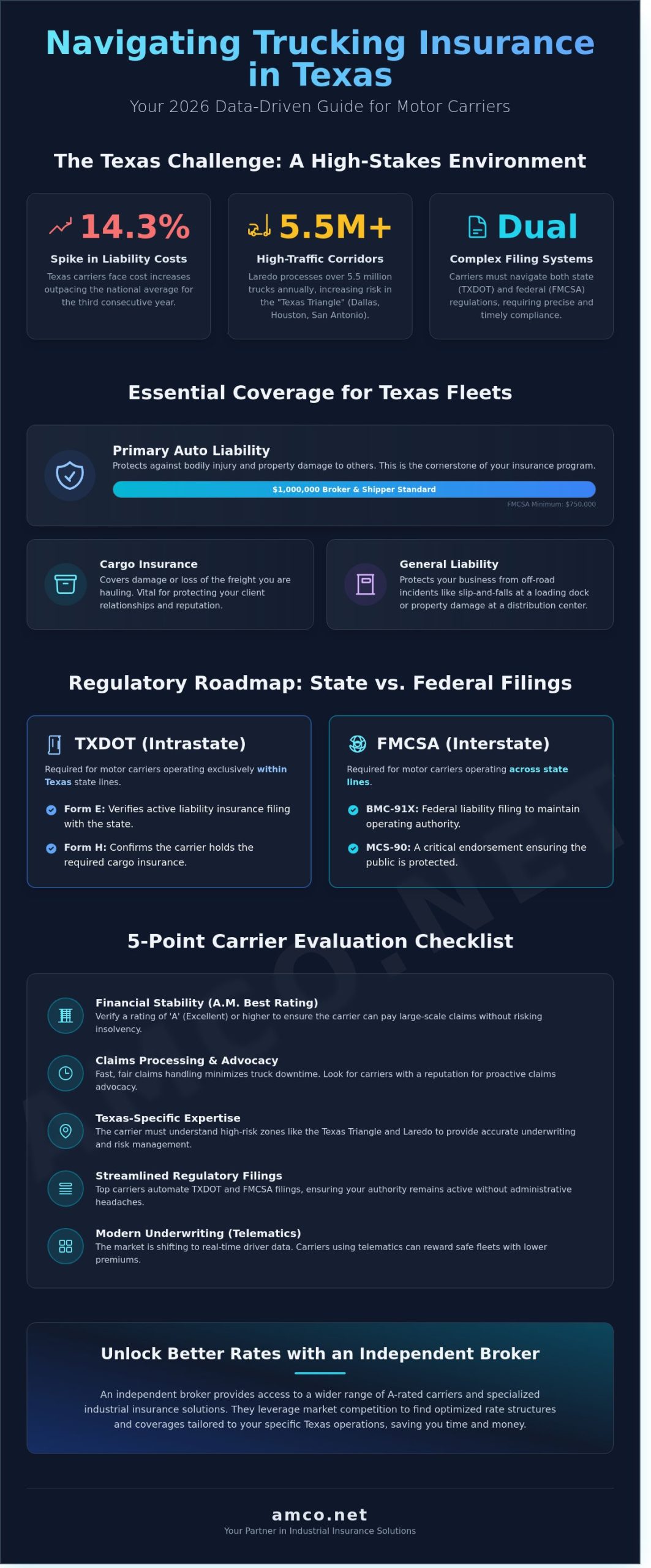
Texas logistics presents unique hurdles for 2026. The Port of Houston continues to experience high drayage congestion, while Laredo remains the busiest land port in North America, processing over 5.5 million trucks annually. These high-traffic zones increase the likelihood of accidents. Consequently, working with "A-rated" carriers is a strategic necessity. An AM Best rating of A- or higher confirms a provider's financial strength, ensuring they can pay out large-scale claims without risking insolvency. This stability is a cornerstone of professional risk management in the B2B sector.
Compliance begins with Primary Auto Liability. While the FMCSA maintains a $750,000 minimum for many operations, the 2026 industry standard has solidified at $1 million to meet the requirements of major freight brokers. Cargo Insurance is equally vital for protecting the diverse freight moving through the Texas Triangle. Additionally, General Liability coverage protects your business from incidents occurring off the road, such as property damage at a Dallas distribution center or a slip-and-fall at a loading dock in San Antonio.
The regulatory environment depends on where your trucks travel. Intrastate carriers operating exclusively within Texas must maintain active TXDOT filings, specifically Form E for liability and Form H for cargo. Interstate carriers fall under FMCSA jurisdiction and require BMC-91X filings to maintain their authority. The top trucking insurance companies streamline this process by automating these filings and providing the MCS-90 endorsement. This endorsement ensures that the public is protected even if an incident isn't explicitly covered by the policy's standard terms.
Selecting the right partner among the top trucking insurance companies requires a data-driven approach to financial stability and regional claims performance. In 2026, the Texas market remains one of the most competitive yet volatile environments for fleet operators. Carriers prioritize an A.M. Best rating of 'A' (Excellent) or higher to ensure long-term solvency against rising nuclear verdicts. National providers now adjust their underwriting appetite monthly based on Texas loss ratios, which hit a 108% peak in certain urban corridors during 2025. This volatility makes it essential to verify current FMCSA insurance requirements before renewing a policy.
The 2026 pricing model has shifted almost entirely toward real-time telematics. Companies don't rely solely on historical data anymore; they use live driver behavior metrics to calculate monthly premiums. This shift rewards fleets that invest in safety technology, while those without integrated ELD systems face significantly higher base rates. For businesses looking to scale, finding a comprehensive industrial solution for their logistics infrastructure is as critical as their insurance coverage.
Niche haulers require specific endorsements that generalist carriers often avoid. Lancer Insurance holds the largest share for passenger and motorcoach operations in the Dallas-Fort Worth metroplex, offering specialized liability limits that meet state-mandated requirements for high-capacity vehicles. Great West remains the gold standard for high-value cargo, specifically for carriers with CSA scores in the top 10% of the industry. Berkshire Hathaway Homestate has expanded its 2026 footprint in Texas by offering integrated packages that combine workers compensation with primary auto liability, simplifying the administrative burden for mid-sized fleet managers. It's a strategy that provides a more stable cost structure than piecing together separate policies from different providers.
Geography determines risk profile more than almost any other factor in the Lone Star State. Top trucking insurance companies utilize granular data to assess premiums based on specific operational zones. For instance, the Texas Triangle, which connects Houston, Dallas, and San Antonio, contains over 70% of the state's population. This concentration creates high-density traffic environments where the frequency of collision claims is 15% higher than in rural districts. Carriers often adjust liability rates upward for fleets primarily operating within these metropolitan hubs because the statistical probability of a multi-vehicle accident is significantly elevated. Fleet managers operating in these corridors should also understand how broader vehicle coverage works in the region, as the same market pressures that affect trucking premiums also drive up costs for every auto insurance company serving Houston and Texas drivers in 2026.
Operational specifics in West Texas and the border regions require specialized coverage that differs from standard regional freight. Oil-field hauling in Midland and Odessa involves navigating unpaved roads and transporting heavy, specialized equipment. Most standard insurers avoid this sector due to the high volatility of the Permian Basin's road safety records. Conversely, operations in Laredo, the busiest inland port in the United States, demand enhanced Motor Truck Cargo insurance. The risk of cargo theft and the complexities of transloading near the border necessitate policies with specific international gap clauses that protect the carrier during the hand-off process.
Expertise in local litigation is another critical factor when selecting an insurance partner. Texas is known for a challenging legal environment regarding large-scale settlements. Fleet owners should prioritize carriers that employ local claims adjusters who live and work in the state. These professionals understand the nuances of Texas intrastate motor carrier requirements and can navigate the state's specific liability laws more effectively than a remote desk adjuster. It's a strategic advantage to have a representative who knows the local court systems in Harris or Bexar County.
Drayage operations near the Port of Houston face unique challenges. High-volume container traffic requires increased liability limits to meet port authority standards. Congestion on the I-610 loop contributes to a higher rate of minor accidents. Top trucking insurance companies that provide local risk management teams can help fleets analyze telematics data to reduce these specific urban risks. This proactive approach often leads to lower premiums over a 24-month period as safety scores improve.
Routes spanning the I-10 or I-35 corridors require a balance between intrastate and interstate compliance. If your drivers return to a base in Dallas or El Paso without a trailer, Non-Trucking Liability insurance is vital to cover those "bobtail" miles. Carriers now heavily rely on ELD data to offer performance-based discounts. Fleets maintaining high safety scores on these long stretches can see rate reductions of up to 12% compared to those with inconsistent log data or frequent speeding violations.
Selecting from the top trucking insurance companies requires a technical audit that goes beyond comparing monthly premiums. In the 2026 landscape, a carrier's ability to integrate with your fleet's operational data is just as critical as their financial reserves. Texas presents unique challenges, from congested corridors like I-35 to a legal environment prone to high-value litigation. A generic policy often fails to address these localized risks, leaving gaps in coverage that can jeopardize a fleet's long term viability.
Use this 5-point framework to evaluate any potential provider:
Technology has shifted from a luxury to a mandatory requirement for 2026. Many of the top trucking insurance companies now mandate ELD integration and AI-powered dashcams to provide real-time risk assessments. These tools don't just lower premiums; they provide the objective data needed to exonerate drivers after highway incidents. Avoid "off-the-shelf" policies that lack these integrations, as they often miss Texas-specific endorsements required for intrastate hauling.
Financial stability is the foundation of any insurance partnership. You shouldn't accept a carrier rated below "A-" (Excellent) by A.M. Best. This rating indicates the company's ability to meet its ongoing insurance obligations. In the event of a large-scale cargo loss, a carrier with "A" or "A+" financial strength typically processes settlements faster because they maintain higher liquidity. It's also vital to verify a carrier's history in the Texas market. Some providers exit the state during economic shifts, leaving fleets scrambling for new coverage at higher rates.
Trucking is a 24/7 operation, and claims reporting must match that rhythm. If an accident occurs at 3:00 AM on a rural Texas highway, a delay in response can lead to lost evidence or unfavorable police reports. Determine if the carrier uses their own Texas-based staff or relies on independent adjusters. Local expertise is essential for managing "nuclear verdicts," which have seen a 300% increase in value over the last decade in certain Texas jurisdictions. A carrier with a deep understanding of the Texas legal system will be better equipped to defend your fleet against aggressive litigation strategies.
For fleets looking to stabilize their operational costs through better risk management, exploring comprehensive industrial safety solutions can provide the necessary framework for long-term protection.
Selecting the right insurance partner determines the long-term stability and cost-efficiency of your fleet operations. A captive agent represents only one insurance brand, which restricts your options to that single company's underwriting appetite. If your fleet's risk profile doesn't perfectly match their rigid criteria, you often face higher premiums or limited coverage. An independent broker like AMCO acts as a strategic consultant instead. We maintain direct appointments with the top trucking insurance companies identified in this 2026 guide, which allows us to pivot between carriers as your fleet grows or market conditions shift.
AMCO has operated with a focus on technical precision and risk mitigation for over 37 years. This deep history in the Texas market provides institutional knowledge that national call centers simply cannot replicate. Instead of a rotating queue of entry-level representatives, you work with a dedicated specialist who understands the nuances of MCS-90 filings, federal compliance, and the specific pressures of the logistics industry. This personalized approach serves as a professional antidote to the impersonal service found at many large-scale national brands. When you need an insurance company near me with specialized Texas expertise, AMCO provides the local knowledge and carrier relationships that make the difference in securing optimal coverage at competitive rates.
Efficiency is a primary driver of profitability in the trucking sector. AMCO streamlines the procurement process by using a single, comprehensive application to solicit bids from a wide network of A-rated insurers. This methodology ensures you don't waste administrative hours repeating data entry for individual carriers. We focus on the following benefits for our clients:
Texas trucking involves unique geographical challenges, from the high-traffic corridors of Houston and San Antonio to the specialized transit routes through Dallas. Our team understands the local infrastructure and the specific regulatory environment of the Lone Star State because we have been part of it since 1987. We combine this veteran experience with modern technology to support your fleet 24/7. Through the AMCO mobile app, your drivers can manage policies and access certificates of insurance instantly while on the road, preventing unnecessary delays at shipping docks or weigh stations.
Get your expert trucking insurance quote from AMCO today and ensure your fleet is protected by the top trucking insurance companies with the support of a local Texas partner.
Selecting the right partner for your fleet involves more than just comparing premiums. It requires a strategic look at how specific Texas routes, from the busy ports of Houston to the border crossings in Laredo, impact your risk profile. The 2026 market demands a focus on A-rated national and regional carriers that offer both financial stability and technological integration. By using a structured evaluation checklist, fleet owners can identify which of the top trucking insurance companies align with their operational goals and safety standards.
Working with an independent agency provides the necessary bridge to these high-tier providers. Since 1987, we've helped Texas truckers navigate complex regulatory shifts and market fluctuations. Our team brings specialized knowledge of the Dallas, Houston, and Laredo logistics hubs to ensure your coverage is as efficient as your routes. Choosing a carrier is a long-term business decision that affects your bottom line and operational continuity. It's about finding a partner that understands the technical demands of the industry.
Compare Top Trucking Insurance Quotes for Your Texas Fleet
You've built a strong foundation for your business; let's ensure it stays protected through 2026 and beyond.
Progressive and Berkshire Hathaway often provide the most competitive entry-level rates for Texas fleets based on recent market analysis. While some regional providers offer lower initial quotes, the top trucking insurance companies provide better long-term value through faster claims processing and higher AM Best financial strength ratings. Carriers with a 90% or higher renewal rate typically offer more stable pricing than those targeting the lowest initial quote to gain market share.
You're required to obtain a USDOT number if your vehicle operates intrastate and has a gross weight exceeding 26,000 pounds. The Texas Department of Motor Vehicles mandates this registration for all commercial motor vehicles under Title 43, Texas Administrative Code, Section 217.56. Even if you don't cross state lines, failing to register can lead to fines starting at 500 dollars and potential vehicle impoundment during roadside inspections. It's a critical step for legal compliance.
Bobtail insurance covers the tractor when it's operated without a trailer, regardless of whether it's on dispatch or personal time. Non-Trucking Liability (NTL) only applies when the truck's used for personal, non-business purposes. Statistics from 2023 show that 15% of independent contractors carry the wrong coverage, leading to denied claims during deadhead transitions. You'll need to verify which specific endorsement your motor carrier's primary liability policy requires to avoid expensive coverage gaps.
Top trucking insurance companies use your Compliance, Safety, Accountability (CSA) scores to determine your risk tier and annual premium costs. If your Unsafe Driving or HOS Compliance BASIC scores exceed the 65% intervention threshold, you'll likely see premium increases of 20% or more. Underwriters review these scores every 30 days. Maintaining a clean record for 24 consecutive months is the most effective way to secure preferred rates from Tier 1 insurers in the Texas market.
New authorities can secure coverage from major providers like Progressive or National Independent Truckers Insurance Company (NITIC), though choices are more limited than for established fleets. Most Tier 1 insurers require at least 2 years of operating authority before offering their most competitive programs. Data indicates that 30% of new trucking businesses fail within their first year, so insurers mitigate this risk with higher down payments, often reaching 20% to 25% of the total annual premium.
Accessing the Port of Houston requires a minimum of 1 million dollars in Primary Auto Liability and 100,000 dollars in Cargo Insurance. You must also be registered with the Uniform Intermodal Interchange and Facilities Access Agreement (UIIA) to handle intermodal containers. The Port Authority verifies these filings through the UIIA database. Ensure your policy includes the specific "Scheduled Autos" or "Any Auto" designation to meet their strict terminal entry protocols and avoid delays at the gate.
You should perform a comprehensive policy review at least 90 days before your annual renewal date to account for market shifts. The Texas insurance market fluctuates based on legislative changes and recent court rulings, such as the 2021 Texas House Bill 19 which altered how commercial vehicle litigation's handled. Conducting a quarterly audit of your driver list and equipment schedule ensures you aren't paying for assets you've already sold. Regular reviews help maintain the leanest possible operational budget.