


Most drivers view an SR-22 as a permanent financial penalty, but it's actually a regulatory bridge designed to restore your legal right to drive. While you might be searching for SR-22 insurance Texas thinking it's a specialized type of coverage, it's actually a Certificate of Financial Responsibility filed directly with the Department of Public Safety. It's natural to feel anxious about rising premiums or the technical complexity of state compliance. A single filing error can lead to a secondary license suspension, which adds unnecessary risk to your professional and personal life.
At AMCO.NET LLC, we understand that navigating the intersection of state law and insurance protocols requires precision rather than guesswork. This guide provides the expert insights you need to manage the filing process, identify competitive rates for high-risk status, and maintain your driving privileges without interruption. You'll find a clear breakdown of 2026 costs, the exact duration of the requirement, and the systematic steps required to ensure your documentation remains compliant with Texas DPS standards from start to finish.
Drivers often find the term SR-22 insurance Texas misleading because it suggests a completely separate insurance product. In reality, an SR-22 is a Financial Responsibility Insurance Certificate required by the Texas Department of Public Safety (DPS). It functions as a specialized endorsement added to an auto insurance policy rather than a standalone plan. This document serves as formal verification that a driver carries the state's minimum liability limits of 30/60/25, ensuring that the individual is financially capable of covering damages in the event of an accident.
Technically defined as SR-22 (insurance), the certificate provides a direct communication link between your insurance provider and the state. Since 1987, our agency has helped drivers understand that this isn't a punishment; it's a professional risk management tool. Its primary purpose is to provide the DPS with a guarantee that your coverage is active and meets all legislative standards. If you don't own a vehicle, you'll still need a non-owner version of this filing to reinstate your license and maintain legal driving status.
To better understand this concept, watch this helpful video:
The SR-22 acts as a binding guarantee between your insurance carrier and the Texas DPS. When an insurer issues this certificate, they're legally obligated to notify the state if the policy lapses, expires, or is cancelled for any reason. This monitoring system ensures that high-risk drivers don't simply purchase coverage to get their license back and then immediately stop paying premiums. A Form SR-22 is filed by an authorized insurer. The state relies on this reporting to maintain road safety and ensure that every driver on Houston roads remains financially responsible through verified coverage.
The Texas DPS typically mandates an SR-22 filing following specific legal judgments or convictions that categorize a driver as high-risk. Understanding why you received this requirement is the first step toward resolving your status. Common triggers include:
The Texas Department of Public Safety (DPS) initiates the mandate by mailing a formal notice of suspension to your registered address. This correspondence outlines the specific legal grounds for the requirement and the exact date your driving privileges will be revoked. For 2026, compliance hinges on maintaining minimum liability limits of 30/60/25. This translates to $30,000 for bodily injury per person, $60,000 per accident, and $25,000 for property damage. These limits are non-negotiable under Texas Transportation Code § 601.072, and they represent the baseline for legal operation on state roads.
The state typically requires you to maintain SR-22 insurance Texas for two consecutive years from the date of the conviction or judgment. It's a rigid timeline that demands perfect continuity. If your policy is cancelled for any reason, your insurer must file a Form SR-26, which triggers an immediate and automatic license suspension. There's no grace period in this automated system. A single missed payment can reset your progress and result in additional state fines, making consistent premium management an operational necessity for anyone looking to keep their license.
Once you've received a suspension notice, the path to restoration involves both financial and administrative steps. You'll need to pay a reinstatement fee to the DPS, which is usually $100 for standard suspensions or $125 for Administrative License Revocation cases. Securing a policy that meets state standards is the cornerstone of this process. Since high-risk profiles require specialized handling, reviewing a comprehensive guide on car insurance Houston can help you understand the local market dynamics before you file. This ensures your underlying coverage is robust enough to support the state mandate while remaining cost-effective over the long term.
Insurance providers charge a nominal administrative fee to process the certificate, which generally ranges between $15 and $25. While paper filings were once common, modern Texas agencies now utilize direct digital filing systems to interface with the state's infrastructure. This technological shift has reduced processing times significantly. Digital submissions are often reflected in the DPS database within 24 to 48 hours. This allows for a much faster reinstatement of driving privileges than traditional mail-in methods, which can take weeks to process. If you're unsure about your current status, you can check your eligibility for reinstatement through our specialized advisory team to ensure every technical requirement for SR-22 insurance Texas is met.
An SR-22 mandate fundamentally reclassifies your insurance tier from standard or preferred to the non-standard market. This shift represents a carrier's assessment of increased liability risk rather than a simple administrative update. In 2026, Texas drivers with a DUI conviction often see their premiums increase by 70% to 110%. While the average monthly cost for a driver with a DUI is approximately $152 for minimum coverage, these rates vary significantly between providers. We utilize our broker advantage to shop a broad network of carriers, identifying those that specialize in high-risk profiles to secure the most competitive rates available in the current market.
Despite the high-risk designation, certain cost-mitigation strategies remain effective. Drivers can frequently reduce their financial burden by leveraging specific discounts that don't disappear with an SR-22 requirement. Common opportunities for savings include:
The type of policy you select is one of the most significant factors in determining your total expenditure for SR-22 insurance Texas. For individuals who do not own a vehicle but must fulfill state requirements to restore their license, a non-owner policy is the most logical financial choice. These policies provide the liability protection mandated by Texas Transportation Code Chapter 601 at a fraction of the cost of a standard policy. Research indicates that non-owner SR-22 coverage can start as low as $28 per month. Conversely, drivers who own a vehicle must carry a standard owner's policy, which typically ranges from $85 to $145 per month for minimum liability coverage.
Your geographic location and personal financial history heavily influence the final quote you receive. Drivers in the urban core of Houston or Dallas typically face higher premiums than those in rural West Texas due to higher accident frequency and litigation costs. Additionally, your credit score remains a critical metric for Texas insurers when calculating risk. The SR-22 filing itself is cheap, but the underlying risk causes the rate increase. By understanding these variables, we can better position your application to find a carrier that offers the best balance of compliance and affordability.
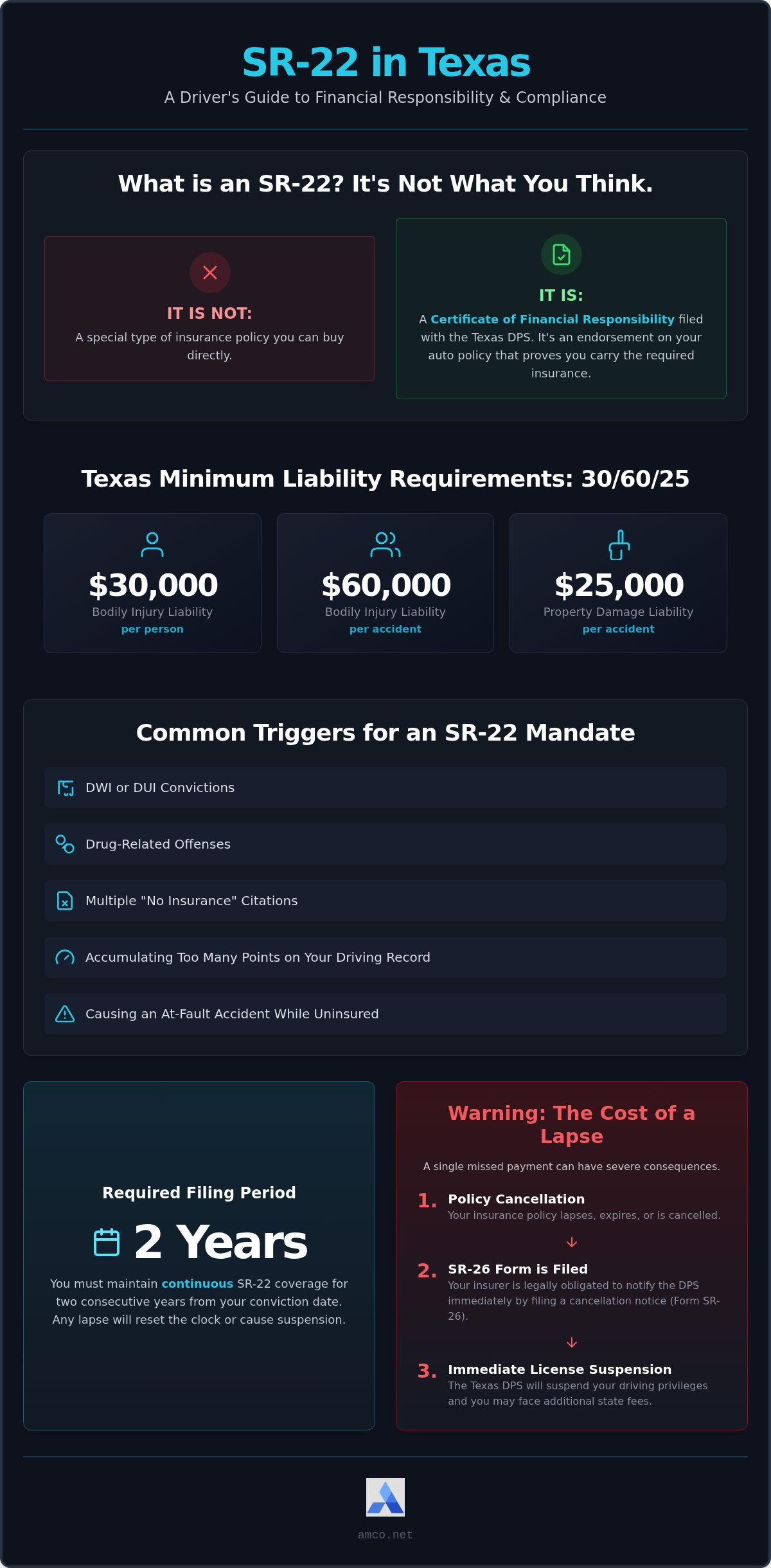
Securing your certificate is only the first step; maintaining continuous compliance is where most drivers face operational challenges. The Texas DPS monitors your status through an automated system that relies on your insurance provider's data. If you miss a premium payment, your insurer is legally mandated to file a Form SR-26. This document notifies the state that your financial responsibility has been terminated, which triggers an immediate suspension of your driving privileges. To mitigate this risk, we recommend setting up autopay through the AMCO mobile app. This ensures that your SR-22 insurance Texas remains active without the risk of human error or forgotten deadlines.
Relocating does not automatically dissolve your legal obligations to the State of Texas. If you move out of state but still have an active Texas SR-22 mandate, you must continue to file proof of financial responsibility with the Texas DPS until the requirement period expires. You'll need to work with an agency that can provide a policy meeting the minimum requirements of your new state while still maintaining the specific Texas filing. It's also vital to monitor your requirement end-date closely. Paying for the filing longer than necessary results in avoidable overhead, so keeping a record of your conviction date and the subsequent two-year window is a sound financial practice.
A policy lapse is more than a temporary inconvenience; it's a technical failure in your compliance strategy. When the DPS receives an SR-26 cancellation notice, they don't offer a grace period. Beyond the immediate loss of your license, a lapse can result in a "reset" penalty. This means the state may require you to restart your two-year requirement clock from the date of the new filing, significantly extending your time in the high-risk insurance tier. If you receive a cancellation notice, you must contact your agent immediately to reinstate coverage before the state processes the termination. You can manage your policy digitally to stay ahead of these critical deadlines.
Successful completion of your mandate requires a proactive transition plan. Once you've reached the end of your two-year period, you should verify your status through the Texas DPS online portal to ensure all requirements are officially fulfilled. Do not simply stop paying for your policy or assume the SR-22 will fall off automatically. You must specifically request your agent to remove the SR-22 endorsement from your documentation. Removing this high-risk marker allows you to shop for standard SR-22 insurance Texas rates again. After years of specialized coverage, this transition back to the preferred market often results in a substantial reduction in your annual premiums.
AMCO.NET has operated as a stabilizing force in the Texas insurance market since 1987. Our longevity allows us to manage complex Texas Department of Insurance regulations with a level of precision that newer agencies cannot match. We've developed a specialized methodology for securing SR-22 insurance Texas by leveraging an extensive network of carriers that prioritize high-risk drivers. This professional infrastructure ensures that our clients aren't just getting a policy; they're receiving a verified compliance solution. Whether you're operating in the urban core of Houston, San Antonio, or Dallas, our local experts provide the situational awareness necessary to handle regional filing nuances effectively.
Digital integration is a core component of our service model. The AMCO mobile application allows you to manage quotes, process payments, and monitor your filing status in real-time. This technological oversight reduces the probability of a policy lapse and the subsequent SR-26 filing discussed in previous sections. By combining decades of industry experience with modern management tools, we provide a reliable pathway for drivers to regain their legal standing. Our team understands the operational challenges of a suspended license and works to eliminate the administrative friction that often delays reinstatement.
Direct insurance carriers often utilize rigid underwriting algorithms that automatically reject applicants with DWI convictions or multiple no-insurance citations. Our position as an independent broker allows us to bypass these limitations. We shop multiple carriers simultaneously to identify the most cost-effective options available for your specific risk profile. Our goal is to find affordable solutions that meet state requirements without compromising the integrity of your coverage. This expertise extends to professional operators as well; we specialize in commercial trucking insurance Houston for drivers who need an SR-22 to maintain their commercial driving credentials and keep their fleet operations moving.
Initiating your filing is a straightforward administrative process that begins with a consultation. You can obtain a quote through our digital portal or by visiting one of our local offices in the Houston area. To ensure a seamless filing, you'll need to provide your Texas driver's license number, your social security number, and the specific cause of the suspension mandate. Once we've identified the optimal carrier, our team handles the digital submission to the DPS. The standard filing fee typically ranges from $15 to $25, and our direct interface minimizes delays. This helps you restore your freedom to drive as quickly as possible. Partner with a team that has spent over 35 years mastering SR-22 insurance Texas to secure your mobility and your financial future.
Reinstating your license requires a systematic approach to state compliance and professional risk management. By recognizing that an SR-22 is a regulatory certificate rather than a standalone policy, you can better navigate the 30/60/25 liability requirements mandated by the Texas DPS. Maintaining continuous coverage is the most effective way to avoid the reset of your two-year filing period and the immediate license suspension triggered by an automated SR-26 filing. Consistency in your premium payments ensures that your transition back to the standard insurance market remains on schedule.
Since 1987, we've provided Texas drivers with the local expertise and broad carrier access needed to resolve high-risk mandates efficiently. Our A+ rated customer service team specializes in both personal and commercial driver restoration, ensuring every technical detail of your SR-22 insurance Texas filing is handled with precision. You don't have to navigate these state requirements alone or face the risk of administrative errors that could further delay your driving privileges. Take the first step toward full license restoration today.
Get a Fast & Affordable SR-22 Quote from AMCO.NET and secure your path back to the road with a partner you can trust. Your mobility and financial stability are our primary professional focus.
No, an SR-22 is not an insurance policy; it's a Financial Responsibility Insurance Certificate. It serves as a specialized endorsement that your insurer attaches to your auto or motorcycle policy. This document provides the Texas Department of Public Safety with verified proof that you maintain the state's minimum liability coverage of 30/60/25. It's simply a technical guarantee of your financial accountability.
The Texas DPS doesn't charge a filing fee for the certificate itself. Instead, your insurance provider typically charges a one-time administrative fee, usually ranging from $15 to $25, to process the SR-22 insurance Texas documentation. You're still responsible for separate state license reinstatement fees, which are $100 for standard suspensions or $125 for Administrative License Revocation cases related to a DWI.
Yes, you can obtain a non-owner SR-22 policy if you don't own a vehicle but need to reinstate your driving privileges. This policy provides the necessary liability protection when you operate a vehicle owned by someone else. Non-owner policies are often the most cost-effective solution for license restoration, with some monthly premiums in the Texas market starting as low as $28.
If your policy lapses, your insurance carrier is legally required to notify the DPS by filing a Form SR-26. This notification triggers an immediate and automatic suspension of your driver's license. You'll then need to secure a new policy, pay additional reinstatement fees, and potentially restart your two-year requirement period from the beginning. Continuous coverage is the only way to avoid these penalties.
Texas law generally mandates that you maintain an active SR-22 filing for two consecutive years from the date of the conviction or judgment. It's critical to maintain perfect continuity during this window. Any gap in coverage during these 24 months will be reported to the state, resulting in a loss of driving privileges and a likely reset of your compliance timeline.
The SR-22 certificate itself only adds a small administrative filing fee to your account. However, the high-risk violation that triggered the mandate, such as a DWI, typically causes premiums to increase by 70% to 110%. Your total cost depends on your specific risk profile, but our role as a broker is to identify carriers that offer the most competitive rates for SR-22 insurance Texas.
Yes, we utilize direct digital filing capabilities to submit your certificate to the Texas Department of Public Safety. This electronic interface is significantly faster than traditional paper methods used in the past. Most digital filings are processed and reflected in the state's database within 24 to 48 hours, allowing for a more efficient license reinstatement process for our Houston clients.
You should verify your eligibility date through the Texas DPS online portal or by reviewing your original suspension notice. Once the two-year requirement period ends, you must proactively contact your agent to remove the SR-22 endorsement from your policy. The state doesn't automatically notify your insurer to stop the filing, so manual intervention is required to transition back to standard insurance rates.