


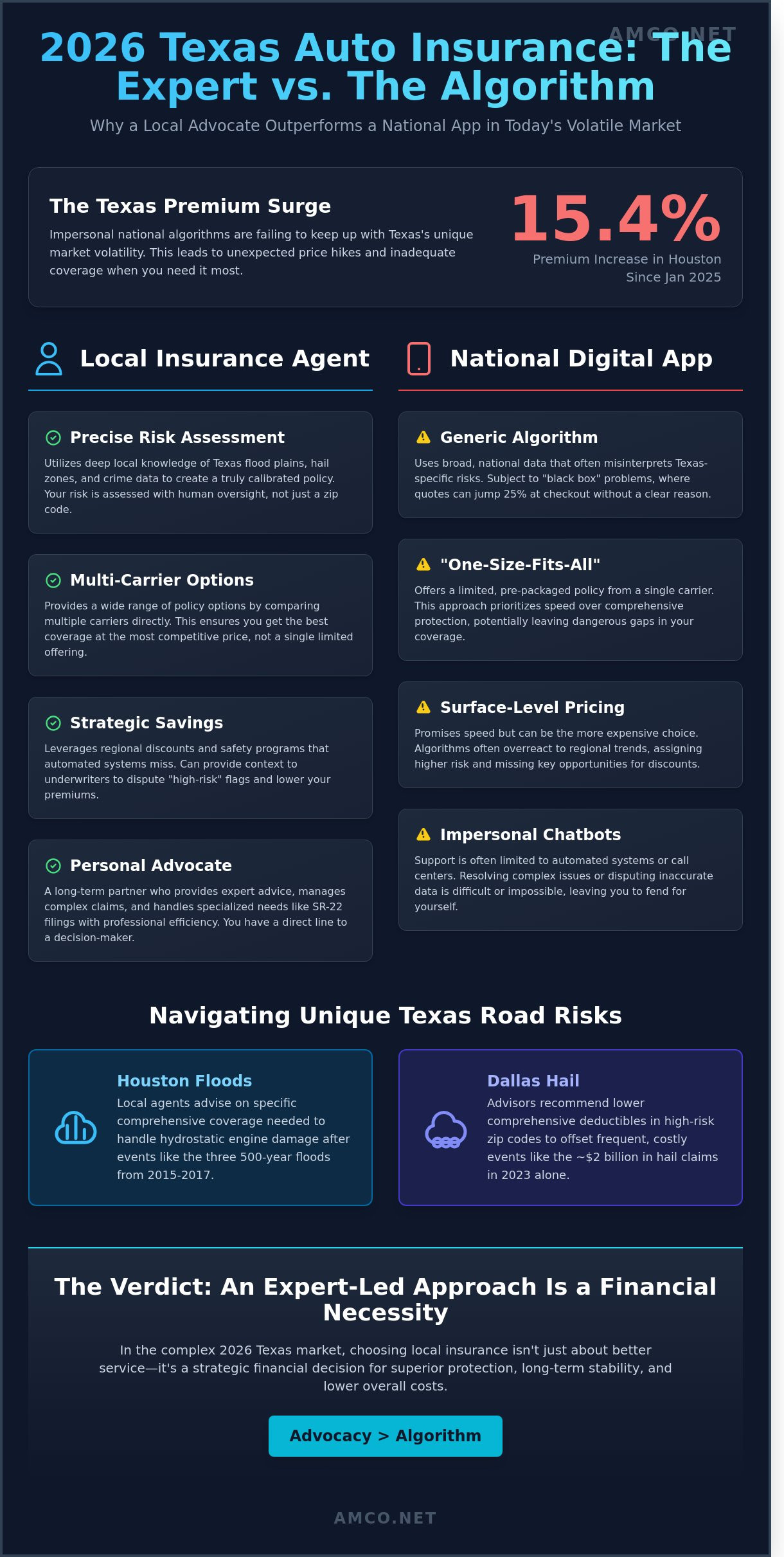
The fastest insurance app on your smartphone might be the most expensive financial decision you make in 2026. While digital platforms promise speed, they often overlook the specific volatility of the Texas market, where premium costs in urban centers like Houston have surged by 15.4% since January 2025. You've likely noticed that automated systems struggle with the nuances of regional risks. Choosing local auto insurance isn't just about finding a policy; it's a strategic move to secure professional advocacy that understands the specific impact of Gulf Coast weather patterns and state-mandated SR-22 filings.
We agree that managing rising costs requires precision and a calm, expert approach to risk management. This guide demonstrates how a local agency identifies gaps in national algorithms to provide superior protection and lower premiums through direct multi-carrier comparisons. You'll discover how to leverage expert advice on hurricane and hail damage risks to ensure your coverage remains robust during the 2026 storm season. We'll also preview how establishing a long-term partnership with a local advocate provides the stability and specialized support that a faceless online interface simply can't offer.
Local auto insurance represents a strategic shift away from the impersonal, algorithm-driven models that dominated the early 2020s. It's a personalized coverage framework managed by licensed professionals who live and work within your specific Texas community. While the 2022-2024 period saw a surge in "DIY" digital insurance apps, the market in 2026 has corrected itself. Drivers now prioritize expert-led brokerage models because the complexity of the Texas insurance market has outpaced the capabilities of simple mobile interfaces.
Texas drivers currently face a challenging environment. State-wide premiums increased by an average of 14.2% in 2025 alone, driven by rising repair costs and frequent severe weather events. In this climate, having a local advocate isn't just a convenience; it's a financial necessity. Understanding the foundational structure of Vehicle insurance in the United States provides a baseline, but local agents apply that knowledge to the specific legal and environmental realities of the Gulf Coast. The core benefit of local auto insurance lies in the synergy between modern data tools and boots-on-the-ground regional expertise.
A local agent operates as a risk consultant rather than a transactional clerk. They understand that a zip code like 77024 in Houston carries different risk profiles than 78209 in San Antonio. These professionals provide manual underwriting oversight, which is a critical safeguard. When an automated system flags a minor lapse in coverage from three years ago, a local agent can provide the context necessary to secure a standard rate. They look beyond the data points to find the most efficient path to long-term stability for your policy.
Generic risk models often misinterpret Texas-specific environmental factors. National algorithms frequently struggle with the "black box" problem, where a quote might jump by 25% during the final checkout phase without a clear explanation. This happens because automated systems overreact to regional trends without considering individual circumstances. Human intervention is vital for resolving "high-risk" flags. An agent can often dispute inaccurate data or provide documentation that satisfies an underwriter, something an app's chat bot cannot achieve. This level of technical support ensures that your premiums reflect your actual risk, not a broad statistical average.
Texas ranks among the most complex states for vehicle protection because of its vast geographic diversity. A policy that works for a driver in the Panhandle rarely provides adequate security for someone navigating the Houston Ship Channel or the I-35 corridor. Texas doesn't treat every driver the same because the terrain and risks change every few hundred miles. Expert agents who specialize in local auto insurance recognize that these regional nuances dictate the actual value of a policy, moving beyond simple price points to focus on functional resilience.
Houston's recent history with extreme precipitation makes comprehensive coverage a technical necessity rather than an optional add-on. Between 2015 and 2017, the region experienced three separate 500-year flood events, totaling billions in automotive losses. Local agents understand that "standard" coverage often fails to account for the specific hydrostatic engine damage common in coastal flooding. In North Texas, the challenge shifts to atmospheric volatility. The Dallas-Fort Worth area saw hail-related insurance claims reach approximately $2 billion in 2023 alone. When selecting local auto insurance, drivers benefit from advisors who know which zip codes require lower comprehensive deductibles to offset the high frequency of these localized weather patterns.
Texas law mandates specific minimum liability limits, known as the 30/60/25 rule. This requires $30,000 for injuries per person, $60,000 for total injuries per accident, and $25,000 for property damage. While these figures represent the legal floor, they often fall short of covering a multi-vehicle accident in high-traffic metros. This Texas auto insurance guide provides a foundational look at these requirements, but local agencies offer the specific analysis needed to determine if these limits protect your personal assets effectively.
Data from 2021 indicates that roughly 8.3% of Texas motorists drive without any insurance. In dense urban environments like Houston or San Antonio, the statistical probability of an encounter with an uninsured driver is significantly higher than the national average. Integrating a professional risk assessment into your insurance planning ensures that your UM/UIM limits are high enough to cover medical expenses and vehicle replacement without depleting your savings. This methodical approach to coverage turns a standard policy into a precise financial tool tailored for the Texas landscape.
Choosing between a direct carrier and a local agency involves more than just a monthly premium comparison. Many direct online carriers operate on a "one choice" model. They offer a single set of underwriting guidelines; if your risk profile changes, your only option is to pay their increased rate or leave. AMCO.NET LLC functions as an independent broker, providing access to over 20 A-rated insurance providers. This creates a competitive environment where carriers bid for your business, rather than you auditioning for theirs.
Independent brokers act as long-term risk management partners. They analyze your specific needs and shop the market to find the most efficient local auto insurance rates. This process isn't a one-time event. Professional agencies typically re-evaluate your policy every 12 months to ensure market shifts haven't made your current plan obsolete. This method prioritizes long-term cost optimization over short-term "teaser" rates that often spike after the first six months. Drivers who want a structured framework for evaluating providers can benefit from understanding how to choose the best auto insurance company in Houston and Texas based on claim-processing efficiency and local risk assessment rather than marketing budgets alone.
The true value of a policy appears during the claims process. When an accident occurs on the I-10 or the 610 Loop, a direct carrier places you in a standardized call center queue. You'll likely speak with a representative in a different time zone who lacks knowledge of Houston's specific legal and repair landscape. A local agent serves as your advocate, navigating the technical requirements outlined in the Texas auto insurance guide to ensure your rights are protected.
Local agencies maintain relationships with regional repair networks and adjusters. They understand that a "cheap" online quote often results from stripped-down coverage that leaves you vulnerable to litigation or out-of-pocket expenses. By conducting annual policy reviews, local experts adapt your coverage as your life or business assets grow. This proactive approach ensures that your local auto insurance remains a functional safety net rather than just a line item on a bank statement. You aren't just buying a policy; you're securing a consultant who manages your risk through every stage of the process.
Reducing insurance costs in a volatile market requires a methodical approach to risk assessment and policy structure. In 2023, Texas saw average auto insurance rate increases of 25.5 percent, according to data from S&P Global Market Intelligence. This trend makes it vital to look beyond the surface level quotes provided by automated algorithms. Effective cost optimization involves a precise evaluation of your driving habits, financial profile, and the specific geographic risks associated with the Houston metropolitan area.
Credit history remains one of the most significant variables in determining your rate within the state. Statistical analysis shows that Texas drivers with a credit score above 800 pay significantly less than those with scores in the 500 range. Improving your score by even 50 points can lead to a measurable reduction in your annual premium during your next renewal cycle. When you work with local auto insurance experts, they can identify the exact point where your credit tier triggers a lower rate category, ensuring you don't pay more than your financial reliability suggests.
Generic online platforms often miss localized affinity discounts that are specific to the Houston workforce. Professional groups including energy sector employees at companies like Shell or ExxonMobil, first responders, and educators often qualify for specialized rate reductions. Bundling remains a primary strategy for cost control; combining your auto policy with renters or commercial coverage can yield savings between 15 and 22 percent depending on the carrier.
As we approach 2026, usage-based insurance (UBI) is becoming the standard for Houston commuters looking to decouple their rates from regional averages. These telematics programs track hard braking and mileage on congested routes like I-45, potentially lowering costs for those who avoid peak-hour transit. It's a data-driven way to prove you're a lower risk than the general population in high-traffic zones.
For older vehicles, the decision to maintain "Full Coverage" should be reviewed annually. If a vehicle's market value has depreciated below $4,000, the cost of collision and comprehensive premiums might exceed the potential payout after a deductible is applied. Adjusting your deductible is another lever for stability. Increasing a deductible from $500 to $1,000 can offset statewide premium hikes by reducing your base rate by up to 30 percent. To find the most efficient balance for your specific vehicle fleet, consult with a professional agent who understands the Texas market dynamics. Choosing local auto insurance ensures that these technical adjustments are based on local repair costs and regional accident data rather than national averages.
Established in 1987, AMCO.NET has spent over 36 years refining a consultative approach to risk management. We don't view insurance as a simple commodity. Instead, we treat your coverage like a vital industrial solution designed to protect your assets and ensure operational continuity. Our team functions as professional consultants who analyze your specific needs to build a framework of security that lasts for years. We focus on the precision of your policy, ensuring that every limit and endorsement serves a functional purpose in your financial strategy. Our goal is to provide stability through technical expertise.
Maintaining a physical headquarters in Houston allows us to observe local market trends and regulatory changes in real time. This proximity is essential for providing accurate local auto insurance that reflects the actual driving conditions on Texas roads. We've developed specialized expertise in high-demand sectors that online-only platforms often struggle to handle correctly. Our core competencies include:
Our commitment to professional service ensures that every driver receives a technical review of their policy. This process identifies potential gaps before they become financial liabilities. For fleet operators and commercial drivers who need specialized coverage, our trucking insurance agency in Houston provides the local expertise necessary to navigate complex Texas filing requirements and maintain operational compliance.
We've integrated modern technology with traditional accountability to create a seamless user experience for our clients. Our mobile app allows for instant payments and digital ID card access. However, we never replace our human experts with automated chatbots. This hybrid model provides the efficiency of a digital platform with the technical depth of an experienced agent. You get the speed you want and the expertise you need.
When you need to discuss a complex claim or adjust your commercial limits, your agent is accessible via a direct line. Moving from a quick online estimate to a comprehensive consultation is a streamlined process. This ensures your local auto insurance is backed by hard data and verified by a specialist who knows your history. Success in insurance requires more than just a low price; it requires a reliable partner who stands behind every policy issued. Get your personalized Texas auto insurance quote from AMCO.NET today and experience the difference that over three decades of local expertise can make for your security.
Navigating the volatile Texas insurance market in 2026 requires more than a digital interface; it demands a partnership built on operational stability and technical precision. You've seen how localized risks, including Houston's recurring flood patterns and North Texas hail events, necessitate coverage that standard algorithms often overlook. By prioritizing local auto insurance, you gain access to expert risk mitigation strategies that protect both personal vehicles and complex commercial trucking fleets.
This principle of seeking specialized guidance extends beyond vehicle protection. As personal and financial needs evolve over time, particularly for those nearing retirement, securing the right healthcare coverage becomes just as critical. While options are state-specific, it's helpful to see what a comprehensive plan looks like. To review an example of the benefits involved, you can learn more and understand how a dedicated brokerage can ensure your health and financial future are protected.
AMCO has supported Texas drivers and businesses since 1987, providing a level of professional oversight that online apps can't replicate. We maintain rigorous partnerships with A-rated carriers to ensure every policy delivers long-term financial security and cost optimization. Our team applies the same detailed analysis to a single commuter as we do for a 50-unit commercial logistics operation. This methodical approach transforms insurance from a mandatory expense into a strategic asset for your financial continuity. For a comprehensive analysis of all available options in the state, review our detailed comparison of top car insurance providers in Houston and Texas for 2026 to ensure you're making the most informed decision for your specific needs. When searching for an insurance company near me with specialized Texas expertise, you'll find that local agencies provide the personalized risk assessment and multi-carrier access that generic national platforms simply cannot match.
Get a Fast & Professional Texas Auto Quote Now
We're ready to help you build a more resilient path forward on Texas roads.
Local auto insurance isn't inherently more expensive; it's often more cost-effective because independent agents access 20 different carriers simultaneously. While a national brand only sells its own product, a local agency identifies gaps that lead to a 15% reduction in annual premiums on average. This specialized approach ensures you aren't paying for redundant coverage layers that don't apply to Houston driving conditions.
Texas law for 2026 maintains the 30/60/25 liability limits for all registered drivers. This mandate requires you to carry at least $30,000 for injuries per person, $60,000 for total injuries per accident, and $25,000 for property damage. Since 1 in 5 Texas drivers remains uninsured, we recommend exceeding these minimums to protect your personal assets from litigation or total loss scenarios.
Local agents provide immediate SR-22 filings and often complete the electronic submission to the Texas DPS within 24 hours. This certificate isn't a separate policy but an endorsement added to your existing coverage to prove financial responsibility to the state. Most Houston agencies charge a one-time filing fee of $25 to $50, ensuring your driving privileges are restored without the delays common in automated online systems.
A local broker saves you money by performing annual market audits and applying regional discounts that online algorithms miss. Bundling your home and vehicle through a local office typically triggers a 20% discount on total premiums. They also identify specific professional credits for Houston-based industries, which reduces costs by an additional $100 to $300 annually compared to generic online quotes.
AMCO.NET provides comprehensive commercial truck insurance for owner-operators and fleets, including $1 million primary liability and cargo coverage. This professional service ensures business continuity for logistics providers operating in the Port of Houston area. We integrate commercial and personal policies to streamline your risk management, providing a single point of contact for all technical insurance specifications and claims.
You should request a comprehensive policy review to adjust your deductibles or search for new carrier incentives if your rates increase. Texas premiums rose by 10% on average last year due to rising repair costs and frequent weather events. A local expert evaluates your 500-point credit score impact and driving record to find a carrier that doesn't penalize your specific risk profile as heavily as your current provider. For a structured approach to evaluating your options, our guide on choosing the best auto insurance company in Houston and Texas for 2026 outlines the key metrics to compare when switching providers.
Local agencies in Houston maintain physical offices for face-to-face consultations, typically operating from 9 AM to 5 PM on weekdays. Visiting an office allows you to review complex technical documents and sign legal forms without relying on digital uploads. This personal interaction builds a long-term partnership, ensuring your insurance professional understands the specific geographical risks associated with your Houston neighborhood.
You can receive a detailed local auto insurance quote within 15 minutes during standard business hours. Unlike automated online forms that often require follow-up calls, a local agent provides a finalized 3-page quote document that accounts for all Texas-specific taxes and fees immediately. This rapid response time allows you to make informed decisions about your coverage without the wait times associated with national call centers.