

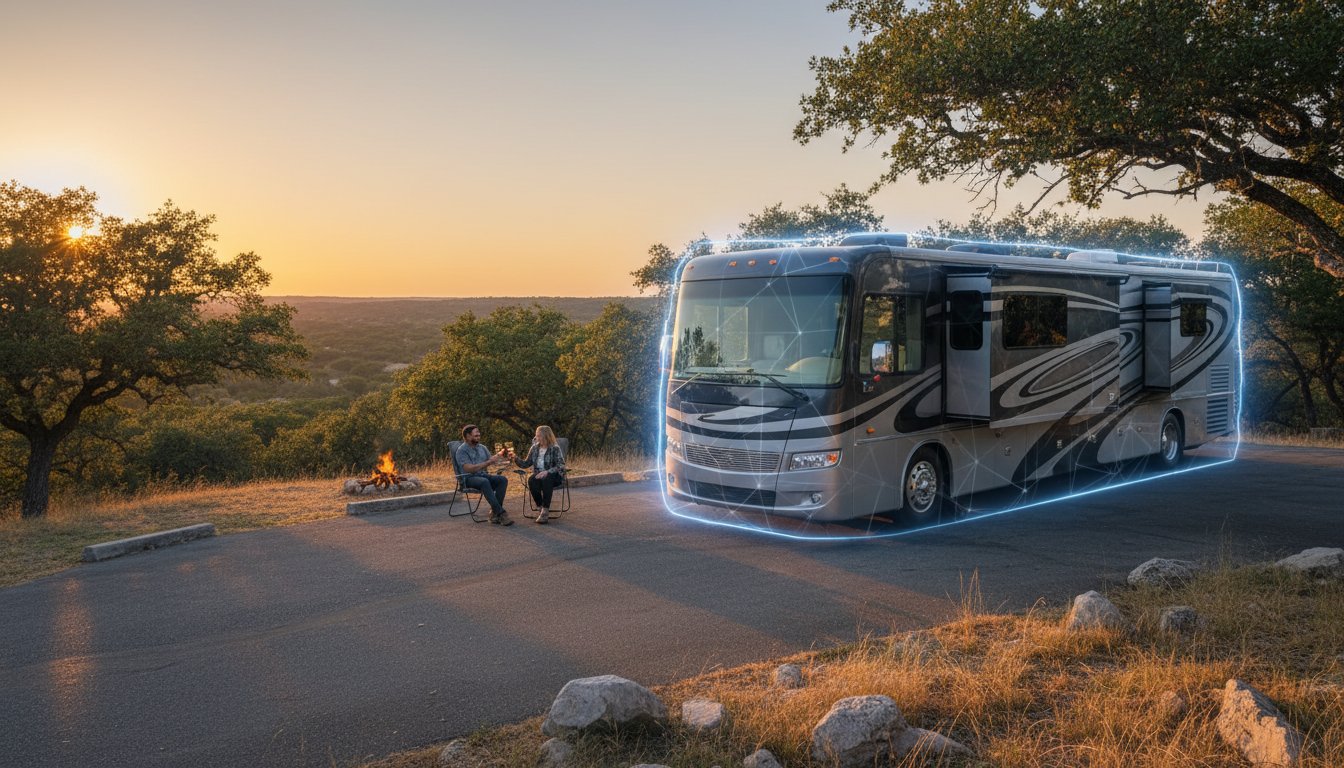
What if your current liability policy treats your $150,000 Class A motorhome exactly like a commuter sedan, leaving your entire living space uninsured during a sudden West Texas hail storm? Owners in Houston and Dallas recognize the necessity of RV Insurance, yet industry data from 2025 suggests that nearly 40% of policyholders remain underinsured for the physical contents inside their vehicles. It's frustrating to pay monthly premiums only to discover your personal belongings aren't covered when you're parked at a campsite.
You've likely felt the pressure of rising costs and the confusion of distinguishing between towable and motorized liability requirements. We're here to provide the technical clarity you need to secure your investment for the 2026 travel season. This guide explains how to achieve comprehensive protection for both your vehicle and your living quarters while staying compliant with Texas state laws. We'll examine local requirements for San Antonio owners, specific cost-saving strategies, and the essential steps to ensure peace of mind during your next long haul across the Lone Star State.
RV insurance functions as a specialized hybrid policy designed to manage the dual risks of transit and habitation. While a motorhome travels on Texas highways like a vehicle, it functions as a residence once parked. Relying on standard car insurance Houston drivers often carry leaves significant gaps in protection, as these policies typically exclude personal liability for guests, loss of specialized equipment, or total loss replacement. AMCO has provided technical coverage solutions since 1987, applying a methodical approach to risk that ensures Texas owners aren't just insured, but strategically protected.
To better understand this concept, watch this helpful video:
The "Road Home" concept is central to Texas law, which recognizes that an RV can serve as a primary or secondary dwelling. When Decoding Coverage Types, it's vital to distinguish between full-timer and part-timer status, as this dictates the scope of your personal liability. Without specialized RV Insurance, a slip-and-fall accident inside your parked rig in a Dallas park could result in personal litigation that standard auto policies won't defend.
Owners in Houston and Laredo face environmental degradation from high humidity and corrosive salt air, which can compromise seals and exterior finishes over time. In Dallas and Midland, the primary threat shifts to severe hailstorms. According to 2024 insurance industry data, Texas consistently ranks as the top state for hail-related claims. Comprehensive RV Insurance is a technical necessity for mitigating these localized climate risks, providing the capital recovery required for specialized repairs that standard body shops cannot perform.
The Texas Department of Insurance (TDI) mandates minimum liability limits of 30/60/25 for motorized RVs. These figures represent $30,000 for bodily injury per person, $60,000 per accident, and $25,000 for property damage. For non-motorized trailers, liability often extends from the tow vehicle, yet this does not cover the trailer's physical value. Under-insurance in high-traffic metros like San Antonio or Austin can lead to license suspension and vehicle impoundment. Professional coverage ensures your asset remains compliant with state statutes while protecting your long-term financial stability.
Motorized units and towable trailers require distinct insurance structures because they face different operational risks. Class A luxury coaches, Class B camper vans, and Class C motorhomes function as both high-value vehicles and mobile dwellings. This duality means a standard auto policy is insufficient for a $200,000 asset. AMCO brokers specialize in RV Insurance policies that address the mechanical complexities of the chassis alongside the residential risks of the coach. Many Texas owners also transport watercraft to the Gulf. If you are hauling a dual setup, reviewing our Boat Insurance guide ensures your entire leisure fleet remains secure during transit to Galveston.
Class A and C motorhomes involve complex engineering that requires two-fold protection. Chassis coverage handles the engine, drivetrain, and frame, while Coach coverage protects the living quarters, including built-in appliances and custom cabinetry. Texas highways, particularly the high-traffic corridors around Dallas and San Antonio, present significant risks. Data indicates that a high percentage of motorists carry only minimum liability. Including Uninsured/Underinsured Motorist protection is a technical necessity for asset preservation on these busy routes. Medical payments or Personal Injury Protection provide essential financial buffers for you and your passengers if a collision occurs. Understanding the Factors That Influence RV Insurance Rates, such as the vehicle's safety features and specialized braking systems, helps owners optimize their long-term costs.
Travel trailers and 5th wheels present a specific risk profile that owners often misunderstand. While liability typically extends from the tow vehicle to the trailer while it is hitched, this extension does not cover physical damage to the trailer itself. If a hailstorm in Bryan or a collision in Odessa damages the unit, the truck's policy will not pay for the trailer's repairs. RV Insurance for towables must include dedicated physical damage coverage to protect the shell and interior. Specialized policies also cover permanent attachments that are often excluded from basic plans, such as:
AMCO provides the technical expertise to ensure these high-value components are scheduled correctly in your policy. For a tailored review of your rig's specific requirements, consult with an AMCO advisor to secure your investment against the unpredictable Texas climate.
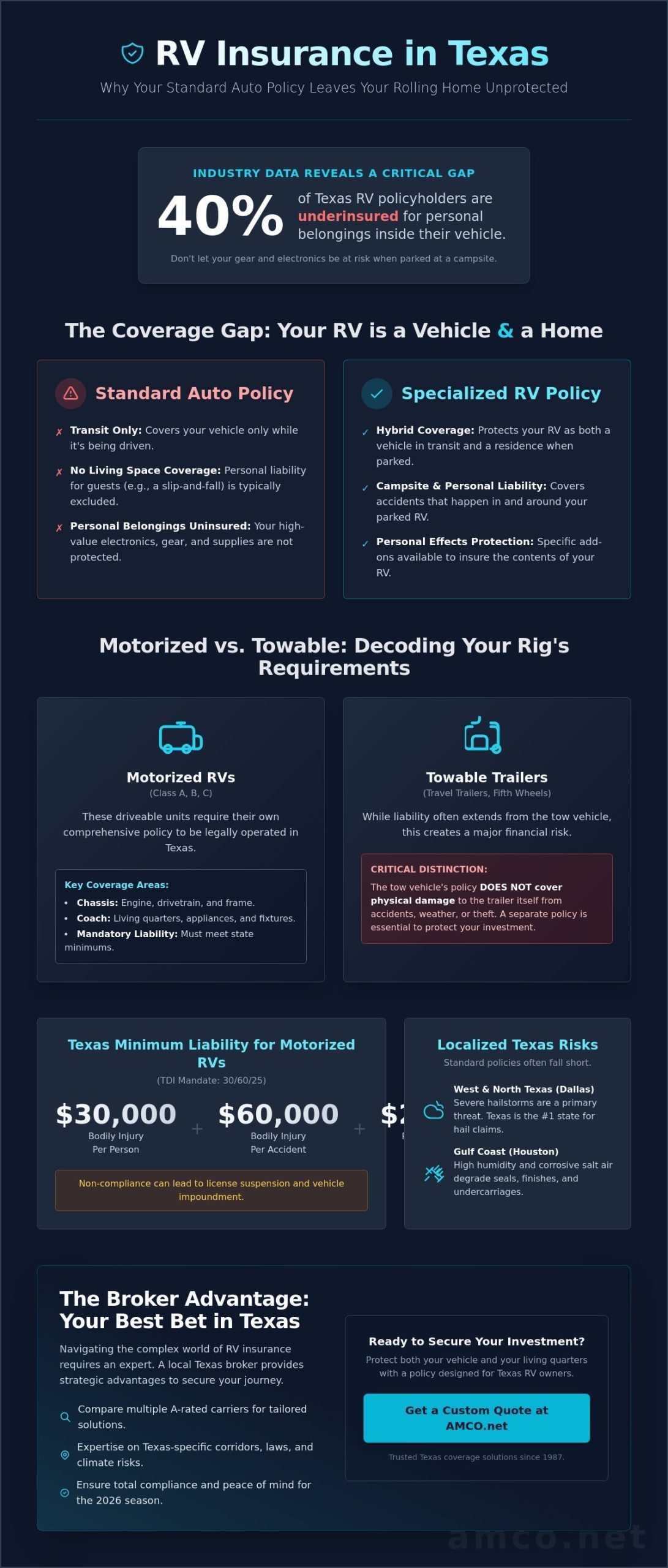
Texas law classifies motorized RVs as vehicles, which subjects them to specific financial responsibility requirements. According to the Texas Automobile Insurance Guide, owners must maintain minimum liability limits of 30/60/25. This translates to $30,000 for bodily injury per person, $60,000 per accident, and $25,000 for property damage. While these figures satisfy the legal minimums in Houston or Dallas, they often fall short of protecting the significant capital investment a modern motorhome represents.
Effective RV Insurance in 2026 requires a distinction between these "must-haves" and specialized "nice-to-haves" that ensure operational continuity during a trip. Professional travelers should prioritize the following specialized protections:
Depreciation is a significant financial risk for owners of high-end rigs. Actual Cash Value (ACV) policies only pay the depreciated market value at the time of a loss. In contrast, Full Replacement Cost coverage ensures that if your RV is totaled within its first five years, the insurer replaces it with a new, comparable model. Owners can also opt for Agreed Value coverage, where the payout amount is fixed at the start of the policy, providing a predictable safety net for custom or luxury builds.
The community of full-time RVers in Texas has grown by 12% since 2023, necessitating specialized insurance structures. For these individuals, the RV is not a recreational vehicle but a primary residence. Full-timer packages add personal liability coverage that mirrors Homeowners Insurance. These policies include loss assessment coverage and medical payments for guests, ensuring that your RV Insurance provides the same level of security as a traditional brick-and-mortar home. This is vital for those utilizing Texas as their legal domicile while traveling the country.
Calculating premiums for RV Insurance in Texas requires a technical analysis of several risk variables. Your specific zip code in Houston or San Antonio serves as a primary data point. High-traffic urban centers typically see higher rates because the statistical probability of a collision increases on congested routes like I-10 or the 1604 Loop. If you store your vehicle in a high-crime area or a region prone to flooding, insurers adjust the comprehensive portion of your premium to account for that localized risk.
Usage frequency plays an equally vital role in your cost structure. Carriers distinguish between "weekend warriors" and full-time travelers. A full-timer who lives in their rig more than six months out of the year requires a specialized policy. This coverage includes personal liability similar to a homeowners policy. If you only take your rig out for three weeks a year, your exposure is lower, which generally results in a reduced premium. Accuracy in reporting your annual mileage is essential for maintaining policy validity.
Your driving history impacts your rates even if you've never operated a large vehicle before. Texas insurers review your standard motor vehicle record to gauge your risk profile. A history of speeding tickets or at-fault accidents in a passenger car suggests a higher likelihood of future claims. Additionally, the physical characteristics of the vehicle dictate the base rate. A 2026 Class A motorhome equipped with advanced safety sensors, anti-lock brakes, and stability control may qualify for lower rates than an older model lacking these technological safeguards.
Many owners in Midland or Odessa park their rigs for several months during the winter. You can optimize your costs by using a "storage option" during these periods. This strategy involves suspending road-related coverages, such as collision and liability, while keeping comprehensive protection active. This ensures your investment stays protected against theft, fire, and hail damage while it's stationary. It's vital to reactivate full RV Insurance coverages before you begin a trip to the Hill Country; driving without liability protection is a violation of Texas law.
Reviewing these factors annually ensures your coverage remains cost-effective as your vehicle ages and your travel habits evolve.
Request a professional insurance assessment to identify every discount available for your specific Texas rig.
Selecting RV Insurance in Texas requires more than a standard search engine query. The 2026 market involves complex variables, from shifting weather patterns to updated liability requirements. AMCO operates as a specialized consultant rather than a traditional vendor. We leverage a network of A-rated carriers to identify policies that prioritize long-term stability over temporary price drops. This methodology ensures your coverage remains robust during the 300-mile stretch between Laredo and Dallas, where road conditions and risk profiles fluctuate significantly.
Efficiency shouldn't sacrifice precision. Our digital quoting engine provides immediate preliminary data, while our agents handle the technical nuances of complex claims. For policyholders traveling outside San Antonio or Austin, the AMCO mobile app facilitates real-time document access and claim filing. This integration of technology and human oversight minimizes downtime. It allows you to focus on the journey rather than administrative hurdles. Our agents don't just process paperwork; they analyze carrier performance to ensure your assets are protected by companies with proven track records in the Lone Star State.
Generic national quotes frequently overlook Texas-specific discounts or regional risk factors. For instance, an RV parked in a Houston suburb faces different environmental stressors, such as humidity and flood potential, than one stored in the Austin Hill Country. AMCO evaluates each carrier's claims-handling reputation and financial solvency based on recent Texas Department of Insurance performance metrics. Having a local advocate means you have a partner who understands the specific logistics of Texas repair shops and salvage values. We compare multiple quotes to find the intersection of cost-efficiency and comprehensive protection.
Transitioning to a 2026 RV Insurance plan involves a few methodical steps to ensure accuracy and maximize your savings. Our process is designed to be thorough yet streamlined for the busy owner. To receive a precise evaluation, please prepare the following information:
By providing these details, you enable our team to conduct a deep-dive search across our carrier network. This ensures no regional discounts or safety-feature credits are omitted from your final premium calculation. Contact AMCO today for a personalized RV insurance consultation.
Navigating the specific risks of the Texas landscape requires more than a standard policy. Owners in Houston and Dallas face unique environmental factors, while those in San Antonio must account for high-traffic corridors and specific regional liabilities. Choosing between motorized and towable coverage isn't just a legal requirement; it's a strategic decision to protect a significant asset. A specialized RV Insurance policy ensures that your rig remains protected against localized risks that generic plans often overlook. Precision in coverage selection prevents costly gaps during long-haul journeys.
Since 1987, we've provided Texas drivers with stable, expert-led insurance solutions tailored to the local market. Our team leverages partnerships with multiple top-rated national carriers to find the precise fit for your specific vehicle type and usage patterns. This long-term market presence allows us to offer a level of technical insight that simple online aggregators can't provide. We focus on the continuity of your travels by addressing Texas-specific risks before they become disruptions.
Get Your Free 2026 Texas RV Insurance Quote Now
Your next trip across the Lone Star State deserves the security of a well-structured plan. We're ready to help you finalize those details so you can focus on the road ahead.
Motorhome owners must carry liability insurance to legally operate on Texas roadways. The Texas Transportation Code Section 601.051 mandates minimum coverage limits of 30/60/25. This translates to $30,000 for bodily injury per person, $60,000 per accident, and $25,000 for property damage. While towable trailers don't require their own liability policy, the motorized vehicle towing them must meet these state requirements.
Your existing auto policy typically extends liability protection to a travel trailer while it's physically attached to your vehicle. It doesn't provide comprehensive or collision coverage for the trailer itself. If a 2024 hailstorm damages your unit's roof, a standard auto policy won't pay for the repairs. Specialized RV insurance is necessary to protect the physical structure and your internal assets from non-collision events.
Vacation liability provides premises protection similar to a homeowners policy while your RV is parked at a campsite. It covers legal and medical expenses if a guest suffers an injury within your designated lot. 90% of premium private campgrounds in Texas require proof of this coverage before check-in. It's a vital safeguard for owners who frequent high-traffic destinations like the Guadalupe River or Gulf Coast resorts.
Premiums in Houston are generally higher than in Midland due to increased flood risks and higher traffic density. Actuarial data shows that Gulf Coast regions face a 15% higher frequency of weather-related claims compared to West Texas. While we can't provide specific quotes, urban centers with higher theft rates always command higher premiums. Your specific zip code and proximity to the coast remain the primary drivers of your annual rate.
You can lower your costs by opting for a storage or lay-up provision during the months your vehicle isn't in use. This specialized RV insurance adjustment suspends road-related coverages like collision while keeping fire, theft, and vandalism protection active. It's an efficient way to manage expenses if you park your unit during the peak hurricane season. Most carriers require the unit to remain stationary for at least 30 consecutive days to qualify.
Full replacement cost coverage ensures you receive a brand new, comparable motorhome if your current one is totaled within its first five model years. It protects you from the 20% depreciation that typically occurs the moment a new unit leaves the dealership lot. If the total loss happens after the initial five-year period, the policy usually pays the original purchase price. This prevents the financial gap created by traditional actual cash value settlements.
You should initiate the claims process immediately through your provider's mobile app or 24/7 emergency hotline. National carriers maintain networks of adjusters across all 50 states to handle out-of-state incidents. Ensure you capture at least 12 clear photos of the damage and obtain a police report if the incident involves another driver. This structured documentation helps the claims adjuster process your file quickly, regardless of your current GPS coordinates.
Standard policies cover permanently attached accessories like solar arrays and built-in outdoor kitchens under the main dwelling limit. You must declare these additions to your agent to ensure they're included in the total insured value. If you've added a custom 400-watt solar system or a high-end lithium battery bank, keep your receipts. These documents are essential for verifying the replacement cost of technical equipment during a total loss claim.