

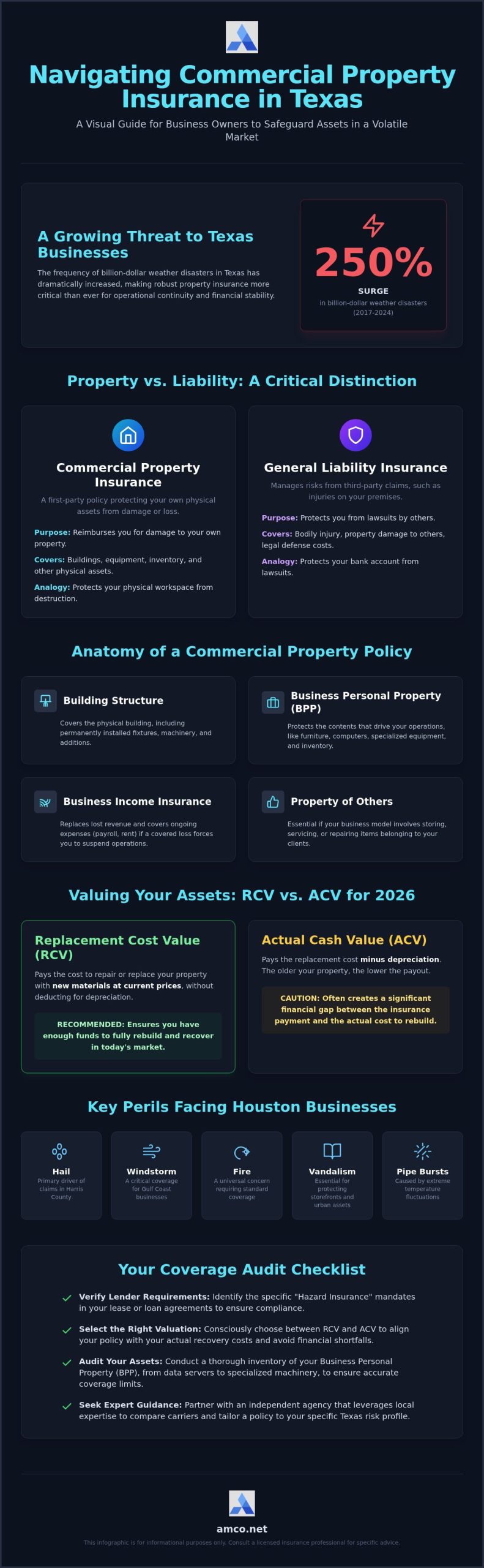
Did you know that billion-dollar weather disasters in Texas surged by 250% between 2017 and 2024? For Houston business owners, this isn't just a statistic; it's a persistent threat to operational continuity that continues to drive premiums upward. You've likely felt the pressure of rising costs and increasingly granular underwriting requirements, especially regarding roof conditions and storm readiness. Securing the right Commercial Property Insurance has become a complex technical challenge rather than a simple administrative task.
We understand that the distinction between general liability and property coverage often creates confusion, leaving gaps that only become visible after a loss. This guide provides the expert clarity you need to safeguard your physical assets and ensure long-term stability. We'll examine the 2026 regulatory landscape, including the transparency requirements of Texas House Bill 2067, and break down the critical differences between Replacement Cost and Actual Cash Value. You'll gain a methodical framework for evaluating your coverage, complete with an asset checklist and insights into choosing the right coverage to ensure your company’s resilience in a volatile market.
At its core, Commercial Property Insurance functions as a technical shield for the physical assets that facilitate your daily operations. This includes not only the building structure itself but also the "Business Personal Property" contained within, such as specialized machinery and inventory. In the Texas regulatory environment, you'll frequently encounter the term "hazard insurance" in commercial lease agreements or lending contracts. This isn't a different product; it's a specific designation lenders use to ensure the physical collateral for a loan remains protected against catastrophic loss. Property insurance provides the contractual certainty that your business can recover its operational capacity after a physical disruption.
To better understand how these policies function in a real-world setting, watch this helpful overview:
Distinguishing between these two pillars of protection is vital for maintaining a resilient balance sheet. General liability insurance is designed to manage the risks associated with third-party claims, such as a customer slipping on your premises. In contrast, property coverage is a first-party policy that reimburses you for damage to your own assets. Many Houston entrepreneurs mistakenly assume that a liability policy offers a safety net for their equipment. This gap in understanding can lead to total asset loss after a major event. Liability coverage protects your bank account from lawsuits, while property insurance protects your physical workspace from destruction.
While fire and theft are universal concerns, Houston's climate introduces unique variables that require expert navigation. Hail remains the primary driver of commercial claims in Harris County, leading to the strict roof underwriting standards we see in 2026. Standard policies often include "named perils" like lightning or explosions, but Gulf Coast businesses must verify that windstorm and hail aren't excluded or subject to unmanageable deductibles. Additionally, the increasing frequency of extreme temperature fluctuations in Texas can lead to pipe bursts or equipment failure. Ensuring your policy addresses these specific regional hazards is the difference between a functional recovery and a permanent closure. Protecting storefronts and urban assets also requires coverage for vandalism and civil commotion, which remain standard but essential components of a robust policy.
A standard policy for Commercial Property Insurance is comprehensive; however, its effectiveness depends entirely on the precision of your asset schedule. This coverage primarily protects the building structure itself, including permanently installed fixtures, additions, and even the machinery used to maintain the premises. While the building is the most visible asset, the U.S. Small Business Administration lists property protection as one of the most common types of business insurance because it secures the foundation of your operations.
Business Personal Property (BPP) encompasses the internal components that drive your daily output. This includes office furniture, electronics, and specialized equipment unique to your industry. For Houston's robust retail and industrial sectors, inventory and stock protection is paramount. If you sell finished goods or store raw materials, this coverage ensures your inventory remains a recoverable asset rather than a total loss after a covered event. You should also consider "Property of Others" coverage if your business model involves repairing, servicing, or storing items belonging to your clients.
Physical damage is often only the first phase of a financial crisis. When a covered loss forces you to suspend operations, Business Income Insurance steps in to replace lost revenue. This coverage is designed to handle ongoing obligations such as payroll, taxes, and rent while your facility is being repaired or rebuilt. Business Interruption coverage serves as a vital financial bridge that maintains your company's solvency while your primary facility undergoes restoration.
Standard property policies often stop at the building's threshold, which creates risks for mobile assets. Inland Marine coverage is necessary for protecting equipment that moves, such as high-end laptops, specialized tools, or cargo in transit. This is particularly relevant when coordinating your broader strategy with commercial trucking insurance Houston to ensure no gaps exist between your warehouse and the road. Finally, remember to audit your outdoor assets. Items like signage, perimeter fences, and even landscaping require specific endorsements to be fully protected against Houston’s unpredictable weather. Identifying these nuances is simpler when you partner with a local expert who understands the specific risks of the Gulf Coast.
Accurately valuing your business assets is a critical step in structuring a Commercial Property Insurance policy that actually performs during a crisis. In the current 2026 market, Houston business owners face a landscape where construction labor and material costs have risen significantly, making historical valuations obsolete. Choosing the wrong valuation method can lead to a liquidity crisis when you attempt to rebuild after a major storm or fire. You must decide between Replacement Cost Value (RCV) and Actual Cash Value (ACV), and the financial implications of this choice are profound.
Replacement Cost Value (RCV) is designed to pay the cost of replacing your damaged property with new materials of like kind and quality, without any deduction for depreciation. This is generally the preferred option for businesses that need to remain operational, as it covers the actual market prices for modern equipment and construction. Conversely, Actual Cash Value (ACV) pays out based on the depreciated value of the item at the time of loss. If your facility’s roof is ten years old, an ACV policy will only pay a fraction of the cost to install a new one, leaving you to cover the remainder out of pocket. Given that Texas construction costs remain high in 2026, an ACV payout often creates a massive financial gap that can stall a company's recovery indefinitely.
Setting your policy limits too low to save on monthly premiums is a high-risk strategy that often backfires due to coinsurance clauses. Most policies require you to insure your property for a specific percentage of its total value, typically 80% or 90%. If you fail to meet this requirement and suffer a partial loss, the carrier may apply a penalty that reduces your claim payout proportionally. Conducting an annual asset audit ensures your coverage limits reflect current market realities rather than outdated historical costs. This proactive approach prevents the technical "under-insurance" that disqualifies many businesses from receiving a full settlement.
In the Houston market, deductibles are rarely a one-size-fits-all figure. While fire or theft may carry a flat dollar deductible, risks like wind and hail often involve percentage-based deductibles. These are calculated as a percentage of the building's total insured value, which means a 2% deductible on a $1 million building results in a $20,000 out-of-pocket expense before the insurance company pays a cent. Balancing this out-of-pocket risk with monthly insurance affordability requires a nuanced understanding of your company's cash reserves. AMCO.NET LLC leverages its status as an independent agency to help Texas businesses find the "sweet spot" where premiums remain manageable without exposing the business to catastrophic deductible obligations.
The scope of Commercial Property Insurance extends far beyond the owners of commercial real estate. Every business entity that maintains physical assets, regardless of the industry, requires a structured approach to risk management. Retailers and storefront owners must prioritize the protection of high-turnover inventory and customer-facing fixtures that are essential for the brand experience. For office-based professional services, the focus shifts toward safeguarding critical data servers, professional libraries, and specialized IT infrastructure. Manufacturers and warehousing operations require even more robust protection for heavy machinery and high-value stock that represents a significant portion of their operating capital, where a single equipment failure could halt production for weeks.
In Houston's logistics-heavy economy, property coverage plays a vital role in supporting the supply chain. While fleet owners focus on commercial trucking insurance for their vehicles, they often overlook the terminals, loading docks, and maintenance bays that house their operations. A loss at the home base can be just as disruptive as a highway accident. These facilities often store high-value cargo and expensive diagnostic tools that require specific valuation. If you're managing a complex logistics operation, you should consult with an AMCO agent to align your property and logistics coverage into a cohesive system.
A common misconception among Houston tenants is that the landlord's policy provides comprehensive protection for their business. While the property owner insures the building shell, you're responsible for "Tenant Improvements and Betterments" (TIBs). These are the modifications you've made to the space, such as custom flooring, lighting, or built-in cabinetry that remain with the building. Standard Texas commercial leases also frequently hold the tenant liable for damage to the building caused by their operations, including accidental fires or plumbing overflows. Without your own property policy, your business personal property and your investment in the space are left entirely vulnerable under a landlord’s limited coverage.
Entrepreneurs operating from a residential address face a unique set of risks that standard homeowners policies simply don't address. Most residential policies in Texas specifically exclude losses related to business pursuits, meaning a fire that destroys your professional inventory or office equipment might not be covered. You may be able to add a "Business Pursuits" endorsement for smaller operations, but larger inventories or client-facing home offices often necessitate a stand-alone commercial policy. This ensures that your professional equipment is valued correctly and protected against the same perils as a traditional office. For a deeper understanding of residential limitations, refer to our Homeowners Insurance guide to see where your personal and professional coverages may conflict.
AMCO.NET LLC has provided technical insurance guidance to the Texas business community since 1987. Our deep roots in the Houston insurance market allow us to navigate the specific challenges of the Gulf Coast with precision. As an independent agency, we maintain a distinct advantage over single-brand carriers. We don't represent a single insurance company; instead, we represent your interests by comparing multiple high-rated carriers to find the most competitive rates and robust coverage terms for your Commercial Property Insurance.
In the 2026 economic landscape, businesses face rising premiums and stricter underwriting requirements. A personalized risk assessment is no longer optional for those seeking to protect their margins. We don't just sell policies; we build comprehensive protection strategies that align with your balance sheet. Our team analyzes your specific operational risks to ensure you aren't paying for redundant coverage while remaining protected against catastrophic loss. This methodical approach provides the stability necessary for long-term growth in a volatile market.
To secure a precise quote, you'll need to provide detailed documentation regarding your physical assets. This includes the building's age, construction type, and the presence of safety features like fire sprinklers and monitored alarms. Local expertise is vital here. We identify specific discounts available to Texas businesses that national call centers often overlook. Starting your journey with a local insurance agency ensures that your neighborhood's unique risk profile is factored into your premium calculations.
Modern risk management requires both efficiency and accessibility. The AMCO mobile app allows you to handle payments, view policy documents, and manage certificates of insurance instantly. However, technology doesn't replace human expertise during critical moments. If you suffer a loss, you'll have a dedicated agent to advocate for you throughout the claims process. We bridge the gap between digital convenience and professional consultation. Contact AMCO today for a comprehensive property risk review to ensure your 2026 strategy is built on a foundation of professional stability and expert oversight.
The complexity of the 2026 Texas insurance market requires more than just a standard policy; it demands a strategic asset protection plan. You now understand that choosing the right Commercial Property Insurance involves a precise calculation of replacement costs and a thorough audit of Business Personal Property. By distinguishing between RCV and ACV and accounting for the specific risks of the Gulf Coast, you've taken the first step toward ensuring operational continuity.
Relying on a partner with deep local roots is the most effective way to manage these variables. Since 1987, AMCO.NET LLC has served as a specialized consultant for Texas business owners, utilizing our A+ rated independent agency expertise to compare multiple carriers. We provide the technical oversight necessary to identify hidden discounts and eliminate coverage gaps that national providers often overlook. Storing your company's value in physical assets is a significant investment that deserves professional stability and expert advocacy.
Securing your physical infrastructure today ensures you're ready for whatever the Texas climate brings tomorrow. Take the next step toward a more resilient future. Protect your business assets with a custom quote from AMCO.NET LLC
The state of Texas does not legally mandate this coverage for business entities. However, it's almost universally required by commercial lenders and landlords to protect their financial interest in the physical collateral. If you lease a workspace or maintain a business loan, your contract will likely specify "hazard insurance" requirements that you must meet to remain in compliance with your agreement.
Standard policies in Texas specifically exclude damage caused by rising water or floods. Given that billion-dollar weather disasters in the state grew by 250% from 2017 to 2024, securing separate flood insurance is a critical operational necessity for Houston businesses. You must obtain a dedicated policy or endorsement to protect your assets from the heavy rainfall and storm surges common to the Gulf Coast.
A Business Owner’s Policy (BOP) is a bundled solution that combines general liability and property coverage into one contract, often at a lower cost than purchasing them separately. In 2026, the average cost for a BOP in Texas is approximately $73 per month. Stand-alone Commercial Property Insurance is typically reserved for larger enterprises or high-risk industries that require specialized limits exceeding the standard BOP thresholds.
Premiums are determined by your specific risk profile, building age, and asset value. For a small operation with $100,000 in property, the annual cost in 2026 typically ranges between $500 and $1,200. Mid-size businesses with $500,000 in property should expect to pay between $1,500 and $3,500 annually. These rates reflect the increased underwriting scrutiny insurers currently apply to Texas properties due to rising construction costs.
No, business vehicles are excluded from property policies and require dedicated commercial auto or trucking insurance. While your property policy protects the equipment stored inside your warehouse, it doesn't extend to assets on the road. It's vital to coordinate these different coverages to ensure that your inventory is protected both while it's stationary at your facility and while it's in transit between locations.
Yes, tenants can obtain coverage specifically for their Business Personal Property (BPP) and Tenant Improvements and Betterments (TIBs). Even if your landlord insures the building shell, their policy won't cover your machinery, office furniture, or the custom upgrades you've made to the space. Renters in a commercial setting need their own policy to safeguard their operational investment and meet the liability requirements of their lease.
Standard property policies generally only cover assets located at the specific address listed on the policy. To protect equipment that moves between job sites, you need an Inland Marine endorsement. This technical addition ensures that tools, laptops, and specialized machinery remain covered while in transit or at a client's location, which is essential for contractors and mobile service providers operating across Houston.
Start by documenting all damage with photos and video before making temporary repairs to prevent further loss. Contact your independent agent to initiate the process and clarify your wind and hail deductibles. Under the new Texas law (HB 2067) effective January 1, 2026, insurance companies must provide a written explanation for certain policy actions, providing you with more transparency during the claims and renewal process.