


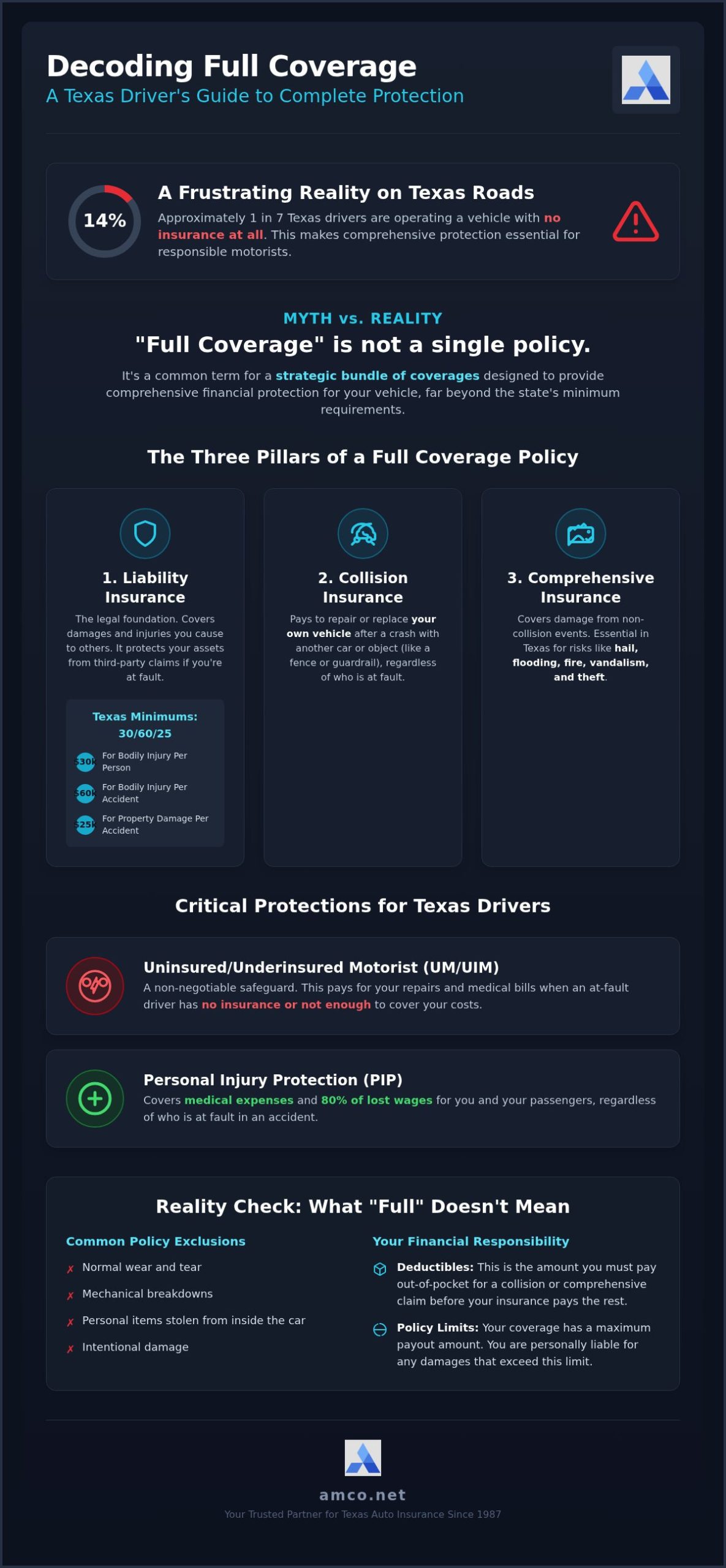
Did you know that approximately 14% of Texas drivers are operating vehicles without any insurance at all? It's a frustrating reality for responsible motorists in hubs like Houston or Dallas who already face some of the highest premiums in the state. You want to ensure your assets are protected from every angle, yet confusing industry jargon often makes it difficult to tell if you're actually covered or just overpaying for redundant options. This guide clarifies exactly what full coverage car insurance means within the Texas regulatory framework so you can build a policy that balances high-level protection with cost efficiency.
We'll break down the essential components of a robust policy, from state-mandated liability to the specific protections needed for Texas-sized risks like hailstorms and uninsured motorists. Since 1987, we've helped drivers understand that "full coverage" isn't a single product, but a strategic combination of collision, comprehensive, and liability limits. By the end of this guide, you'll have the technical knowledge required to secure a policy that satisfies both your lender requirements and your long-term financial security. We'll show you how to shop the market effectively to find that precise balance between premium costs and comprehensive safety.
In technical terms, "full coverage" doesn't exist as a singular policy type. It's a colloquialism used by drivers, lenders, and dealerships to describe a specific bundle of protections. While the Texas Department of Insurance doesn't recognize it as a formal product, the industry uses the term to differentiate between basic liability and a more comprehensive risk management strategy. This distinction is vital for understanding Vehicle insurance in the United States and how it applies to Texas roads.
When you finance or lease a vehicle in Houston or San Antonio, your lender will mandate full coverage car insurance. They aren't just following state law; they're protecting their financial interest in the asset. If the vehicle is totaled, they want to ensure the loan balance is covered. This requirement goes far beyond the Texas state minimum liability limits of 30/60/25, which only cover damages you cause to others.
To better understand this concept, watch this helpful video:
The term "full" can create a false sense of absolute immunity. Every full coverage car insurance policy has specific technical boundaries and conditions. Deductibles represent your portion of the risk; you must pay this amount before the insurer contributes to the repair. If you choose a $1,000 deductible, you're responsible for the first $1,000 of any claim. Additionally, standard policies often exclude wear and tear, mechanical breakdowns, or personal items left inside the car. Policy limits also play a crucial role. If you have a $25,000 limit for property damage but cause a $50,000 accident, you're still personally liable for the difference. Understanding these technical boundaries prevents financial surprises during the claims process.
While the core trio of liability, collision, and comprehensive forms the foundation, a robust full coverage car insurance strategy in Texas requires addressing local variables. Texas law dictates that insurers must offer Personal Injury Protection (PIP) and Uninsured/Underinsured Motorist (UM/UIM) coverage. You can reject these in writing, but doing so creates significant exposure. Approximately 14% of Texas drivers operate without any insurance, making UM/UIM a non-negotiable component for those seeking genuine security. This coverage steps in when an at-fault driver lacks the policy limits to pay for your repairs or medical bills.
Understanding the nuances of Texas auto insurance requirements is the first step in building a resilient policy. PIP is particularly valuable because it covers medical expenses and 80% of lost wages regardless of fault. While Medical Payments (MedPay) is a similar supplement, it only covers direct medical costs and lacks the wage replacement benefits of PIP. For drivers in rapidly expanding metros like Austin or Dallas, Gap insurance is another critical consideration. It covers the difference between your car's actual cash value and your remaining loan balance if the vehicle is totaled shortly after purchase.
Environmental factors in Texas demand specific attention within your comprehensive coverage. Houston drivers frequently face flash flooding, which can total a vehicle in minutes. Residents in San Antonio and Dallas must account for severe hail damage, which often results in costly bodywork repairs. A standard full coverage car insurance package includes comprehensive protection for these "acts of God," but you should ensure your deductible is manageable enough to use for multiple claims if necessary. Metropolitan areas like Conroe or Austin also see higher rates of vandalism and theft, making these protections essential for urban commuters.
Maintaining mobility and legal compliance is a priority for every driver. For those required to file SR-22 insurance Texas forms, we ensure your high-risk status doesn't prevent you from accessing quality coverage. Beyond compliance, rental car reimbursement is a functional necessity. If your truck is in a Midland body shop for two weeks after a collision, this add-on pays for a temporary vehicle so your daily operations remain uninterrupted. Our team of independent insurance experts can help you evaluate these specialized add-ons to ensure your policy matches your specific driving patterns in cities like Bryan and College Station.
Deciding between a state-minimum policy and full coverage car insurance requires a cold, analytical look at your vehicle's Actual Cash Value (ACV). Liability insurance only covers the other party's losses. If you're involved in a collision in Dallas or a flood in Houston, a liability-only policy leaves you entirely responsible for your own repairs or replacement costs. For many, the financial shock of totaling a $30,000 vehicle without insurance support is a risk too great to bear. Understanding What Is Full Coverage Car Insurance? helps clarify that this investment is essentially a hedge against the sudden loss of a major asset.
The peace of mind that comes with comprehensive risk mitigation is hard to quantify until a crisis occurs. While liability-only premiums are lower, they offer no protection against the environmental and human risks we've discussed in previous sections. A robust policy ensures that a single mistake or a sudden hailstorm doesn't result in a total loss of transportation, which is vital for maintaining professional and personal continuity in the Texas landscape.
Contractual obligations often dictate your insurance level before you even consider the math. If you finance or lease a vehicle, the lender legally requires you to carry both collision and comprehensive coverage. They want to ensure their collateral remains protected. Beyond legal mandates, high-value vehicles in Austin's tech corridor or luxury SUVs in San Antonio demand this protection because the replacement cost far exceeds what most individuals keep in liquid savings. Additionally, if your vehicle serves your Texas small business, maintaining full protection ensures that an accident doesn't halt your professional operations or drain your commercial capital.
As vehicles age, the cost-benefit ratio shifts. A common benchmark is the "10% Rule." If the annual cost of your collision and comprehensive premiums exceeds 10% of your car's ACV, it might be time to drop back to liability only. For example, paying a high premium for an older work truck worth only $4,000 may not be a sound fiscal strategy. However, even when scaling back, you shouldn't compromise on security. We recommend maintaining high liability limits and UM/UIM coverage on older Texas work trucks. You can also optimize your budget by increasing your deductibles. This strategy lowers your monthly premium while ensuring you're still protected against catastrophic losses that could impact your long-term financial stability.
Securing full coverage car insurance in 2026 requires a tactical approach to risk management rather than simply accepting the first quote you receive. One of the most effective methods for reducing your total expenditure is leveraging multi-policy bundles. By combining your vehicle protection with Homeowners Insurance through a single provider, you create a consolidated risk profile that insurers reward with significant premium reductions. This efficiency benefit often outweighs the savings found by sourcing policies from separate carriers.
Your specific ZIP code in Midland or Odessa remains a primary driver of your premium. While you can't change your location, you can optimize your financial strategy through strategic deductible selection. Increasing your deductible from $500 to $1,000 lowers your monthly premium, provided you maintain sufficient liquid assets to cover that higher upfront cost during a claim. Additionally, insurers in Texas use credit-based insurance scores to set rates. Maintaining a strong credit profile can significantly reduce your monthly obligations. We also recommend installing anti-theft devices to trigger additional security discounts that lower the cost of the comprehensive portion of your policy.
Direct carriers are limited by their own proprietary underwriting models, which means they can't always offer the most competitive rates as market conditions shift. Since 1987, AMCO.NET LLC has emphasized the "Independent Advantage." As brokers, we shop the market across multiple carriers to find the precise intersection of high protection and affordability. This process is far more efficient than a driver individually contacting ten different companies. Annual policy reviews are a critical part of this process. Texas inflation and shifting population patterns in hubs like Laredo or Conroe mean the policy that was competitive last year may no longer be the most efficient solution for your budget. We monitor these market shifts so your coverage always reflects current economic realities.
Specific demographics can access specialized savings that often go overlooked. Young drivers attending universities in Bryan or College Station can frequently qualify for "good student" discounts by maintaining a B average or higher. For high-mileage commuters in the Austin metro area, telematics or usage-based insurance programs offer a way to prove safe driving habits in exchange for lower rates. Many insurers also offer affinity group discounts for Texas educators, first responders, and various professional associations. These layers of discounts, when applied correctly, make a high-limit full coverage car insurance policy much more accessible. To ensure you're capturing every available incentive, request a comprehensive premium comparison from our expert team today.
Choosing the right partner for your full coverage car insurance is as critical as the policy components themselves. Unlike direct carriers that only offer their own proprietary products, AMCO.NET LLC operates as an independent agency. This means we aren't beholden to a single insurance company; instead, we work exclusively for you. Since our founding in 1987, we've navigated the complexities of the Texas market, helping drivers find the most efficient balance between comprehensive protection and affordable premiums. Our role is to act as your consultant, leveraging our deep industry relationships to identify the optimal solution for your specific risk profile.
Our professional distance from the insurance carriers allows us to maintain a purely objective perspective on your coverage. We analyze your technical needs, from high-limit liability to specialized environmental protections, and shop the market to find the carrier whose underwriting model best fits your unique situation. This independent advantage is especially valuable in a state as diverse as Texas, where a driver in Houston faces significantly different risks than one in Midland or Laredo. We ensure your policy isn't just a generic document but a calibrated system designed for the specific roads you travel.
Our commitment to stability is rooted in decades of operational history within the Lone Star State. Serving major hubs like Houston, San Antonio, Dallas, and Austin, we understand that every region presents unique challenges. As a local auto insurance expert, we provide a level of nuanced insight that national, direct-to-consumer platforms often lack. We don't just sell policies; we build long-term systems of protection for Texas families and professionals in Conroe, Odessa, and beyond. Whether you're a standard driver seeking high-limit security or someone requiring specialized SR-22 filings, our team delivers the technical expertise needed to maintain your legal compliance and financial safety. When a crisis occurs, our professional claims support ensures you aren't navigating the recovery process alone.
The process of securing full coverage car insurance shouldn't be a source of frustration or confusion. We've streamlined our comparison methodology to ensure you receive a comprehensive view of the market without the administrative burden of contacting multiple agencies yourself. Our approach combines modern digital management tools with the personalized support of a dedicated agent. This hybrid model allows you to manage your policy with ease while still having access to expert advice when complex questions arise. We invite you to experience the clarity and professionalism that has defined our agency for nearly forty years. Secure your full coverage quote with AMCO.NET LLC today.
Constructing a resilient full coverage car insurance strategy is a technical necessity for any driver who prioritizes their financial stability. By recognizing that "full coverage" is a customized combination of liability, collision, and comprehensive protections, you can effectively address regional risks like severe hailstorms and the high percentage of uninsured motorists on our roads. The Independent Advantage allows for a precise alignment between your premium budget and the actual cash value of your vehicle.
Our agency has served the Texas community since 1987, providing the expertise required to navigate complex cases and SR-22 filings with ease. We compare multiple A-rated carriers to find the most efficient solutions for drivers in Houston, San Antonio, and beyond. This professional distance from individual insurers ensures that our advice remains objective and focused on your long-term security. Get a Fast & Professional Full Coverage Quote from our advisors today. We're ready to help you maintain your mobility and protect your assets with confidence.
Texas state law only mandates minimum liability limits of 30/60/25 to operate a vehicle legally on public roads. While the state doesn't require full coverage car insurance, your financial institution almost certainly will if you have an active loan or lease agreement. Lenders view these additional protections as a necessary risk management tool to safeguard their collateral. If you own your vehicle outright, maintaining these higher limits is an optional but highly recommended strategy for asset protection.
Rental car reimbursement is not an inherent feature of a standard full coverage package; it's an optional endorsement you must add to your policy. If your vehicle is in a repair shop following a covered collision or comprehensive claim, this add-on pays for a temporary replacement vehicle. Without this specific rider, you'll be responsible for all out-of-pocket transportation costs while your car is being serviced in cities like Austin, Dallas, or San Antonio.
Comprehensive insurance is a specific component that covers non-collision events like fire, theft, or severe hail damage. In contrast, full coverage car insurance is a non-technical term used to describe a policy that combines liability, collision, and comprehensive protections into a single risk management strategy. You can purchase comprehensive coverage without having a full policy, but you cannot have a full policy without including comprehensive as one of its core foundational pillars.
Premiums fluctuate based on localized risk data, and Houston generally sees higher rates than Dallas due to its increased traffic density and frequent flash flooding events. While we don't provide fixed pricing because every driver's risk profile is unique, industry data consistently shows that major urban centers command higher premiums than rural areas. Factors such as your specific ZIP code, driving history, and chosen deductibles will ultimately determine your final costs in these major Texas metropolitan areas.
Yes, protection against flood damage is provided through the comprehensive portion of your policy. This is a critical safeguard for drivers in coastal regions or flood-prone areas like Houston and East Texas. Since Texas is an at-fault state, your liability coverage won't help with weather-related damages to your own vehicle. Comprehensive coverage ensures that if your car is submerged during a tropical storm or flash flood, the insurer pays for repairs or its actual cash value.
Transitioning to higher limits after an SR-22 filing typically results in a premium increase because you're adding collision and comprehensive protections to a high-risk profile. The SR-22 itself is a certificate of financial responsibility that follows serious violations, which already elevates your base rate. Adding more coverage layers increases the insurer's potential payout. An independent broker can help you find carriers that specialize in providing affordable rates for drivers with complex histories or high-risk designations.
No, auto insurance policies generally don't cover personal belongings like laptops, tools, or luggage stolen from inside your vehicle. Your comprehensive coverage only pays for the repair of the car itself or the replacement of the vehicle if the entire car is stolen. To protect your personal property, you should rely on your renters or homeowners insurance policy. We often recommend bundling these policies to ensure seamless protection for both your vehicle and its physical contents.
Securing full protection for a vehicle with a salvage title is challenging in the Texas market. Most insurers will only provide liability coverage for these vehicles because determining an accurate actual cash value for a previously totaled car is difficult. However, some specialized carriers may offer collision and comprehensive options if the vehicle has been rebuilt and passes a rigorous safety inspection. It's best to consult with an independent agent to explore these specific carrier requirements and technical limitations.