


Did you know that defending a single liability claim in Texas can cost over $50,000 before a case even goes to trial? For a business owner in Houston, this isn't just a statistic; it's a significant risk to your operational continuity that makes General Liability Insurance a critical component of your risk management strategy. You've likely felt the pressure of providing proof of insurance just to sign a new contract, or perhaps you're worried about how high-value jury awards could impact your bottom line. It's understandable to feel overwhelmed by the technical details of policy types and coverage limits.
This guide clarifies everything you need to know to protect your Texas business from third-party claims while securing the right coverage through local expert insights. We'll explore current 2026 market trends, explain the standard $1 million per occurrence limits required for most Houston commercial leases, and show you how to find a local partner to manage multiple quotes efficiently. By the end, you'll have a clear roadmap to maintain compliance and financial stability in an increasingly complex legal environment.
General Liability Insurance serves as the fundamental layer of protection for any commercial entity operating in the Texas market. It specifically addresses third-party claims involving bodily injury, property damage, and personal or advertising injuries that occur during your business operations. Industry experts frequently refer to this coverage as the "foundation" of a commercial insurance portfolio. Without this base, specialized policies like Commercial Property or Workers Compensation lack the necessary context to fully secure your balance sheet against common operational risks.
General Liability Insurance acts as a robust financial shield, protecting your business assets from the potentially catastrophic costs of litigation and settlements. It's vital to distinguish this from Professional Liability, often called Errors and Omissions (E&O). While General Liability covers physical accidents, such as a customer slipping in your Houston storefront, Professional Liability addresses financial losses resulting from your professional advice or service errors. Both are necessary, but they solve different problems.
Understanding where one policy ends and another begins is essential for eliminating coverage gaps. For Houston businesses managing fleets, it's a common misconception that General Liability covers vehicle-related incidents. It doesn't. You need Commercial Auto Insurance to handle accidents involving company trucks or vans. Similarly, the relationship between General Liability and Workers Compensation Insurance in Texas is distinct. General Liability covers third parties, like clients or vendors, while Workers Comp is designed to protect your employees. Even if you operate as an LLC or a corporation, these legal structures only provide a layer of personal asset protection; they don't stop a lawsuit from draining your company's bank accounts. A dedicated liability policy ensures the business itself remains solvent after a claim.
Texas state law is unique because it doesn't mandate General Liability Insurance for most private businesses. However, operating without it is rarely a viable option in the modern economy. Most commercial leases in Houston require a minimum of $1 million per occurrence in coverage before you can move into an office or warehouse. Additionally, if you work in construction or commercial trucking, you'll find that most prime contractors and government entities won't let you on a job site without proof of insurance. In a state where Harris County has one of the heaviest dockets for premises liability cases, the risk of going "bare" is a gamble that few established business owners are willing to take. The cost of a legal defense alone often exceeds the annual premium of a comprehensive policy.
General Liability Insurance isn't a monolith; it's a structured system built on five distinct pillars: bodily injury, property damage, personal injury, advertising injury, and products/completed operations. While many business owners focus on the potential payout to a third party, the legal defense provision is often the most valuable component of the entire policy. Legal defense coverage often proves more financially significant than the settlement itself because it funds the expertise required to dismiss meritless claims and manages the high costs of litigation in the Texas court system.
Understanding your policy limits is vital for maintaining fiscal stability. Most Houston firms operate with a split limit structure, typically $1 million per occurrence and $2 million aggregate. The occurrence limit is the maximum the insurer pays for a single incident. The aggregate limit represents the total available funds for all claims during the policy period. If these distinctions seem complex, it's beneficial to consult with a local agency to determine the right balance for your specific risk profile.
This pillar covers physical harm to non-employees on your premises. For instance, if a client trips over a loose cable in your Houston office, this coverage manages their medical expenses and legal claims. It also extends to property damage caused by your team while working off-site. If an HVAC technician accidentally causes water damage at a customer's facility, the policy addresses the repair costs. You should be aware that this does not cover your own tools or business property; those require separate commercial property coverage.
This protection shifts focus from physical damage to reputational and intellectual harm. It covers claims of libel, slander, or defamation arising from your business communications. In an era where digital marketing is ubiquitous, copyright infringement in your promotional materials can lead to expensive lawsuits. This coverage also handles invasion of privacy claims, providing a safeguard against errors in how you handle or reference third-party information.
For Houston-based contractors and manufacturers, this is a critical safeguard. It covers liability for damages that occur after a project is finished or a product has been sold. If a plumber finishes a job and a pipe bursts three weeks later, causing extensive damage, completed operations coverage steps in. Retailers also rely on this to manage injury claims related to the products they distribute. This is especially important for installers whose work involves long-term structural or utility connections.
Houston's economic engine is powered by a diverse mix of heavy industry, retail, and professional services. This variety requires a highly specific approach to risk management. In a city where large-scale commercial developments and energy infrastructure projects are constant, General Liability Insurance becomes the entry ticket for business participation. You'll find that in the Texas market, "proof of insurance" isn't merely a suggestion; it's a non-negotiable prerequisite for securing leases, vendor agreements, and government contracts.
Retailers and service providers in high-traffic areas like the Houston Heights or Sugar Land face a different set of challenges. These businesses deal with constant public interaction, which naturally increases the statistical probability of premises liability claims. In a city known for its heavy legal dockets, even a minor slip-and-fall incident can escalate into a multi-year legal battle. Having a robust policy in place ensures that your business can survive the defense costs associated with these claims, regardless of whether you're found at fault.
For electricians, plumbers, and HVAC specialists operating across Harris County, the need for coverage is driven by the contractual hierarchy of the construction industry. General contractors almost universally require subcontractors to carry their own GL policies to ensure that any property damage or bodily injury claims don't automatically default to the prime contractor's policy. The risks shift significantly between residential and commercial projects. While a residential plumber faces claims related to water damage in a single-family home, a commercial installer must account for the higher financial stakes of multi-story office buildings or industrial facilities.
The Port of Houston serves as a global logistics hub, creating a massive ecosystem of freight forwarders, warehouse operators, and logistics consultants. While many of these businesses focus on commercial trucking insurance Houston to protect their fleets and cargo, they often overlook the necessity of general liability for their physical locations. It's critical to distinguish GL from Motor Truck Cargo or Auto Liability. While those policies protect the vehicle and the goods in transit, General Liability Insurance handles accidents that occur on your warehouse floor or in your dispatch office. AMCO has supported this logistics hub since 1987, helping firms navigate the complex intersection of these different policy types to ensure no operational gaps exist.
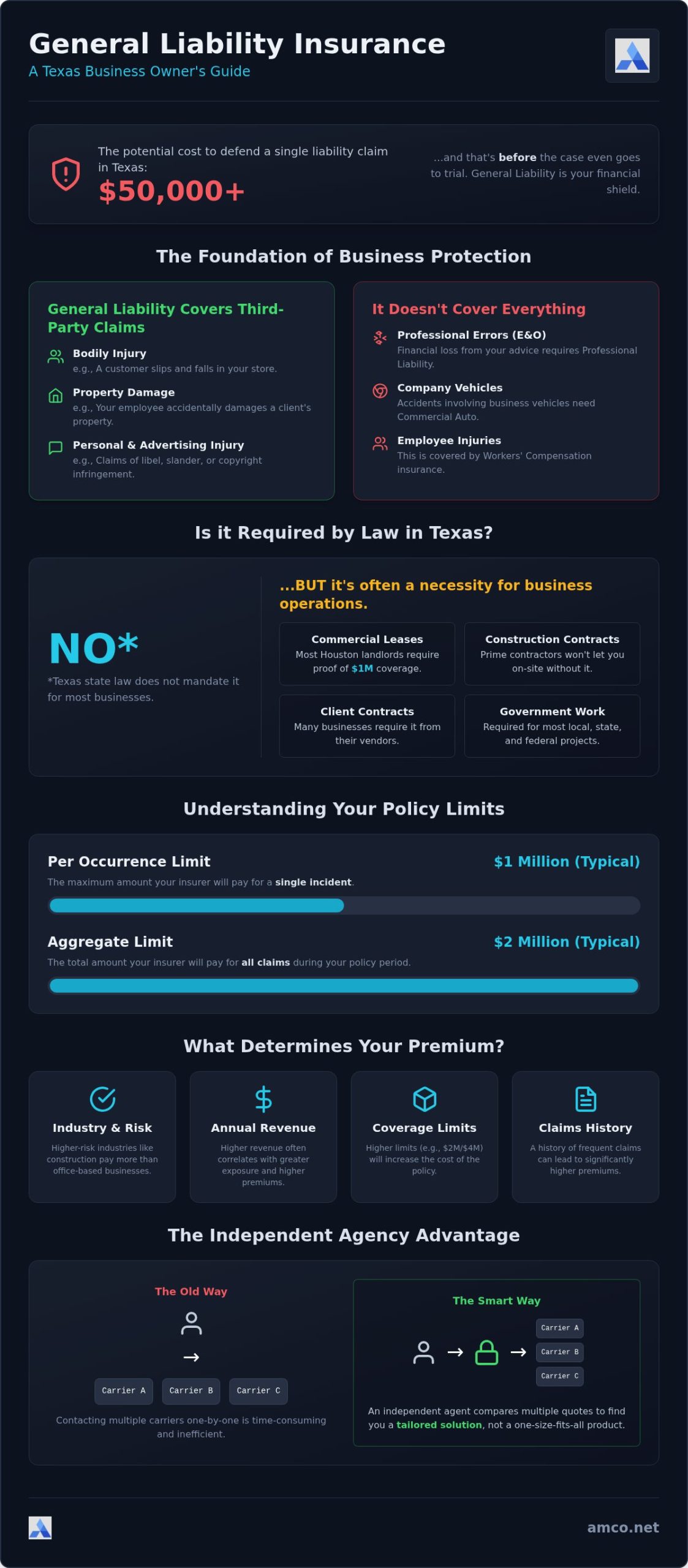
Premiums for General Liability Insurance are determined through a meticulous actuarial process that evaluates specific risk variables. Industry risk classification serves as the primary driver in this calculation. For instance, a roofing contractor in Houston will inherently pay more than a management consultant. This difference reflects the physical risks associated with height and heavy machinery versus the relatively low physical exposure of an office-based professional. Carriers use these classifications to predict the statistical likelihood of a claim occurring within your specific sector.
Business size and annual revenue also function as critical rating factors. As your company grows and your revenue increases, your "exposure units" expand. This reflects the higher volume of customer interactions, larger project scales, and the increased financial stakes involved in your daily operations. Carriers view higher revenue as an indicator of greater potential liability, which necessitates a corresponding adjustment in premium to maintain adequate reserves for potential settlements.
Your claims history acts as a long-term indicator of your risk management efficiency. A clean record over several years suggests a commitment to safety and operational excellence, which often results in more favorable rates. Conversely, even small but frequent claims can signal systemic issues, leading to higher costs. Geography also plays a significant role; businesses operating within the Houston metropolitan area often face different risk profiles than those in rural Texas. The higher density of population and the litigious nature of urban court dockets in Harris County contribute to these regional variations.
A Certificate of Insurance is arguably your most important operational document. It acts as the "passport" for your business, providing immediate proof that you carry valid General Liability Insurance. When bidding on new contracts or securing a lease, you'll need to request a COI through your agency. Most Houston commercial contracts require specific endorsements, such as naming the client as an "Additional Insured" or including a "Waiver of Subrogation." These technical additions ensure that your policy protects the interests of the project owner or landlord, fulfilling your contractual obligations and allowing work to proceed without delay.
Optimizing your insurance spend often involves strategic bundling. A Business Owners Policy (BOP) is a common solution that combines general liability with commercial property coverage, often at a lower total cost than purchasing them separately. While some owners attempt to bundle business needs with their Homeowners Insurance or personal auto policies, this approach often leads to dangerous coverage gaps because personal policies aren't designed for commercial risks. To ensure your protection is comprehensive, you should request a tailored quote from a specialist who understands the Texas market. A professional insurance Houston review can identify opportunities to consolidate your commercial trucking, workers comp, and liability policies into a single, cohesive risk management system.
Choosing the right partner for your General Liability Insurance involves more than just selecting a policy; it requires a strategic alliance with an advocate who understands the Texas regulatory environment. The primary distinction between a direct carrier and an independent agency like AMCO lies in representation. While a direct carrier is limited to its own proprietary products, an independent broker works on behalf of the business owner. Since 1987, AMCO has served as a bridge between Houston entrepreneurs and the broader insurance market, ensuring that coverage is tailored to operational realities rather than carrier quotas.
Our methodology involves "shopping" the market across a diverse panel of A-rated carriers. This process isn't merely about finding the lowest premium; it's about identifying the optimal balance of price, policy exclusions, and financial stability. By comparing multiple quotes, we can isolate the most competitive terms for your specific industry classification. When a claim arises in the litigious Houston market, having a local advocate provides a significant advantage. You won't be navigating a generic call center; you'll have a partner with a deep professional history who understands how to manage the technical details of the claims process to protect your business's interests.
AMCO provides a single point of entry to a wide array of insurance markets that are often inaccessible to the general public. This is particularly valuable for businesses operating in high-risk sectors like commercial trucking or heavy construction, which national direct carriers might avoid. Our expertise extends beyond Houston, providing specialized solutions for the unique economic climates of San Antonio, Austin, and Dallas. Whether you're managing a retail footprint in the Hill Country or a logistics hub in North Texas, we ensure your liability system is robust enough to meet local contract requirements. We focus on long-term stability and professional continuity, ensuring your coverage evolves as your business scales.
The transition toward a more secure insurance posture is straightforward. To obtain a precise business liability quote, you'll need to provide basic operational data, including your projected annual revenue, payroll figures, and a summary of your claims history. Our consultants analyze this information to build a risk profile that accurately reflects your operational needs. We then leverage our carrier relationships to secure the most favorable terms available in the 2026 market. Don't leave your company's future to chance in an unpredictable legal landscape. Protect your business today with a General Liability quote from AMCO.NET.
Maintaining a competitive edge in Houston's dynamic economy requires more than just operational excellence; it demands a proactive approach to risk management. General Liability Insurance serves as the essential foundation for satisfying commercial lease requirements and securing high-value contracts. By understanding your policy limits and the specific nuances of the Texas legal environment, you position your firm for sustainable growth while protecting your assets from the high costs of litigation.
Since 1987, AMCO has functioned as a trusted partner for Texas business owners, providing access to multiple top-rated insurance carriers through a single point of contact. Our local Houston-based experts understand your industry's unique challenges and can help you navigate the complexities of the 2026 insurance market. Instead of settling for a generic policy, leverage the expertise of a broker who shops the market to find the precise balance of protection and value your business deserves.
Get a Free General Liability Quote for Your Texas Business today and ensure your enterprise remains resilient against the unexpected. With the right coverage in place, you can focus on scaling your operations with confidence.
Yes, General Liability Insurance premiums are typically considered a tax deductible business expense by the IRS. Since these costs are necessary for the ordinary operation of your trade or profession, you can often deduct them on your annual tax return to reduce your taxable income. You should consult with a certified public accountant to confirm how these deductions apply to your specific entity structure and local Texas tax obligations.
General liability insurance does not cover your employees for work-related injuries or illnesses. This policy is designed to protect your business against claims from third parties, such as customers, vendors, or bystanders. To provide medical benefits and wage replacement for your staff in the event of an on-the-job accident, you must secure a separate Workers Compensation Insurance policy as part of your risk management system.
A deductible is the specific dollar amount your business is responsible for paying out of pocket before the insurance carrier begins to cover a claim. In a liability policy, deductibles can apply to property damage or bodily injury depending on the specific terms of your contract. Choosing a higher deductible often leads to lower monthly premiums, but it requires you to have sufficient cash reserves to manage these initial costs.
Yes, you can obtain a dedicated liability policy even if you operate from a home office in Houston. Most standard homeowners insurance policies specifically exclude business related liabilities, leaving you exposed if a client or delivery person is injured on your property. A separate policy ensures that your professional activities are protected without jeopardizing your personal residential coverage, maintaining a clear boundary between personal and business assets.
A typical Texas contractor generally requires a policy with limits of $1 million per occurrence and $2 million in aggregate. These limits have become the industry standard for most commercial contracts and municipal projects across the state. While some smaller artisans might consider lower limits, carrying less than the $1M/$2M standard often disqualifies you from bidding on larger projects or working as a subcontractor for major general contractors.
No, general liability does not provide coverage for professional mistakes, negligence, or bad advice. If your business provides specialized services, consulting, or technical advice, you need Professional Liability Insurance, also known as Errors and Omissions. While General Liability Insurance handles physical accidents and property damage, Professional Liability is required to protect against financial losses resulting from your technical errors or failure to deliver a promised service.
Operating without coverage means your business is directly responsible for all legal defense costs, settlements, and court awarded judgments. In the litigious Texas market, even a successful defense can cost tens of thousands of dollars in attorney fees. Without an insurance buffer, a single significant lawsuit can lead to the liquidation of business assets or the permanent closure of your company, as there is no carrier to absorb these shocks.
AMCO prioritizes operational speed, often providing a Certificate of Insurance within the same business day of your request. We understand that missing a COI can delay a contract or prevent your team from entering a job site. Our local Houston agents utilize efficient digital systems to process these documents quickly, ensuring you can meet your contractual obligations and maintain your project timelines without unnecessary administrative delays.