


Did you know that in 2023, Texas led the United States with 16 separate billion dollar weather disasters? For a business owner in Houston or Dallas, these figures aren't just data points; they represent the daily reality of rising premiums and the threat of operational interruptions. You're likely concerned about whether your current Commercial Property Insurance can actually withstand a major windstorm or fire without depleting your capital reserves. It's a valid worry when regional volatility makes standard policies feel insufficient and asset valuation becomes a moving target.
This guide provides a technical framework to help you secure localized coverage that prioritizes long term business continuity and cost efficiency. We'll clarify the technical gap between Replacement Cost and Actual Cash Value while detailing how to value your assets with precision. You'll also learn the strategic differences between a Business Owner’s Policy and standalone coverage to ensure your Texas enterprise remains resilient through 2026. By understanding these regional risks, you can transform insurance from a mandatory expense into a stable pillar of your industrial or commercial operation.
Commercial property insurance serves as the primary mechanism for protecting a company's physical infrastructure against unforeseen disruptions. In the Texas market, this coverage specifically addresses risks like fire, theft, and the high-velocity wind events that frequently impact the Gulf Coast. For a foundational perspective on how these policies structure their payouts, Understanding Property Insurance offers technical insights into replacement cost versus actual cash value. By 2026, the rapid expansion of metropolitan areas like Houston and Dallas has significantly altered the risk landscape. Business owners can't rely on valuations from three years ago because construction material costs and labor rates in Texas have increased by approximately 18% since 2023.
A standard policy separates the physical building from the equipment inside. Fixed assets include the roof, walls, and HVAC systems. Movable assets encompass everything from office laptops to heavy-duty forklifts. In Texas, outdoor signage and landscaping often require specific endorsements; these items are particularly vulnerable to the hail and high-wind cycles seen in North Texas and the Panhandle. Business Personal Property (BPP) for 2026 is defined as all movable tangible assets used in your trade, including inventory and furniture, which must be valued accurately to comply with modern tax and insurance reporting standards. Maintaining an updated Commercial Property Insurance policy ensures that both your permanent facility and your operational tools remain secure against regional volatility.
Understanding the technical nuances of your policy is essential for long-term operational stability. Commercial Property Insurance protects more than just the physical structure; it safeguards the core assets that keep your business functional. A standard policy typically includes the building itself and everything permanently attached to it. This extends to critical infrastructure like plumbing systems, HVAC units, and permanently installed fixtures. In cities like Houston, where extreme humidity puts constant strain on climate control systems, ensuring these units are covered is a matter of technological continuity.
Beyond the bricks and mortar, the policy protects Business Personal Property (BPP). This includes inventory and supplies, which is a vital consideration for Houston-based wholesalers managing high-volume stock. It also covers furniture, computers, and the specialized tools used by Texas contractors. A detailed analysis of Commercial Property Insurance Coverage reveals how these policies act as a financial safety net for both mobile and fixed assets. For instance, if a pipe bursts and damages a fleet of specialized diagnostic tools, the policy helps cover the replacement costs to minimize downtime.
Business Interruption insurance remains a critical component of any Texas policy. Given the history of power grid failures, such as the February 2021 winter storm that affected over 4.5 million homes and businesses, this coverage is indispensable. It helps replace lost income and pays for ongoing expenses like payroll while your operations are suspended due to a covered peril. Consulting with an expert to evaluate your specific equipment needs ensures no gaps remain in your recovery plan.
In Texas, your geographic location dictates specific coverage requirements. Coastal counties often require separate deductibles for wind and hail damage. This is a standard risk management practice to account for hurricane frequency. For North Texas business owners, hail events are a recurring threat. It is vital to ensure your policy covers full roof replacement rather than just actual cash value. The Texas Department of Insurance provides specific guidelines for property claims that owners should review to verify their coverage aligns with state-mandated protections.
If you lease a storefront in Houston, you've likely invested in customizations to suit your brand. These are known as tenant improvements and betterments. Since the landlord's policy only covers the shell of the building, you must insure the flooring, custom lighting, and partitions you installed yourself. Protecting these investments is a key part of your business strategy. While securing your physical assets, it is equally important to address operational risks through General Liability Insurance for a comprehensive approach to professional protection.
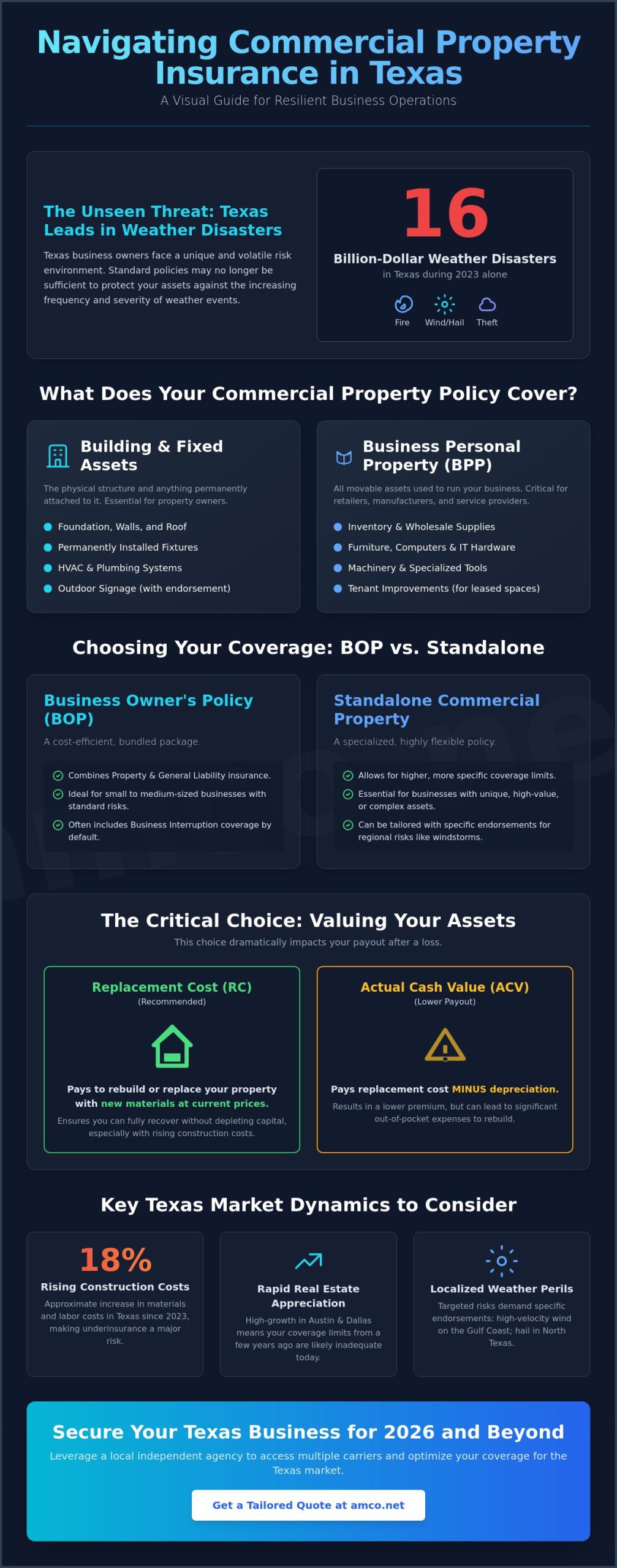
Selecting the right structure for your Commercial Property Insurance depends on your company's scale and risk profile. For many Houston based enterprises, the choice is between a bundled Business Owner’s Policy and a dedicated standalone policy. A BOP combines General Liability and Property insurance into a single contract. This integration simplifies administration; it ensures there are no coverage gaps between your liability for third party injuries and your physical asset protection.
The synergy between these two coverages is vital. While property insurance covers the building and its contents, general liability handles the legal costs if a visitor is injured on that same property. Bundling these into a single policy ensures that a single event, such as a fire that also causes injury to a client, is handled by one carrier under one claim process. This reduces the administrative burden on your management team.
Small businesses with predictable risks find the BOP most efficient. Generally, eligibility for these programs requires annual revenues under $5 million and office or retail space below 35,000 square feet. The primary advantage is cost. Bundling these coverages often results in a 10% to 15% lower premium compared to purchasing them separately. It provides a streamlined approach for local shops or professional services in the Houston metro area. To build a robust safety net, many owners also add Workers Compensation Insurance as a third pillar of their risk management strategy. This creates a comprehensive shield for both physical property and human capital.
High value assets in Dallas or Midland often exceed the rigid limits of a standard BOP. Large scale warehouses or manufacturing plants require higher limits and more granular endorsements. A standalone Commercial Property Insurance policy allows for precise adjustments for specialized machinery, electronic data processing equipment, or inventory with high fluctuations in value.
Industries like heavy manufacturing or trucking face unique exposures that a BOP cannot accommodate. For instance, a 100,000 square foot distribution center in Laredo needs dedicated limits for fire, theft, and business interruption that far exceed the "off the shelf" capabilities of a bundle. Contractors managing these high stakes projects may also require Surety Bonds to satisfy contractual obligations and provide financial guarantees to their clients. This level of customization ensures that complex technical operations remain resilient against localized disasters or equipment failures.
Accurate valuation is the foundation of a robust commercial property insurance policy. In 2026, Texas business owners face a volatile market where static figures quickly become obsolete. Austin real estate appreciated by 14% between 2024 and 2025, while industrial construction costs in Houston rose by 9.2% in the same period. Relying on national automated estimates often results in underinsurance because these models fail to account for local labor shortages or specific Texas building codes. Professional local appraisals provide the technical precision required to reflect true market conditions in the Permian Basin or the I-35 corridor.
Replacement Cost Value (RCV) pays for the total expense of rebuilding your facility with modern materials at 2026 market rates. It doesn't deduct for wear and tear, ensuring your business can return to full capacity without a capital shortfall. Conversely, Actual Cash Value (ACV) only covers the depreciated value of the asset. For a Houston-based manufacturing plant built in 2012, an ACV policy might leave the owner underfunded by 40% when trying to rebuild today. It's vital to recognize that most Texas carriers enforce an 80% co-insurance rule. If your coverage limit falls below 80% of the building's current value, the insurer applies a proportional penalty to your claim, even for partial losses. This penalty can devastate a company's recovery budget after a storm or fire.
Inventory fluctuations require a strategic approach, especially for distribution businesses in San Antonio or Laredo. These trade hubs often see inventory spikes of 35% during peak shipping seasons. Your policy should include a peak season endorsement to cover these surges without overpaying for high limits during slower months. For tech-heavy firms in Dallas or Austin, documentation is the primary defense against claim denials. High-value assets like specialized servers, robotics, or laboratory hardware must be inventoried with serial numbers and purchase dates. Store all digital records in a secure, off-site cloud environment. This ensures you can substantiate a claim even if the physical premises are inaccessible. This methodical approach to documentation protects your long-term ROI and ensures your commercial property insurance functions as intended during a crisis.
Ensure your business assets are fully protected with a tailored commercial property insurance solution designed for the unique Texas market.
Choosing the right partner for your risk management strategy requires more than just comparing premiums. It demands a consultant who understands the specific environmental and economic pressures facing Texas businesses. AMCO has operated as an independent agency in Houston since 1987, providing the stability and technical expertise necessary to protect physical assets through varying market cycles. We've navigated the complexities of the Texas economy for nearly four decades, from oil price fluctuations to the rapid expansion of the tech corridors. Unlike national carriers that rely on automated call centers, we prioritize direct professional consultation.
As an independent broker, AMCO doesn't represent a single insurance company; we represent the client. We evaluate policies from multiple top rated carriers to secure the most competitive Commercial Property Insurance rates available in the Texas market. This objective approach ensures that your coverage aligns with your actual risk profile rather than a generic corporate template. Our longevity in the region provides us with a unique perspective on how local infrastructure and weather patterns impact long term policy performance. It's this dedication to data driven results that separates our consultancy from high volume national agencies.
Modern business owners require efficiency and immediate access to their documentation. The AMCO mobile app allows you to manage your Houston business policies, access certificates, and review coverage details directly from your device. For those seeking a broader perspective on the regional market, our Comprehensive Guide to Insurance in Houston offers deep insights into industry trends and regulatory changes expected through 2026.
Securing an accurate quote for the 2026 fiscal year requires precise technical data. Underwriters increasingly focus on structural resilience and preventative systems to mitigate loss. To begin the process for your Bryan or College Station facility, you should have the following specifications ready:
Local knowledge of Houston neighborhoods is vital for accurate underwriting. A warehouse in the Port of Houston faces different logistical risks than a retail space in The Heights. Our agents analyze these micro-geographic factors to optimize your Commercial Property Insurance costs and ensure you aren't overpaying for unnecessary risk categories. Whether you operate in San Antonio, Dallas, or Austin, contact an AMCO agent today to initiate a professional review of your portfolio. We focus on cost optimization and technical accuracy to ensure your business remains resilient against unforeseen disruptions.
Navigating the complexities of the Texas market requires more than a standard policy. Since 1987, AMCO has provided technical expertise to help business owners distinguish between the efficiency of a Business Owner’s Policy and the robust protection of standalone coverage. Accurate property valuation in fast-growing hubs like Dallas and San Antonio ensures your physical assets remain protected against inflation and evolving construction costs. It's vital to recognize that generic coverage often fails when faced with the specific demands of the Lone Star State's diverse climate and economic landscape.
High-risk coastal properties in Houston face unique environmental challenges that demand localized knowledge. Securing the right Commercial Property Insurance isn't just a regulatory hurdle; it's a strategic move to maintain operational continuity and professional stability. Our agents across Austin and the Gulf Coast focus on long-term risk mitigation rather than quick fixes. We've spent nearly four decades refining our consultative approach to help you avoid the pitfalls of under-insurance. You've worked hard to build your enterprise, so don't leave its future to chance.
Protect your Texas business assets today with a personalized commercial property quote from AMCO.NET
We look forward to partnering with you to safeguard your professional achievements for years to come.
Texas state law doesn't mandate that private business owners carry commercial property insurance. However, 95% of commercial mortgage lenders and landlords require this coverage as a non-negotiable condition of your lease or loan agreement. It's a fundamental tool for risk management that ensures your operations can survive a total loss event.
Standard commercial property insurance policies in Houston typically exclude damage caused by rising water or floods. You must secure a separate policy through the National Flood Insurance Program (NFIP) or a private insurer to protect against these risks. Since 25% of Harris County land sits in high-risk flood zones, this specialized coverage is a critical component of a professional safety strategy.
Deductibles in Texas often vary based on the specific peril, with wind and hail usually carrying a percentage-based cost. While fire claims might have a flat $1,000 deductible, windstorm deductibles frequently range from 1% to 5% of the building's total insured value. For a facility valued at $1,000,000, a 2% deductible means you'll pay $20,000 out of pocket before the carrier contributes.
Homeowners policies in Dallas typically limit coverage for business-related property to just $2,500. This amount is rarely sufficient for professional-grade hardware, specialized tools, or significant inventory. To ensure your assets are protected at their full replacement value, you'll need a dedicated commercial property insurance policy or a specific home-business endorsement.
Business interruption coverage only activates if the power failure results from direct physical damage to your property by a covered peril. During the 2021 winter storm, many businesses without a Utility Service Interruption endorsement couldn't claim lost income because their buildings weren't physically damaged. Adding this specific endorsement ensures you're compensated for lost revenue when off-premises utility equipment fails.
You can manage fluctuating stock levels by adding a Peak Season Limit of Insurance endorsement to your policy. This allows your coverage to increase automatically by a set percentage, such as 25%, during your busiest months of the year. It's a cost-effective method to maintain precision in your coverage without paying for high limits during your slower periods.
Under-insuring your property in a fast-growing market like Austin triggers a coinsurance penalty during a claim. Most policies include an 80% coinsurance clause, meaning you must insure the building for at least 80% of its current replacement value. If you only insure for 60%, the insurance company will reduce your claim payout proportionally, leaving you to cover the significant financial gap.
Commercial property insurance doesn't cover the theft or damage of motorized vehicles used for your business. You'll need a separate commercial auto policy to protect vans, trucks, or cars owned by the company. While the property policy might cover the tools or equipment stored inside the vehicle, the vehicle itself is excluded from standard property forms.