


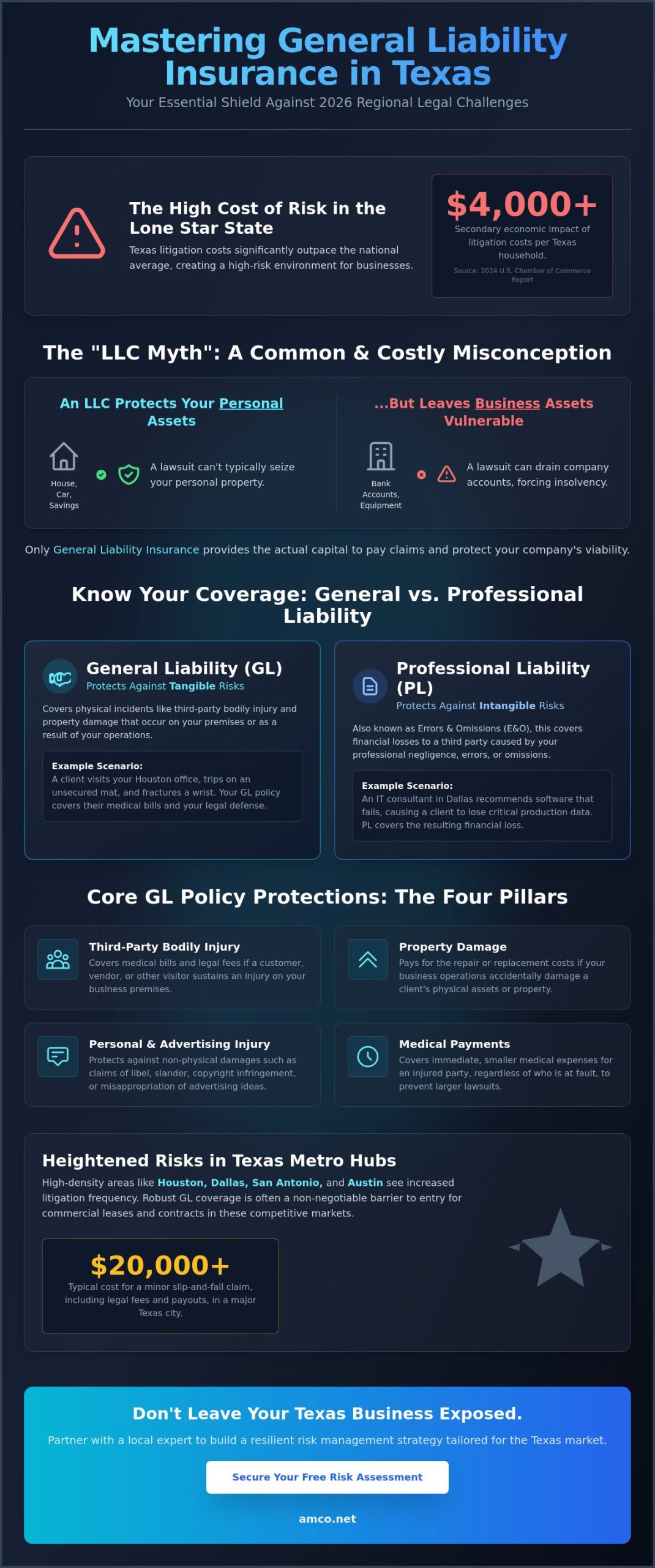
In a 2024 report by the U.S. Chamber of Commerce Institute for Legal Reform, Texas was identified as a state where litigation costs significantly outpace the national average, often exceeding $4,000 per household in secondary economic impact. You likely recognize that operating in high-density markets like Houston or San Antonio carries inherent risks that a standard safety protocol simply can't fully mitigate. It's a reality that General Liability Insurance serves as the foundational layer of protection for your physical and financial assets against unpredictable third-party claims.
This guide will help you master the essentials of your coverage to ensure your Texas-based business remains resilient against regional legal challenges through 2026. We'll clarify the technical distinctions between general and professional liability while providing a logical framework for selecting limits that match your current scale. You'll gain the specific knowledge needed to adjust your protection as your enterprise grows, ensuring that your long-term stability and professional reputation are never compromised by a single courtroom dispute.
General Liability Insurance serves as the primary defense mechanism for any commercial entity operating within the Lone Star State. This policy provides a critical safety net by covering third-party claims related to bodily injury, property damage, and advertising injuries. Whether you operate a manufacturing facility in El Paso or a retail boutique in Fort Worth, this coverage ensures that a single accident doesn't lead to total financial insolvency. It functions as the foundational layer of a professional risk management strategy, providing the liquidity needed to handle legal defense costs and settlement fees.
Many entrepreneurs fall for the "LLC Myth," believing that their legal business structure offers complete protection. While an LLC or Corporation separates personal assets from business liabilities, it doesn't stop a lawsuit from draining the company's bank account. If a visitor is injured on your premises, the business entity itself is still liable for damages. General Liability Insurance provides the actual capital to pay those claims, preserving the company's operating budget and long-term viability.
Operating in high-density areas like San Antonio and Austin introduces specific risks. These regions have seen a rise in litigation frequency; data from 2024 suggests that even minor slip-and-fall claims can cost a business upwards of $20,000 in legal fees and medical payouts. In these competitive markets, General Liability Insurance acts as a barrier of entry for securing commercial leases and partnership agreements. General Liability Insurance serves as an essential shield for business assets within the volatile Texas market. Without this protection, a firm faces the full weight of the state's legal system alone.
Relying on a single policy type often leaves dangerous gaps in your coverage. A balanced approach ensures that both the physical environment of your business and the professional output of your team remain protected against unforeseen claims.
General Liability Insurance serves as the foundational layer of risk management for Texas enterprises. In 2026, as industrial automation and high-traffic retail spaces expand across the state, the scope of these policies remains focused on four primary pillars. These pillars ensure that a single accident doesn't compromise the financial stability of your operations. A standard policy covers:
Texas retail and warehouse environments present unique risks. In a busy Dallas distribution center, a forklift accident involving a visiting contractor could result in six-figure medical claims. General Liability Insurance mitigates these specific Texas-sized risks. For businesses leasing space in Houston's industrial corridors, the 'damage to premises rented to you' provision is vital. It covers fire or smoke damage to your rented facility, which standard property insurance might exclude. Texas manufacturers also rely on products-completed operations coverage. This ensures that once a product leaves your facility, you're protected against claims arising from defects that cause injury or damage after the sale. Maintaining a secure workspace through optimized packaging and logistics solutions reduces the frequency of these physical risks.
Legal fees in Texas jurisdictions can quickly surpass the actual settlement amount of a claim. Defense costs for a standard liability case frequently exceed 50 percent of the total claim value due to expert witness fees and discovery processes. Your policy provides a lawyer and manages court costs, ensuring your cash flow remains steady during litigation. It's a critical distinction that GL defense costs are often provided 'outside' the policy limit. This means your lawyer's fees won't deplete the funds available to pay out an actual settlement or judgment, providing an extra layer of financial security for your firm.
Texas law doesn't strictly mandate General Liability Insurance for every private business, unlike the clear legal requirements for commercial auto coverage. However, the regulatory landscape managed by the Texas Department of Insurance (TDI) creates a environment where operating without it is functionally impossible for established firms. Most commercial lease agreements in cities like Austin or San Antonio require tenants to maintain a minimum of $1 million per occurrence in liability coverage. This isn't a mere suggestion; it's a contractual prerequisite for securing physical operational space.
The TDI sets the standards for policy forms and rate filings, ensuring that General Liability Insurance providers remain solvent and capable of paying claims. Beyond state oversight, the real pressure comes from the private sector. General contractors and project owners across the state utilize "Master Service Agreements" that demand proof of insurance before a subcontractor can even step onto a job site. If you're a business owner, you'll find that your ability to scale is directly tied to your capacity to produce a Certificate of Insurance (COI) on demand.
Texas construction firms face a dual-layered requirement system. While GL covers bodily injury and property damage, many public and private projects also require Surety Bonds to guarantee that the work meets specific contractual obligations. In the transportation sector, carriers often find that their General Liability Insurance must be carefully synchronized with Commercial Trucking Insurance to close coverage gaps during loading and unloading operations. For oil-field service providers in Midland and Odessa, specialized "MSAs" often include "knock-for-knock" indemnification clauses that require highly specific policy endorsements unique to the Permian Basin's high-risk environment.
Geography in Texas dictates your risk profile. In Houston and Laredo, high humidity and frequent heavy rainfall increase the likelihood of slip-and-fall claims or property damage related to water intrusion. The 2024 storm season demonstrated that businesses without robust liability protection struggle with "attractive nuisance" claims if their damaged sites aren't quickly secured. In contrast, Dallas and Fort Worth business owners deal with risks associated with extreme urban density, where third-party property damage is a more frequent occurrence due to tight construction spaces. Pairing your liability coverage with a comprehensive Commercial Property Insurance policy is a critical step for Texas businesses facing both weather-related asset losses and third-party liability exposure simultaneously.
Texas follows a "modified comparative fault" rule, specifically the 51% bar. This means if a claimant is found to be more than 50% responsible for their own injury, they can't recover any damages. A policy backed by local expertise understands these nuances of Texas tort law, providing a more precise defense if a case goes to litigation. Using a broker who understands the difference between a claim filed in Harris County versus one in Ector County is vital for long-term business stability. For a broader perspective on managing all your coverage needs in the region, the comprehensive guide to insurance in Houston, TX provides valuable 2026 industry insights on cost optimization and local regulatory compliance.
Most Texas small businesses start with a $1 million per occurrence and $2 million aggregate General Liability Insurance policy. While this serves as a baseline, it often falls short for firms involved in heavy machinery, logistics, or large-scale construction. By 2026, the average cost of commercial litigation and medical expenses has risen by 18% compared to 2022 data, making higher limits a strategic necessity rather than an optional upgrade. Large Texas firms frequently opt for $5 million or $10 million limits to satisfy the rigorous requirements of municipal contracts and enterprise-level partnerships.
For a growing Houston business, choosing a policy based solely on the lowest monthly premium is a high-stakes gamble. A single incident involving property damage or bodily injury at a client site can easily exceed $750,000 when legal defense fees are included. If your coverage caps out at $500,000, your company must cover the remaining balance from its operating capital. This financial strain often leads to insolvency for businesses that prioritized "cheap" premiums over adequate protection. Scaling your limits should happen in tandem with your revenue growth; as your contract values increase, your liability exposure follows the same trajectory.
Your specific Texas ZIP code significantly influences your risk profile and premium. For example, businesses operating in high-density areas like Dallas or Austin often face higher rates due to increased litigation frequency and higher property values. Payroll and sub-contractor costs also play a critical role; as your workforce expands, the statistical probability of an on-site accident increases. Higher deductibles can lower premiums but increase out-of-pocket risk during a claim. Insurance providers use these metrics to calculate the likelihood of a payout and set your rates accordingly.
The industry you operate in dictates your baseline risk. A San Antonio construction firm faces significantly higher liability threats than a consulting agency in Bryan. If your Texas business handles high-value contracts or works in hazardous environments, an Umbrella Policy is essential. This provides an extra layer of protection that kicks in once your primary General Liability Insurance limits are exhausted. For a personalized assessment of your specific needs, you can consult our Insurance Company Near Me guide to find local experts who understand the Texas regulatory landscape.
To ensure your operational continuity and financial stability, contact AMCO for a technical risk assessment and find a solution tailored to your industrial requirements.
National insurance providers often lack the regional nuance required to protect a business in the Lone Star State. Since 1987, AMCO has operated as an independent agency, prioritizing the specific needs of Houston, Dallas, and San Antonio business owners. Unlike faceless national carriers, an independent partner compares multiple A-rated carriers to find the most cost-effective General Liability Insurance policy for your unique operation. This approach ensures you aren't overpaying for coverage you don't need or leaving gaps that could lead to financial ruin. We focus on long-term stability and professional support, ensuring your coverage evolves as your business grows.
Local expertise translates to better risk management. Our agents understand that a contractor navigating Houston traffic or Austin's evolving tech corridors faces different logistical risks than a retail shop in a rural county. We've spent nearly four decades analyzing these trends to provide fast policy placement for our clients. Because we work with various carriers, we act as your advocate, not a salesperson for a single brand. This independence allows us to find the best value for your specific industry, whether you're in construction, professional services, or manufacturing. Our commitment extends beyond the initial quote; we provide ongoing support to help you manage certificates and claims efficiently.
Securing protection shouldn't be a bureaucratic hurdle. Our streamlined online quote process allows you to submit your information and receive a response quickly. Once your policy is active, you can manage your coverage through our mobile app, making it easy to provide proof of insurance to clients on the job site. Many entrepreneurs find value in a consultation to discuss bundling their General Liability Insurance with Homeowners Insurance. This holistic approach simplifies your risk management and often uncovers additional savings for business owners who work from a home office.
Before you begin the application process, gather these essential documents to ensure your quote is as accurate as possible:
Professional risk management is the foundation of a resilient business. By choosing a partner with deep roots in the Texas market, you gain access to specialized knowledge that national call centers simply can't provide. Contact AMCO.NET for a customized General Liability quote today and ensure your business is protected by experts who understand the Texas landscape.
Navigating the operational landscape of 2026 requires more than just professional competence; it demands a calculated approach to risk management. Protecting your assets starts with a robust General Liability Insurance policy that addresses the specific litigation trends and regulatory requirements inherent to the Texas market. By identifying your exact coverage limits and understanding the nuances of local liability, you ensure that unexpected claims don't disrupt your long-term production or growth. Stability in business isn't accidental. It's the result of precise planning and choosing partners who understand the local industrial environment.
AMCO has been serving Texas businesses since 1987, providing the technical expertise needed to optimize your insurance portfolio. With local offices in Houston, Dallas, and San Antonio, our independent experts offer fast, personalized quotes tailored to your specific operational needs. We focus on cost optimization and professional reliability so you can focus on your core business objectives. Don't leave your company's continuity to chance when expert guidance is readily available.
Secure Your Texas Business: Get a General Liability Quote Now
We're ready to help you build a more resilient future for your enterprise today.
Texas law doesn't mandate General Liability insurance for most private businesses as of 2024. However, state agencies often require a minimum of $1,000,000 in coverage for government contracts. While it's not a statutory requirement like auto insurance, most commercial landlords in cities like Austin or Dallas won't sign a lease without proof of coverage. It's a functional necessity for professional operations.
General liability policies don't cover employee injuries sustained during work activities. You'll need a separate Workers' Compensation policy to handle medical bills and lost wages for your staff in Texas. This policy focuses strictly on third-party bodily injury and property damage. If a delivery person trips in your warehouse, this policy applies; if your warehouse manager trips, it won't provide any financial support.
A Certificate of Insurance is a formal document summarizing your policy's limits, coverage types, and expiration dates. Texas clients request it to verify you have the financial backing to cover damages or accidents on their property. It shifts the risk away from the client and onto your insurance carrier. Most B2B contracts in 2026 require a $1,000,000 per occurrence limit to ensure project continuity and liability protection.
Small businesses in Houston typically pay a median premium of $45 per month according to 2023 industry benchmarks. Your specific rate depends on your industry risk class and annual revenue figures. A retail shop in the Galleria area might see lower rates than a heavy machinery operator. Total annual costs often range between $400 and $1,200 for standard $1,000,000/$2,000,000 limit policies. For a broader understanding of how rising premiums are affecting all coverage types across the region, reviewing the latest insurance Houston market trends for 2026 can help you benchmark your costs against current industry data.
This policy doesn't cover professional mistakes, technical errors, or bad advice given to your clients. You need Professional Liability insurance, also known as Errors and Omissions, for those specific risks. General liability handles physical accidents like a client slipping on a wet floor in your office. If an architect provides a faulty blueprint that causes a construction delay, only an E&O policy addresses the resulting financial losses.
You can obtain coverage even if your Texas business operates in a high-risk sector like roofing, demolition, or oilfield services. Surplus lines insurers specialize in these elevated risks that standard carriers often reject. Data from 2025 indicates that specialized brokers successfully place 92% of high-risk applicants. You'll likely face higher premiums and specific safety requirements, but coverage remains accessible through the non-admitted market.
General Liability insurance is a fully tax-deductible business expense for your Texas-based LLC under IRS Publication 535. You can deduct the premiums paid during the tax year as long as the coverage is for a trade or business purpose. This deduction reduces your overall taxable income, improving your company's long-term ROI. Always keep your digital receipts and policy declarations to support these claims during a tax audit.
Your business must pay all legal fees, settlements, and court costs out of pocket if you're sued without a policy. The average cost of a small business slip-and-fall claim reached $20,000 in 2023, excluding the cost of a legal defense team. Without insurance, a judge can order the seizure of business assets or garnish future earnings to satisfy a judgment. This financial strain leads to permanent closure for 40% of uninsured small firms.