

Could a single document be the primary barrier between your company and a multi-million dollar municipal contract? For many entrepreneurs, the process of obtaining surety bonds for small business Houston feels like an opaque regulatory hurdle that triggers anxiety about credit scores and complex legal jargon. It's common to feel frustrated by the distinction between traditional insurance and these three-party agreements, especially when a contract bid deadline is approaching rapidly.
This guide provides a professional roadmap to help you manage Houston's specific 2026 requirements, from new electronic filing mandates through the NMLS to updated notary regulations under Senate Bill 693. You'll learn how to secure the necessary bonds to protect your reputation and win larger projects with confidence. We examine current permit costs, the impact of federal infrastructure investment on local demand, and the specific financial benchmarks sureties use to evaluate your business stability in the current market.
A surety bond isn't insurance for your company; it's a financial guarantee for your clients. At its core, What is a surety bond? It functions as a legally binding contract where a third party guarantees that your business will perform its duties. For those seeking surety bonds for small business Houston, understanding this mechanism is the first step toward operational compliance. The City of Houston mandates these bonds to protect the public from financial loss caused by a business's failure to follow local codes or contractual obligations.
Whether you're bidding on a municipal project at Bush Intercontinental Airport or applying for a specialized trade license, these bonds ensure that the city's standards remain intact. If your business fails to meet the terms of a contract, the surety steps in to compensate the affected party. This setup creates a layer of accountability that traditional insurance doesn't provide, making it a staple of the local regulatory environment.
To better understand this concept, watch this helpful video:
The structure of a bond involves three distinct entities, each with a specific role. The Principal is your small business, the entity that purchases the bond and takes on the primary obligation. The Obligee is the party requiring the bond, which is often the City of Houston or a private project owner. Finally, the Surety is the professional entity, like AMCO.NET LLC, that provides the financial backing. This relationship ensures that risk is managed through a rigorous underwriting process before any work begins.
Securing surety bonds for small business Houston does more than satisfy a legal checkbox. It builds immediate credibility. When you can state that your business is "bonded and insured," you signal to Houston clients that you've passed a thorough financial vetting process. For high-value sectors like commercial trucking and heavy construction, bonds are often a non-negotiable prerequisite for even entering the bidding room.
A surety bond acts as a seal of approval from professional underwriters who have verified your business's financial health and operational capacity. This verification allows you to compete for larger, more lucrative contracts that remain out of reach for unvetted competitors. By positioning your company as a low-risk partner, you protect your reputation while expanding your market share across Harris County.
The landscape of surety bonds for small business Houston is diverse, with requirements varying significantly depending on your specific industry and the scale of your projects. These bonds aren't a one size fits all solution; they're specialized financial instruments designed to address specific risks. In Harris County, the most frequent categories include license and permit bonds, contract bonds, fidelity bonds, and court bonds. Each serves a distinct purpose in the local commercial ecosystem, ensuring that businesses operate within the bounds of the law and fulfill their professional promises.
Fidelity bonds protect your company from internal losses caused by employee dishonesty or theft. While not always mandated by the city, they're a vital component of a comprehensive risk management strategy for businesses handling sensitive client data or high value inventory. Court bonds, on the other hand, are often required by Texas probate courts to ensure that executors or guardians perform their legal duties faithfully. Identifying which category applies to your current operational phase is essential for maintaining compliance and avoiding project delays.
Most Houston entrepreneurs encounter bonding requirements when applying for professional licenses. For instance, independent car lots in the area must secure a $25,000 motor vehicle dealer bond to operate legally. Local bars and restaurants must often obtain alcoholic beverage bonds to ensure the proper payment of TABC taxes. Specialized trades, including HVAC, plumbing, and electrical contractors, face specific bonding mandates to guarantee their work adheres to the City of Houston's building codes. Even minor infrastructure work requires attention; a Right of Way Bond in Houston is typically set at $2,000 to cover potential damages to city property during construction. Consulting with an agency that understands these local nuances, such as AMCO.NET LLC, helps ensure you select the correct bond type for your specific permit application.
Construction firms bidding on public works projects in Texas must navigate strict statutory thresholds. A payment bond is required for any public contract exceeding $25,000, while a performance bond becomes mandatory for projects over $100,000. Bid bonds serve as a preliminary guarantee that you'll sign the contract and provide the necessary follow up bonds if you win the bid. Performance bonds guarantee that the project will be completed to the city's technical standards, while payment bonds ensure that your subcontractors and material suppliers receive their due compensation. To help entrepreneurs enter this competitive space, the SBA Surety Bond Guarantee Program provides essential backing for small businesses that might not yet have the extensive financial history required by traditional sureties. These bonds function as a critical growth tool, allowing smaller firms to compete for substantial municipal infrastructure projects across the Houston metro area.
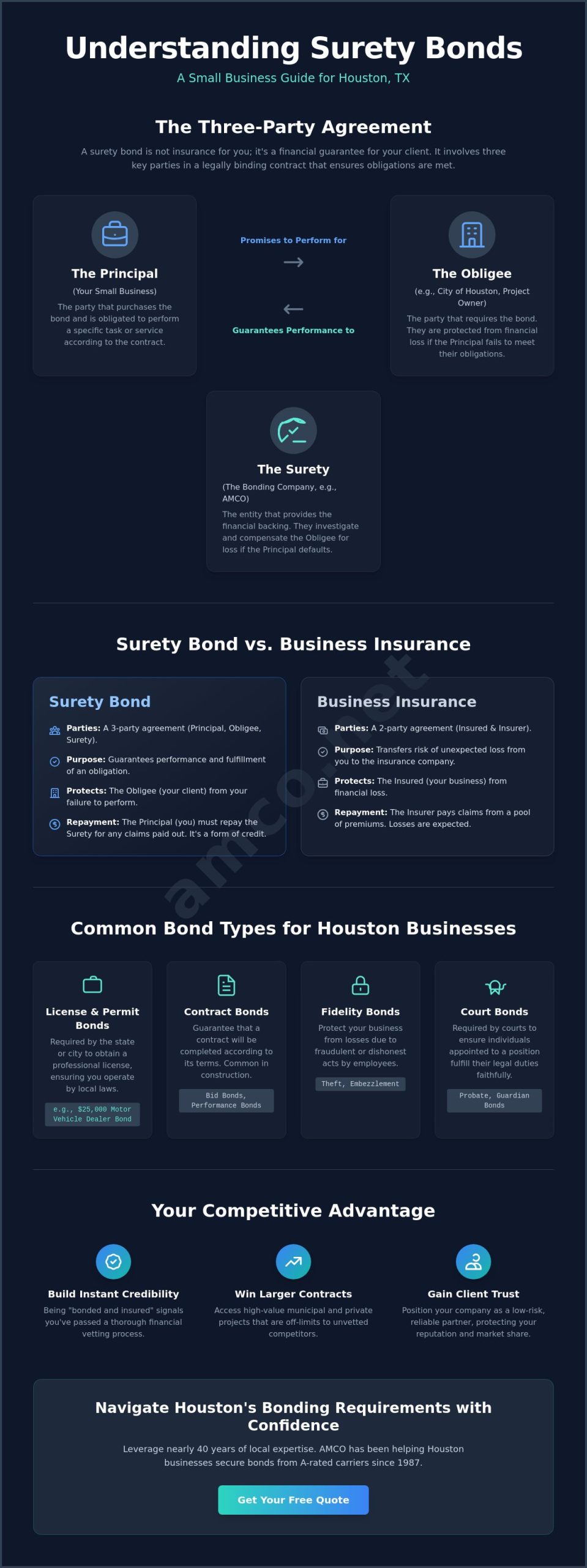
Distinguishing between insurance and bonding is a fundamental requirement for any professional operating in the Houston market. While both products offer financial protection, they serve entirely different masters. Traditional business insurance is a two-party agreement designed to protect the policyholder from unforeseen accidents or losses. In contrast, surety bonds for small business Houston act as a three-party guarantee that prioritizes the protection of the client or the government entity requiring the bond. This distinction is critical for resource allocation and risk management.
Insurance operates on the principle of risk transfer, where the insurer expects a certain volume of claims and uses premiums to cover them. Bonding is built on risk mitigation. Underwriters issue bonds only when they're reasonably certain that the business will fulfill its obligations without a claim. If you carry General Liability Insurance, the policy protects your company's balance sheet from third-party lawsuits. A surety bond protects the project owner's balance sheet from your potential default.
The payout structure reflects this difference in focus. When a liability claim is filed, the insurance company pays the victim to shield your business from the full financial impact. In a bond claim, the surety pays the obligee to rectify your failure, but the financial responsibility ultimately circles back to you. Most City of Houston contracts require both types of coverage because they address different risks. One handles the "what if" of accidents, while the other handles the "what if" of non-performance.
The duty to indemnify is the most significant operational difference for small business owners. Unlike insurance, where your financial obligation ends with the premium and deductible, a bond carries a personal and corporate guarantee. You remain legally responsible for every dollar the surety pays out on your behalf. This makes the selection of a bonding partner a long-term strategic decision rather than a simple transaction.
Underwriting for bonds feels more like applying for a bank loan than buying a policy. Premiums are typically calculated as a percentage of the total bond amount, often ranging from 1% to 10% based on your creditworthiness and financial history. For applicants with a credit score above 700, the rate often stays between 1% and 3% of the total bond value. The surety examines your liquid assets, work history, and debt-to-income ratio to determine your capacity to handle the project.
Indemnity is the legal obligation to reimburse the surety for any losses, costs, or expenses incurred due to a claim on the bond. This requirement is why a bond functions like a line of credit. It provides a financial backstop that allows you to secure contracts, but it doesn't absolve you of the underlying debt. Understanding this repayment structure ensures you manage your projects with the necessary financial discipline to avoid claims and protect your business's future bonding capacity.
Securing surety bonds for small business Houston requires a methodical approach to documentation and financial transparency. The qualification process is designed to prove to the surety that your company is a low-risk partner capable of fulfilling its contractual obligations. Unlike a simple purchase, this is a formal underwriting process that examines your business's health and your personal track record. Following a structured path ensures you meet City of Houston filing deadlines without unnecessary delays.
To begin your application with a local expert who understands these steps, you can request a surety bond quote from AMCO.NET LLC today.
Underwriters evaluate applications based on the 'Three Cs' of bonding: Character, Capacity, and Capital. Character refers to your history of meeting obligations and your professional reputation. Capacity measures your technical ability and equipment to complete the specific work. Capital examines your financial strength and liquidity. For surety bonds for small business Houston that exceed $50,000, underwriters often require more rigorous documentation, including CPA-prepared financial statements and detailed resumes of key personnel to verify industry experience.
Your personal credit score remains a primary factor in determining your eligibility. While earlier sections noted how scores above 700 influence premium rates, underwriters also use this data to gauge the likelihood of a claim. They look for a history of stable financial management in the Houston market and the absence of significant tax liens or legal judgments.
Startups and businesses with credit challenges still have viable paths to bonding. Utilizing the SBA Surety Bond Guarantee program is a strategic way to overcome credit hurdles, as it provides a government guarantee that encourages sureties to issue bonds to smaller firms. This program is particularly effective for those entering the construction or municipal service sectors. Providing additional collateral or a letter of credit can also bridge the gap for higher-risk applications. Working with an experienced agent allows you to present your business case effectively, highlighting your operational strengths to offset financial weaknesses.
Since 1987, AMCO has served as a reliable partner for the Houston commercial sector. Securing surety bonds for small business Houston involves more than a simple transaction; it requires a deep understanding of the city's specific regulatory environment. With nearly 40 years of local experience, we've managed the complexities of the Texas Department of Insurance (TDI) rules and the evolving needs of Harris County contractors. This longevity provides a level of stability that helps our clients build long term trust with their own customers. We don't just sell bonds. We provide integrated system solutions that protect your company's operational continuity.
Our agency maintains access to multiple A-rated surety carriers. This allows us to compare terms and identify competitive rates tailored to your business's financial health. Whether you're a startup or an established enterprise, having options ensures you aren't forced into unfavorable agreements. Our advisory approach focuses on your total risk profile, ensuring you have the capacity to bid on larger projects as you grow. We prioritize transparency in our underwriting process so you understand exactly what the surety requires.
Efficiency is a core component of our service. For many operators, bonding is one part of a broader protection strategy. We offer seamless integration with other vital services, such as commercial trucking insurance and general liability. This comprehensive view ensures your business remains compliant across all regulatory fronts without the need for multiple disparate providers. We focus on the technical details so you can focus on production.
Working with a local independent agency offers distinct operational benefits. We understand the specific nuances of surety bonds for small business Houston, including city permit bonds and Harris County trade requirements. This localized knowledge leads to faster turnarounds on bid bonds, which is vital when a contract deadline is approaching. You aren't a number in a national database; you're a partner in the Houston community. We serve as a one stop shop for all your business insurance needs, reducing your administrative workload and providing a single point of contact for your renewals and claims.
Securing the right financial guarantee shouldn't be a source of frustration. We've streamlined our application process to respect the time of busy business owners. Our experts provide personalized consultations to ensure you select the specific bond type required for your next contract. Don't let administrative hurdles slow your growth. You can secure your Houston surety bond with AMCO today and move forward with the professional backing your company deserves.
Navigating the regulatory landscape of surety bonds for small business Houston is a strategic move that transforms a legal requirement into a competitive asset. By mastering the distinction between insurance protection and bonding guarantees, you position your company to win larger municipal and private contracts. Success in the 2026 market depends on your ability to maintain financial transparency and adapt to evolving electronic filing standards; these proactive steps ensure your business remains a low-risk partner for any obligee in Harris County.
Don't let administrative uncertainty stall your next big bid. Get a Fast Surety Bond Quote for Your Houston Business and take the next step toward scaling your operations with confidence. Your business has the capacity to grow, and we're here to provide the stable financial backing to make it happen.
Bond premiums aren't fixed costs but percentages based on a thorough risk assessment of your business. For surety bonds for small business Houston, rates typically range from 1% to 10% of the total bond value. Applicants with a credit score of 700 or higher often qualify for the lower end of that spectrum, generally between 1% and 3% of the bond amount.
Bad credit doesn't automatically disqualify you from obtaining a bond in Texas, though it does influence the premium you'll pay. High risk applicants can often secure bonding by paying a higher percentage or utilizing the SBA Surety Bond Guarantee Program. This program provides government backing that encourages sureties to issue bonds to businesses with less established financial histories or lower credit scores.
A bid bond guarantees that you'll accept the contract if your bid is selected, while a performance bond guarantees the actual completion of the work. If you win a bid but refuse to sign the contract, the bid bond compensates the project owner for the cost difference of hiring the next bidder. The performance bond takes effect once the project begins, protecting the owner from financial loss if you fail to meet technical specifications.
The timeline for bonding depends on the complexity of the bond and the depth of underwriting required for your industry. Simple license or permit bonds often reach approval within 24 to 48 hours. Larger contract bonds for construction projects require a more thorough examination of your financial statements and work history, a process that can take several business days or even weeks to finalize.
If a claim is filed, the surety company conducts a thorough investigation to determine the validity of the complaint. If the claim is verified and the surety pays the obligee, your business is legally obligated to repay every dollar through the indemnity agreement. This process is distinct from insurance because the financial responsibility ultimately rests with you, making claim avoidance a critical part of your strategy.
The requirement for multiple bonds depends on the nature of your work and the specific surety bonds for small business Houston mandates. License and permit bonds are typically annual requirements that cover all your operations within a specific jurisdiction like Harris County. Construction contract bonds are project specific, meaning you'll need separate bid, performance, and payment bonds for each individual project you undertake.
Filing locations vary based on the obligee that required the bond in the first place. For City of Houston permit bonds, you'll typically file with the specific department overseeing your trade, such as Houston Public Works. As of January 1, 2026, many Texas state bonds, including those for mortgage loan servicers, must be filed electronically through the Nationwide Multistate Licensing System (NMLS).