


If a serious workplace injury occurred tomorrow, would your business assets survive a multi-million dollar lawsuit? Texas remains the only state where Workers Compensation Insurance is optional, but this unique freedom creates a complex landscape of liability that many employers find overwhelming. It's natural to feel concerned about rising premiums while simultaneously fearing the legal consequences of opting out of the state system.
We understand that balancing your bottom line with comprehensive protection is a significant operational challenge. This guide is designed to help you master the nuances of Texas regulations for 2026, helping you understand your specific liability risks and identify the most cost-effective coverage for your workforce. We'll preview the latest state benefit rates, analyze the dangers of non-subscriber status, and provide actionable strategies to lower your premiums through improved workplace safety. By the end of this article, you'll have a clear roadmap for legal compliance and long-term asset protection.
At its core, Workers Compensation Insurance is a specialized policy designed to provide medical care and partial wage replacement to employees who suffer job-related injuries or illnesses. While most states mandate this coverage for nearly all businesses, Texas operates with a distinct model. Within the broader U.S. workers' compensation system, the Lone Star State is famous for its "non-subscriber" option. This allows private employers to opt out of the state-regulated insurance pool, though doing so introduces significant legal vulnerabilities that we will analyze later in this guide.
The regulatory landscape for 2026 is defined by a 3.8% average decrease in advisory loss costs, reflecting a continuing trend toward lower base rates for many Texas industries. This year, the Texas Department of Insurance (TDI) has also shifted its focus toward digital integration. New regulations prioritize electronic reporting and streamlined data exchange between carriers and the state. This shift aims to accelerate claim processing times, ensuring injured workers receive care faster while reducing the administrative burden on business owners. It's a dual benefit; it stabilizes the worker's recovery timeline and protects the employer's operational continuity by resolving claims with greater precision.
For the vast majority of private businesses, the answer is no. However, this freedom isn't universal. Public employers, such as state agencies and municipalities, must provide coverage. Additionally, certain government contracts or construction projects for public entities often mandate that all participating contractors carry a policy. As of 2026, Texas remains a non-subscriber state, meaning private employers may legally choose whether or not to provide workers' compensation coverage through the state-regulated system. If you choose to opt out, you must still notify the state and your employees of your status to avoid administrative penalties.
The Division of Workers’ Compensation (DWC), a branch of the TDI, oversees the entire ecosystem. They regulate the delivery of benefits, monitor insurance carrier performance, and resolve disputes through a structured mediation process. For business owners in major hubs like Houston and Dallas, compliance is not just about having a policy. It's about adhering to strict filing deadlines. If you are a non-subscriber, you are required to file DWC Form-005 annually. Failing to submit this digital filing can lead to fines even if no injuries have occurred. DWC regulations ensure the system remains fair, but they also create a rigorous framework that requires constant attention to detail from local management teams.
A standard Workers Compensation Insurance policy is structured into two distinct components. Part One covers statutory benefits, which are the medical and income payments mandated by state law. Part Two, often overlooked in basic summaries, provides Employers’ Liability insurance. This protects the business owner if an employee or their family members file a lawsuit for damages not covered by statutory benefits, such as loss of consortium or third-party over-actions. Understanding this dual-layered protection is essential for proactive risk management.
The "Exclusive Remedy" rule is the cornerstone of this system. When an employer provides coverage, the employee generally loses the right to sue the company for negligence in exchange for guaranteed medical and income benefits. This trade-off provides financial predictability for the business while ensuring the worker receives immediate care. For detailed regulatory guidance on these requirements, the Texas Department of Insurance offers comprehensive resources for business owners. If you're unsure how these limits apply to your specific industry, our team can help you evaluate your current coverage needs through a consultative approach.
Coverage under Part One is extensive. It pays for all reasonable and necessary medical care related to the work injury. This includes emergency room visits, complex surgeries, and ongoing prescription costs. If the injury requires long-term adjustments, the policy covers physical therapy and vocational rehabilitation to help the worker return to the job. In the Texas system, the "Designated Doctor" plays a critical role. This state-appointed physician provides an independent evaluation to resolve disputes regarding the employee's medical condition or their ultimate ability to return to work.
When an injury prevents an employee from working, income benefits provide a financial safety net. Texas uses a four-tiered system: Temporary Income Benefits (TIBs), Impairment Income Benefits (IIBs), Supplemental Income Benefits (SIBs), and Lifetime Income Benefits (LIBs). For 2026, the State Average Weekly Wage (SAWW) is $1,271.05. This figure dictates the maximum weekly benefit amounts, with TIBs capped at $1,271.00 and IIBs capped at $890.00. If a tragic workplace accident results in a fatality, the policy provides death benefits to eligible survivors, covering burial expenses and ongoing financial support for the family.
Choosing to operate as a non-subscriber in Texas is often framed as a cost-saving measure, but it represents a fundamental shift in business risk. While opting out of Workers Compensation Insurance provides immediate relief from premium payments, it strips away the legal protections that have stabilized the Texas business environment for decades. Without a policy, your company is exposed to the full weight of the civil justice system. A single workplace incident can transform from a manageable medical claim into a catastrophic lawsuit that threatens your company's very existence.
Many business owners mistakenly believe that General Liability insurance or an "Occupational Accident" policy provides equivalent protection. They don't. General Liability policies almost universally exclude injuries to your own employees. Similarly, Occupational Accident plans are private contracts with fixed benefit caps; they don't provide the "exclusive remedy" protection of the state system. If an employee is dissatisfied with the benefits from a private plan, they retain the right to sue you for unlimited damages. In the Houston metro area, where litigation rates are historically high, this exposure is a significant threat to long-term asset protection.
The most severe consequence of non-subscription is the immediate loss of three critical common law defenses. In a standard personal injury case, an employer can argue "contributory negligence," claiming the employee was partially responsible for their own injury. As a non-subscriber, you lose this right. Even if an employee was 99% at fault, you can still be held liable for 100% of the damages if the worker proves you were just 1% negligent. This legal imbalance is why research on Texas workers' compensation costs often highlights the volatility of non-subscriber litigation. Beyond potential settlements, the cost of specialized legal defense fees alone can bankrupt a small or mid-sized enterprise before the case even reaches a jury.
Opting out doesn't mean you are invisible to the state. Texas law requires non-subscribers to adhere to strict administrative protocols to remain in good standing. Failure to follow these steps can result in administrative fines and further complicate your legal standing during a dispute. Key requirements include:
If you miss these deadlines, the DWC can assess penalties of up to $5,000 per day, per violation. Staying compliant requires a methodical approach to documentation that many busy employers find difficult to manage without professional guidance.
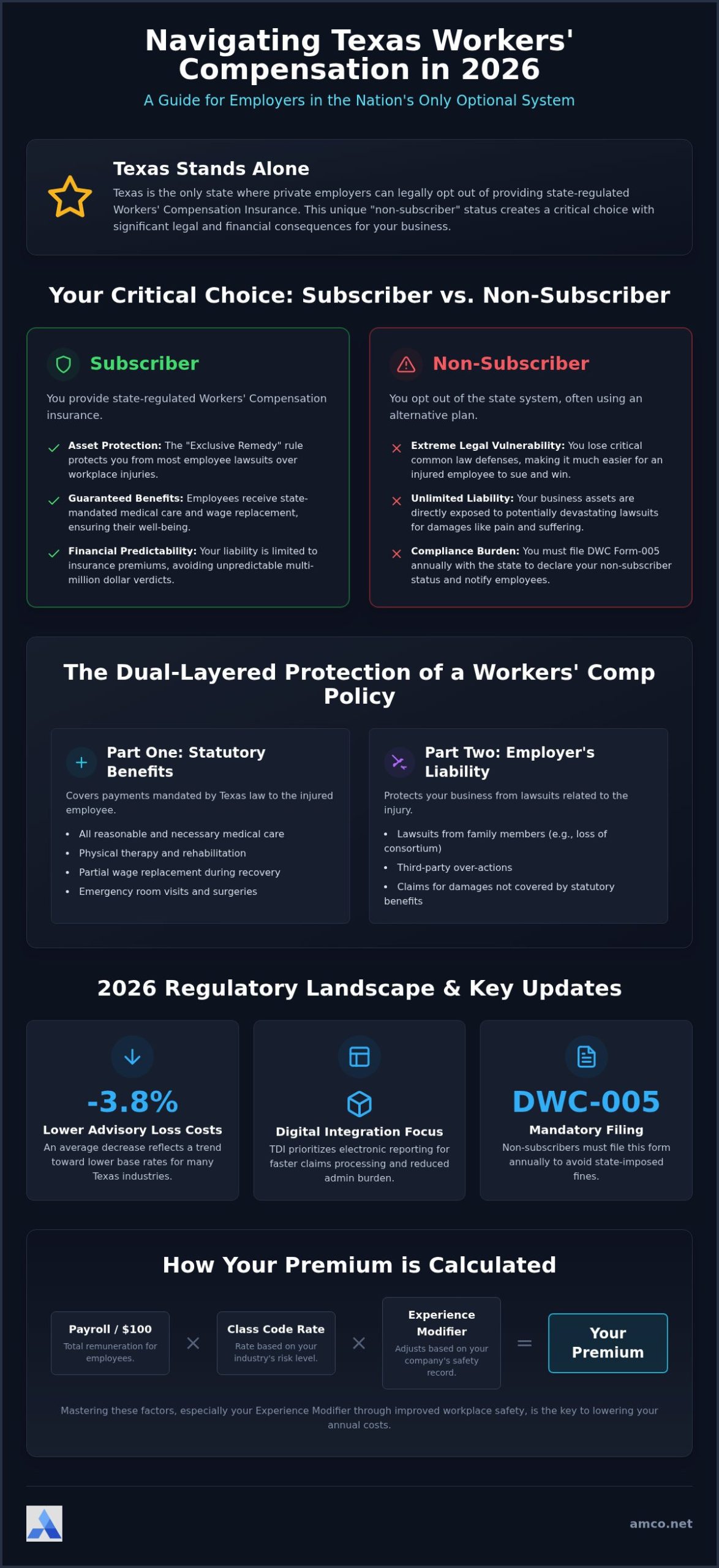
Understanding the financial mechanics of Workers Compensation Insurance is the first step toward controlling your overhead. Insurance carriers don't pull premium numbers from thin air. They use a standardized mathematical formula: (Annual Payroll / 100) x Class Code Rate x Experience Modifier. While you cannot control the base rates set for your industry, you have significant influence over your total Workers Compensation Insurance expenditure through payroll accuracy and safety performance. For 2026, the 3.8% decrease in advisory loss costs provides a favorable baseline, but your individual business characteristics will ultimately determine your final invoice.
The NCCI (National Council on Compensation Insurance) assigns four-digit codes to every job description based on historical injury data. For example, a roofing company (Code 5551) faces a much higher base rate than a clerical office (Code 8810) due to the inherent physical risks of the profession. Accurate reporting is vital because misclassifying a high-risk field worker as clerical staff will inevitably lead to significant back-premium penalties during a mandatory year-end audit. Regional factors also play a role in how carriers perceive risk. A trucking firm in Houston might face different risk profiles than an oilfield services company in Midland or Odessa, where the severity of industrial accidents often outweighs the frequency of claims.
Your Experience Modifier, or E-Mod, is a numerical representation of your safety record compared to the industry average. An E-Mod of 1.0 is the baseline. If your score is 0.85, you receive a 15% discount. If it's 1.25, you pay a 25% surcharge. Implementing a formal safety program and a Return-to-Work policy are the most effective ways to drive this number down. A Return-to-Work program allows injured employees to perform light-duty tasks, which reduces the indemnity, or wage-replacement, portion of a claim. Since indemnity payments weigh more heavily on your E-Mod than medical-only claims, this strategy directly protects your bottom line.
Regular payroll audits also ensure you aren't overpaying on estimated figures. By reviewing your actual payroll versus your projections mid-year, you can avoid a large, unexpected bill at the end of the policy term. If you are ready to see how your safety record translates into market-leading rates, you can request a multi-carrier premium comparison from our specialist brokers.
Selecting a policy isn't just a transaction; it's a strategic decision that affects your company's long-term stability. AMCO.NET LLC operates as an independent broker, which provides a significant advantage over direct carriers that only sell their own proprietary products. Instead of being limited to a single appetite, we compare quotes from multiple A-rated Texas providers to find the most competitive rates for your specific risk profile. This consultative approach is especially valuable for high-risk operations, such as those requiring Commercial Trucking Insurance Houston, where specialized knowledge of industry-specific hazards is required to secure favorable terms.
Serving Houston, San Antonio, and the Dallas metro areas, we understand the local economic pressures facing Texas employers. Whether you're managing a construction crew or a logistics fleet, our team ensures your Workers Compensation Insurance is integrated seamlessly into your broader risk management strategy. We focus on technological continuity and professional precision, ensuring that your coverage remains robust as your business scales. Our role is to act as a buffer between your assets and the inherent volatility of workplace liability.
A local broker offers insights that national call centers simply can't match. AMCO.NET LLC has been serving Texas businesses since 1987, giving us deep roots in the state's unique insurance environment. We don't just provide a policy; we assist with the administrative complexities that often trip up busy owners. From ensuring your DWC Form-005 is filed correctly to helping you navigate the stresses of an annual policy audit, we act as your professional partner. This hands-on support is critical for maintaining compliance and avoiding the administrative fines that can accumulate from simple reporting errors.
To provide an accurate quote, we'll need to review your basic business information, including your Federal Employer Identification Number (FEIN), estimated annual payroll by department, and your current experience modifier score. Our brokers specialize in creating comprehensive protection packages. By coordinating your Workers Compensation Insurance with your General Liability Insurance, we eliminate coverage gaps and often identify additional savings through multi-policy structures.
Don't leave your assets vulnerable to the uncertainties of the Texas legal system. Contact AMCO.NET LLC today for a comprehensive business insurance review. We'll help you secure the coverage you need to protect your workers and your business for 2026 and beyond.
Managing a company in the Lone Star State requires a strategic approach to risk. We've explored how Workers Compensation Insurance functions as more than just a medical policy; it's a critical shield against the unlimited liability and lost defenses inherent in the Texas non-subscriber model. By prioritizing workplace safety and understanding the mathematical drivers of your premium, you can transform a necessary expense into a competitive advantage for your operations. Professional oversight ensures that your coverage remains aligned with the latest 2026 regulatory updates and benefit caps without exposing your assets to civil litigation.
Success in this complex environment depends on having a partner who understands the specific hazards of Texas industries. Since 1987, AMCO.NET LLC has served as a team of Texas-based experts with specialized knowledge in the trucking and construction sectors. We provide access to A+ rated carriers, ensuring your assets are protected by the most stable providers in the market. Our brokers handle the technical details of policy audits and DWC filings, so you can focus on your primary business goals without administrative distraction.
Protect your business and employees with an AMCO.NET LLC Workers’ Comp quote today. We're ready to help you navigate these complexities with the professionalism and stability your enterprise deserves.
No, Texas is the only state where Workers Compensation Insurance is optional for most private employers. However, public employers and businesses under certain government or construction contracts must carry coverage. Even if you aren't legally forced to buy it, you must still notify the Texas Department of Insurance (TDI) of your decision to opt out to remain compliant with state administrative codes.
A non-subscriber is a private employer who chooses not to provide state-regulated workers' compensation coverage. The primary risk is the loss of common law defenses in court. If an injured employee sues you, you can't argue that the employee's own negligence contributed to the accident. This legal imbalance often leads to much higher settlement costs and legal fees compared to the regulated system.
Sole proprietors and partners aren't automatically covered, but they can elect to include themselves in a policy. For the 2026 policy year, the TDI has set the fixed annual payroll for sole proprietors and partners at $82,600 for premium calculation purposes. This allows business owners to access the same medical and income benefits as their employees while protecting their personal assets from work-related injury litigation.
The main difference lies in legal protection. Workers Compensation Insurance provides the "exclusive remedy" defense, which generally prevents employees from suing their employer. Occupational accident insurance is a private health and disability contract that pays fixed benefits but doesn't provide any lawsuit protection. If an employee is dissatisfied with an occupational accident payout, they can still file a personal injury lawsuit against your business.
Costs are determined by your total payroll, industry risk classification, and your company's safety record, known as an E-Mod. While we don't provide generic price estimates, the Texas Department of Insurance approved a 3.8% decrease in advisory loss costs effective July 1, 2026. This trend toward lower base rates helps many small businesses find affordable coverage. Your specific premium will reflect your industry's class code and claims history.
In most cases, they cannot. The "exclusive remedy" provision of the Texas Workers' Compensation Act protects subscribing employers from negligence lawsuits. There is a narrow exception for cases involving gross negligence that results in a fatal injury. In those tragic instances, a surviving spouse or heirs might pursue exemplary damages. For non-fatal injuries, the insurance policy typically serves as the final resolution for all claims.
Failing to report a qualifying injury can lead to severe administrative penalties. Employers must file the "Employer's First Report of Injury or Illness" within eight days of the employee's first day of absence. If you miss this deadline or fail to report, the Division of Workers' Compensation can assess fines of up to $5,000 per day. Timely reporting also helps the insurance carrier manage the claim costs more effectively.
Obtaining a precise quote requires gathering your Federal Employer Identification Number (FEIN), a detailed payroll breakdown by job duty, and your loss run reports for the past three to five years. As independent brokers, we compare these details across multiple A-rated carriers. This ensures your trucking operation receives a policy that accounts for the specific risks of the logistics industry while maintaining the most competitive market rates available.